Introduction
John Milton’s life was one of banishments or cancellations, either imposed or endured. In 1644, his Areopagitica eloquently opposed the pre-publication censorship of the Licensing Order, which had attempted to silence the voices of radical Protestants. In 1649, his Tenure of Kings and Magistrates defended the execution of Charles I, who had been condemned by Parliament at the end of the Second English Civil War. In the early 1650s, Milton completely lost his eyesight, an event that some contemporaries described as God’s punishment for supporting regicide. While Milton did (barely) escape execution when the Stuart monarchy was restored in 1660, his political appointment was withdrawn, and in 1667, writing from a position of cultural exile, Milton published an epic poem that easily could have been titled Paradise Cancelled.
However, I want to focus on a kind of banishment in one of Milton’s lesser-known works: his so-called “Nativity Ode,” written in December 1629 when Milton was only twenty-one years old.[1] Here, I will explore how Milton’s poem both participates in and subverts a narrative of disenchantment.
Before getting into the main argument, which includes an interlude on the folklore motif of “the departure of the fairies,” let me briefly summarize the plot points of Milton’s Christmas poem. In the four-stanza introduction, Milton asks the heavenly muse to provide a nativity ode for Christ, since it is now December, the month Christ was born. After the introductory stanzas, in the first four stanzas of the actual hymn, personified Nature and Peace work to set the stage for Christ’s arrival. Nature exchanges fall’s colorful leaves for winter’s snow, and Peace descends from the heavens to halt all warfare, at least momentarily. In Stanzas 5–15, we meet the shepherds and angels and hear the music of the spheres. In Stanzas 16–26, we see the banished pagan gods fleeing from their temples. And in the final stanza, as the sun rises on Christ’s birthday, the Star of Bethlehem pauses over the stable, while angels sit awaiting their orders from the newly arrived Son of God.
Participation
Milton’s “Nativity Ode” participates in the narrative of disenchantment by locating the source of disenchantment at the Nativity. Despite counter-narratives by Jason A. Josephson-Storm and others, disenchantment narratives remain commonplace these days, stemming from works by Friedrich von Schiller, Max Weber, and Charles Taylor.[2] But these stories are not modern inventions. Numerous ancient writers noticed a curious change in the first century after Christ. For example, the second-century bishop Ignatius of Antioch writes in Chapter 19 of his Letter to the Ephesians that at the Nativity, magic was destroyed, leading to the breaking of chains, the abolishing of ignorance, and the perishing of the old kingdom.[3]
Even non-Christian writers noticed this change. Around the beginning of the second century, the Greek philosopher Plutarch wrote an essay on “The Cessation of Oracles,” found in his Moralia. This essay has become famous for its description of the apparent demise of magic. What makes Plutarch’s account so notable is that he had spent decades of the first century as a priest in the Temple of Apollo at Delphi, home of the renowned Oracle. In “The Cessation of Oracles,” a fictitious dialogue in which philosophers discuss reasons for the silence of the oracles, a man tells a story of a sailor who is told to cry out “The great Pan is dead” as he passes an island. Immediately after the sailor does so, a lament arises from the shore, and the story of Pan’s death spreads, leading to speculation about why the pagan oracles have grown mute.[4]
In the fourth century (and echoing Ignatius), the church historian Eusebius in his work Preparation for the Gospel provides a Christian explanation for the phenomenon that Plutarch had observed: it was Christ’s work of casting out demons that vaporized the oracles’ power.[5] Around the same time, Athanasius, both in his Life of Anthony[6] and On the Incarnation,[7] writes that the cross functioned as a crucifix—a sacred object thrust into the air, scattering magic and sorcery. One writer paraphrases Athanasius by describing Christ as a kind of exorcist, expelling demons by means of the cross.[8]
Milton’s seventeenth-century “Nativity Ode” continues this story of vanquished magic by showing the pagan gods’ flight from their temples at Christ’s first advent. Closely imitating Plutarch’s language, Milton writes, “The Oracles are dumb,/ … /And [on] the resounding shore,/A voice of weeping [is] heard.”[9] For about ten stanzas, Milton catalogs the various gods who have been ousted by the arrival of the true God, including Baal, Dagon, Ashtaroth, Ammon, Tammuz, Moloch, Isis, Horus, Anubis, and Osiris.
Milton includes Satan in the rout, using the imagery of Revelation 20:2 to describe the binding of “the dragon, that old serpent, which is the Devil, and Satan” (KJV)—an event that Milton locates at the Nativity.[10] This binding of Satan has been interpreted as a limiting of his power to deceive the nations. As Milton puts it, the “deceiving” words of the pagan gods no longer run throughout the Delphic cavern’s “arched roof.”[11]
Earlier in the poem, however, Milton is clear that the birth of Christ will not immediately bring about a golden age of Truth and Justice.[12] About a dozen years after the composition of the “Nativity Ode,” in one of Milton’s several prose tracts written in opposition to the English episcopacy, titled Of Reformation (1641), he acknowledges that despite the binding of Satan, the deceptive dragon can rear his head from time to time, bringing about temporary darkness. Milton writes that the Reformation revived the study of Scripture, the learning of original biblical languages, and the allegiance of princes and cities to God. But this revival was necessary because of “the black and settled night of ignorance and antichristian tyranny” that had arisen through “the fiery rage of the old red Dragon.”[13] In other words, the binding of Satan at the Nativity was not a terminal act. The inexorable advancement of the Kingdom of God waxes and wanes. As Milton writes in the “Nativity Ode,” full and perfect bliss will come later, but even so, the official conquest “now begins”—a conquest that includes the banishment of dark magical powers.[14]
In the penultimate stanza of the “Nativity Ode,” as the sun rises, the shadows troop off to their hellish jail, just like ghosts that slip back into their graves or like black stallions that gallop away, taking the night with them, while yellow-skirted fairies (“Fayes”) fly close behind.[15] Christ’s birth thus disenchants the world, so to speak, purging it of pagan gods, demons, oracles, magic, the night shadows, and fairies.
Interlude
Milton’s reference to departing fairies leads me to an interlude regarding the folklore motif of “the departure of the fairies.” In recent decades, one of the most common versions of the disenchantment narrative has been the Roman Catholic account of how the Reformation supposedly disenchanted the world. This storyline, found in the work of historians such as Brad Gregory, goes something like this: The Reformers, perhaps unintentionally, disenchanted the world in their rejection of saints, priests, relics, transubstantiation, etc. In particular, the loss of the literal presence of Christ’s physical body in the Eucharist, combined with the popularization of Zwinglian memorialism, represents for Catholics a de-sacralization of the very world itself. This has led, eventually, to the disenchantment, secular Western world of today, with all its attendant spiritual ills.
In fact, however, Catholics are not the only ones who have contributed to this story. Some anti-Puritan Anglicans have also participated in this narrative of lament, as it were. Richard Corbett, a seventeenth-century bishop in the Church of England during the reign of Charles I, wrote several anti-Puritan poems, including “The Fairies Farewell” and “The Distracted Puritan,” published in the mid-seventeenth century.[16] With strong connections to the general narrative of disenchantment, “The Fairies Farewell” employs a distinct literary motif: “the departure of the fairies.” Corbett laments the fact that, whereas fairy circles were present in Mary Tudor’s days, the fairies disappeared during the reigns of the Protestant rulers Elizabeth I and James I. The departed fairy folk knew how to make merry, but making merry was now punished by Puritan strictures. Corbett even goes so far as to say that the fairies’ practice of stealing infants from their cradles was preferable to the way the Puritans had changed the religious landscape. Several centuries later, Rudyard Kipling uses part of the first line of Corbett’s poem as the title of his second volume of short stories: Rewards and Fairies (1910). Kipling’s first volume of short stories, Puck of Pook’s Hill (1906), includes a story that claims that the fairies left Merry England because of the strife of the Reformation.[17]
However, from a theological angle, Zwingli’s memorialist view of the Eucharist is hardly a representative position of all Protestants. And from a literary angle, scholars such as Josephson-Storm have pointed out that “the departure of the fairies” motif pre-dates “the printing press, the Protestant Reformation, the ‘scientific revolution,’ or the urbanization of England.”[18] Josephson-Storm observes that Chaucer’s fourteenth-century “Wife of Bath’s Tale” begins with a comment that while a multitude of fairies lived in King Arthur’s day, there are no more fairies in England. The Wife of Bath attributes the loss of fairies to Catholic friars who have purged the air, so to speak, but she adds that while the incubi might not defile you, the friars probably will. Apparently, the purging of the air does not necessarily lead to purity. Furthermore, based on Chaucer’s account, it is plausible that alleged disenchantment activity pre-dates the Protestant Reformation and comes from Roman Catholic practices.
While Chaucer’s criticism comes from within the system of late medieval Catholicism, Thomas Hobbes as an atheist outsider is harsher, arguing directly in his Leviathan (1651) that belief in fairies is useful for a corrupt Catholic Church that wants to control superstitious people with exorcisms, crucifixes, and holy water.[19] Toward the end of his treatise, Hobbes makes many comparisons between the fairy kingdom and the Catholic “kingdom of darkness,” including their power over ignorant people and their alleged origins in old wives’ tales and poems.[20] Hobbes argues that Henry VIII and Elizabeth I were right to suppress Romanism in England.[21] My point here is not to take a theological side, but simply to show that “the departure of the fairies” as a literary motif precedes any Catholic-Protestant disagreements and is not always one-sided.
In his posthumously published book The Discarded Image (1964), C. S. Lewis makes an intriguing point about fairies that further complicates the common disenchantment narrative. In his chapter on “The Heavens,” Lewis argues that the orderly medieval conception of the cosmos contributed to a feeling of confinement—that is, the order itself was disenchanting. Lewis writes,
The human imagination has seldom had before it an object so sublimely ordered as the medieval cosmos. If it has an aesthetic fault, it is perhaps, for us who have known romanticism, a shade too ordered. For all its vast spaces it might in the end afflict us with a kind of claustrophobia. Is there nowhere any vagueness? No undiscovered by-ways? No twilight? Can we never get really out of doors? The next chapter will perhaps give us some relief.[22]
Lewis’s next chapter is on the fairies, or long-lived ones (“Longaevi”). According to Lewis, fairies introduce “a welcome hint of wildness and uncertainty into a universe that is in danger of being a little too self-explanatory.”[23] In other words, fairies help to re-enchant a beautiful but rigid world.
Lewis then uses three occurrences of the word fairy in Milton’s work to show the different meanings of the word.[24] One kind of fairy, which Lewis draws from Milton’s Masque (1634), is horrific, grouped with dark elves, giants, and witches.[25] A second conception of fairies appears in works such as Shakespeare’s A Midsummer Night’s Dream (1605), Drayton’s Nymphidia (1627), and Milton’s Paradise Lost (1667); these are tiny humanoid creatures, ranging from the size of dwarves down to insects.[26] Lewis calls the third kind of fairy, found in Milton’s Paradise Regained (1671), “High Fairies,” and they are characterized by splendor, graciousness, and courtesy.[27] In a long letter likely composed in 1951 (coincidentally addressed to someone named Milton), J. R. R. Tolkien expresses his preference for this latter kind of fairies, or elves, explaining that his elves in The Lord of the Rings are more like Spenser’s fairies and less like Shakespeare’s.[28] Indeed, Edmund Spenser’s Faerie Queene (1590s) is home to the High Fairies that Lewis mentions, and Spenser’s work brings us back to Milton’s poem.
Subversion
Despite Milton’s participation in the narrative of disenchantment (in the poem’s banishment of pagan gods, fairies, etc.), his “Nativity Ode” simultaneously subverts this narrative by identifying the Christ child as a kind of Pan himself—the god of shepherds revealing himself to shepherds. Milton is not the first to imagine Christ as a type of Pan, but he does go further than certain predecessors, such as his literary hero Edmund Spenser.
In his Shepherdes Calender (1579), Spenser imagines Pan as a type of Christ. In the Calender’s May eclogue, one of the shepherds considers how to respond if the “great Pan” were to ask the shepherds to give an account.[29] Following the eclogue, a detailed gloss explains that Christ, as the great and good shepherd, is the true god of all shepherds. The gloss continues and explains how Eusebius’s Preparation for the Gospel tells the story of Plutarch’s tale of the ceasing of the oracles, along with the story of the great shriek arising from the island after the announcement of Pan’s death. Since then, the gloss continues, the Oracles have ceased, and the ability of enchanted spirits to deceive people has been curtailed. The gloss concludes by affirming Eusebius’s interpretation, that the death of Pan was really the death of Christ—“the onely and very Pan, then suffering for his flock.”[30]
But Milton’s “Nativity Ode” more uniquely situates Christianity’s relationship to magic, not only by moving up the inciting moment to the Nativity (as opposed to the Crucifixion), but also by more fully embracing the mythic quality of the Christian story. Christ is Hercules and Pan, and better versions of both. Milton’s oblique reference to Hercules occurs after the catalog of fleeing gods, where he adds that none of the gods “Longer dare abide,” especially not Typhon.[31] Milton’s placement and description of Typhon in the poem seem to conflate Egyptian and Greek mythology intentionally. Typhon appears in the poem after a list of Egyptian gods, and in Egyptian mythology, Typhon is himself a god. In Greek mythology, however, Typhon is described as a serpentine monster. So, on a passive level, Christ is superior to gods and monsters by virtue of the fact that he remains while they have fled.
On a more active level, however, Christ outperforms the heroes and gods of pagan mythology. In Milton’s poem, Christ, while “in his swaddling bands,” can “control the damned crew” of fleeing gods.[32] Here, Milton alludes to the story of how the infant Hercules strangled serpents in his cradle. The Christ child can defeat serpents such as Typhon just as handily as the hero Hercules could. On a more divine level, Christ is superior to Zeus, who defeated Typhon when the two struggled for cosmic superiority. But in Milton’s poem, Typhon prefers not even to remain for a fight. In a sense, Christ does more by doing less—the terror of his mere existence is enough to evict Typhon. Thus, the newborn baby is both a greater man than Hercules and a greater god than Zeus, scattering enemies with his very presence.
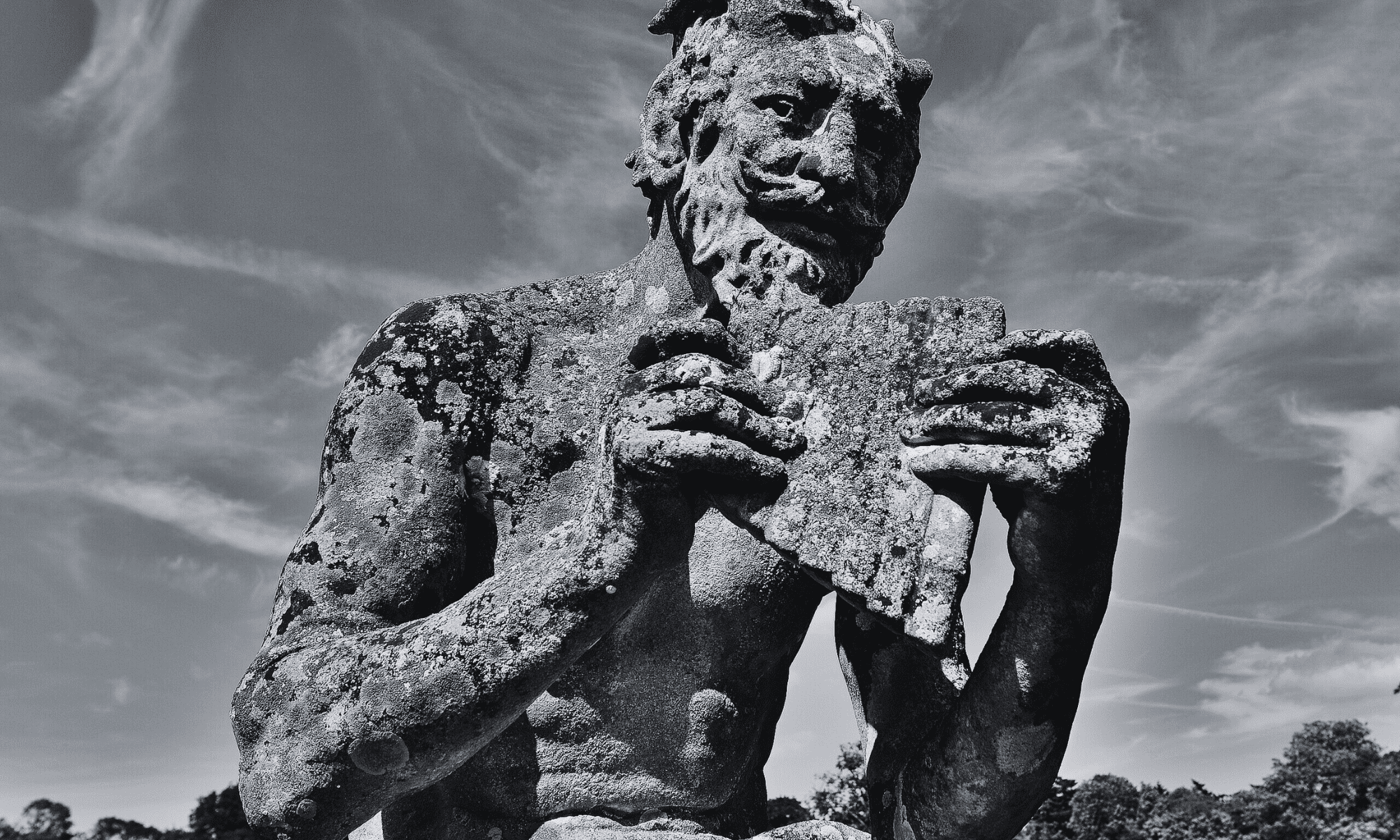
The Christ child in Milton’s “Nativity Ode” is also a true and better Pan. Like Shakespeare’s becoming a character in his own play, the Son of God arrives to the shepherds as “the mighty Pan/…kindly come to live with them below.”[33] This replacement goes further than other writers’ descriptions in which Christ supplants Pan. For example, G. K. Chesterton writes in The Everlasting Man (1925), “It is said truly in a sense that Pan died because Christ was born. It is almost as true in another sense that men knew that Christ was born because Pan was already dead. A void was made by the vanishing of the whole mythology of mankind, which would have asphyxiated like a vacuum if it had not been filled with theology.”[34] However, in Milton’s subversive poem, Christ’s Nativity is not merely an account of the receding of one god and the revelation of his replacement. The Nativity is the arrival of a true and better Shepherd of shepherds. Milton does not give us the death of Pan. He gives us the birth of Pan.
Finally, we should note that in Milton’s catalog of departing pagan gods, Apollo, the Greek god of the sun, is the first god to depart.[35] Milton is attuned to the cosmic and astronomical significance of the Nativity, and his “Nativity Ode” is infused with astral imagery from beginning to end, including references to the “Star-led wizards”—also known as the wise men or Magi[36]—and the “youngest… Star,” also known as the Star of Bethlehem.[37] With the dawning of Christ’s birthday, the sun god Apollo yields to a superior Sun.[38] The connection between spiritual powers and heavenly bodies has roots in the writings of multiple church fathers, including Tertullian, Augustine, and Calvin.[39] Following their lead, Milton conceives of the pagan deities as being the bearers of the new names given to the fallen angels-stars,[40] which had been swept out of the sky by the great dragon.[41] With this Christmas arrival of the Sun of suns, the deep magic and influence of the old stars have no choice but to bow to the deeper magic of newer, brighter, and truer stars, including the Star of Bethlehem and the newborn Sun of God.
Conclusion
Focusing on disenchantment, Daniel Shore argues that Milton’s Christmas poem is not iconoclastic per se, but rather “an alternative response to idolatry, one that foregoes breaking.”[42] According to Shore, “Far from destroying idols, Milton seeks to capture and preserve them under judgment, investing them with poetic care even as he hollows them out from the inside, thereby refashioning them as the instruments of their own disenchantment.”[43] But Shore misses the re-enchanting quality of Milton’s subversive poem. Other scholars have commented on the nontraditional character of the “Nativity Ode,” with one going so far as to say that the poem is less about joy than it is about fear.[44] Of course, anyone who thinks that the experiences of joy and fear are mutually exclusive has clearly never gotten married. Arguing for the joyful character of this poem would require another essay, but Milton clearly demonstrates the possibility of synthesizing a banishment of pagan magical power with a celebration of a greater power that is no less supernatural.
Jeremy Larson is Assistant Professor English at Regent University.
*Image Credit: Wikimedia Commons