Tradition, in theological discourse, is frequently invoked as a sort of guard against the dangers of individual interpretation. Indeed, the testimony of history is a weighty sort of consensus, if such a consensus truly exists. However, there are other times when tradition ceases to be an authentic monument to the past and instead becomes its own organism—living, growing, and expanding. In this case, “tradition” no longer maintains stability but rather becomes creative. Ironically, tradition becomes innovative. This is why classical Protestants maintain that tradition can never, on its own, be an adequate grounding for doctrine. We cannot require others to hold to a conviction as doctrine, that is, as something required by God in order to please Him and to avoid sin, unless we have sufficient warrant from God Himself, from His word as found in the Holy Scriptures.
More than this, however, it is also important for Christians, especially researchers and teachers, to have an understanding about how tradition typically functions over the course of centuries. Some traditions are surely ancient, but others develop slowly. They are affected by controversy and even historical error. At times, traditions are invented.
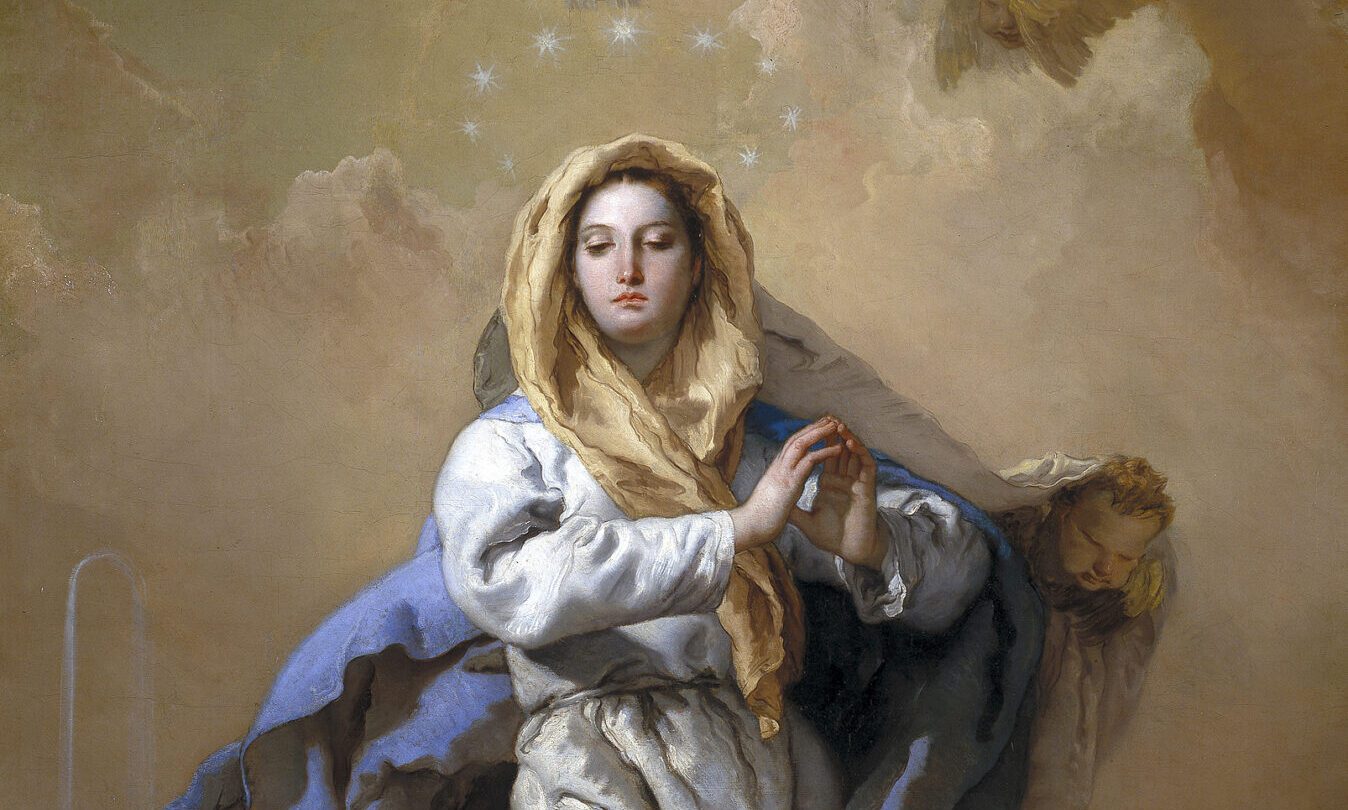
One significant tradition of this sort is the Roman Catholic dogma of the Immaculate Conception of Mary. Not formally elevated to the level of dogma until 1854, this doctrine nevertheless claims to have been “ever held as divinely revealed and as contained in the deposit of heavenly revelation” (Pius IX, Ineffebilis Deus). What is this doctrine which is said to be universal? It is this, “that the most Blessed Virgin Mary, in the first instance of her conception, by a singular grace and privilege granted by Almighty God, in view of the merits of Jesus Christ, the Savior of the human race, was preserved free from all stain of original sin”. The Immaculate Conception is defined as “a doctrine revealed by God” which must “be believed firmly and constantly by all the faithful.” Various sanctions are attached to any denial of this doctrine, including suffering “shipwreck in the faith” and separation “from the unity of the Church.” Legal penalties are also threatened against any who would “express in words or writing or by any other outward means the errors he thinks in his heart.”
Considered merely as an idea in its own right, the Immaculate Conception does not usually elicit the most vocal protests from detractors. It may seem like a generous gesture towards the mother of our Lord, which, even if of dubious provenance, is nevertheless a pious sentiment. But if considered as an instance of tradition overstepping its boundaries and doing violence against the conscience, the dogma of the Immaculate Conception is a rather gross offender. Its claims to universality can be disproven by several of the Roman Catholic Church’s own greatest doctors, not the least of whom are Thomas Aquinas, Augustine of Hippo, and John Chrysostom. Looking into their examples more deeply, we can see that the claim that the church “never changes anything, never diminishes anything, never adds anything” (Ineffebilis Deus, “testimonies of tradition”) is false. But more than this, we can also get a glimpse behind the scenes, as it were, and see how tradition works in real life.
Thomas Aquinas did not believe that Mary was conceived without sin. This is not merely a case of him being silent on the matter or not yet being in possession of the fullness of later development. Instead, Thomas rejects the claim made by the contemporary dogma. He did believe in what we might call Mary’s gestational sanctification, that she was sanctified of all sin in the womb of her mother and thereafter preserved from all actual sin. But he does not believe that Mary was entirely preserved from original sin. Instead, he believes that she bore its guilt (ST III, Q. 27, Art. 1, ad. 3) and was still affected by concupiscence (ST III, Q. 27, Art. 3, co.). Further, Thomas explicitly denied that Mary was sanctified prior to “animation” (ensoulment). If this were so, he argued, it would imply that Mary was not truly saved by Christ (ST III, Q. 27, Art. 2, co.). He then added that it is not known when Mary was sanctified (ST III., Q. 27, Art. 2, ad 3).[1]
So far, this summary evidence shows that Thomas is out of step with the contemporary Roman Catholic dogma. He does not believe that she was “kept free from all stain of original sin” from the “first moment of her conception.” Rather, he believes that Mary was sanctified of some of the stain of original sin at a date occurring after her conception. Beyond this, however, a few more important points can be observed about the nature of tradition as a theological concept. Even though Thomas does not affirm the Roman Catholic dogma of the nineteenth century, we might still ask why he holds the position that he does. From where does he derive his doctrine of Mary’s early sanctification? A closer look reveals at least two curiosities in Aquinas’ discussion and demonstrates the way that tradition tends to grow and expand over time.
Thomas freely acknowledges that his belief that Mary was sanctified in the womb did not come from the written word of God: “Nothing is handed down in the canonical Scriptures concerning the sanctification of the Blessed Mary as to her being sanctified in the womb; indeed, they do not even mention her birth” (ST III, Q. 27, Art. 1, co.). Instead of the Scriptures, he appeals to St. Augustine. But interestingly, in both of his references, there are mistakes. He is not faithfully handing down a tradition but is instead interpreting and even transforming one.
Thomas’ first appeal to Augustine is an error due to his own historical limitations. Having acknowledged that the Scriptures do not teach anything concerning Mary’s early sanctification, he claims that Augustine made a reasoned argument for the doctrine based on a prior commitment to another extra-scriptural doctrine, the assumption of Mary. Thomas writes:
But as Augustine, in his tractate on the Assumption of the Virgin, argues with reason, since her body was assumed into heaven, and yet Scripture does not relate this; so it may be reasonably argued that she was sanctified in the womb.
This argument, as stated, might meet with difficulty on the grounds of it being a petitio principii or of relying on an undistributed middle. It is also telling that the quote Thomas here uses does not say that the doctrine of Mary’s sanctification in the womb has been passed down from apostolic tradition but rather that “it may be reasonably argued” based on a sort of parallel to other doctrines. However, an even more substantial obstacle is that the source is not from Augustine at all. Though such a tract bearing Augustine’s name was handed down throughout history, it has since been determined to have been spurious.
To make matters worse, there is at least one source in Augustine’s authentic corpus which testifies against his belief in the Assumption of Mary. In his eighth tractate on the Gospel of John, Augustine writes, “He commends His mother to the care of the disciple; commends His mother, as about to die before her, and to rise again before her death” (Tractates on the Gospel of John, Tract. 8.9). Lacking biblical authority, Thomas turned to Augustinian authority. In this case, he believed that he had found a trusty source. We can now see that he had not.
Thomas later makes a second appeal to Augustine. In arguing that Mary committed no actual sin, Thomas quotes Augustine to this effect:
On the contrary, Augustine says (De Nat. et Grat. xxxvi): “In the matter of sin, it is my wish to exclude absolutely all questions concerning the holy Virgin Mary, on account of the honor due to Christ. For since she conceived and brought forth Him who most certainly was guilty of no sin, we know that an abundance of grace was given her that she might be in every way the conqueror of sin.” (ST III, Q. 27, Art. 4, s.c.)
Thomas then concludes that Mary “committed no actual sin, neither mortal nor venial” (ST III, Q. 27, Art. 4, co.). This appeal to Augustine is not based on a spurious source, but it is nevertheless an unsound citation. In Thomas’ rendering, Augustine has absolutely excluded Mary from the class of sinners. However, when the original source is consulted, we see certain important qualifications. In context, we see that it is Pelagius who has asserted that Mary lived without sin, along with a list of many other sinless saints. Augustine is responding to this claim, when he says:
We must except the holy Virgin Mary, concerning whom I wish to raise no question when it touches the subject of sins, out of honour to the Lord; for from Him we know what abundance of grace for overcoming sin in every particular was conferred upon her who had the merit to conceive and bear Him who undoubtedly had no sin[1 John 3:5]. Well, then, if, with this exception of the Virgin, we could only assemble together all the forementioned holy men and women, and ask them whether they lived without sin while they were in this life, what can we suppose would be their answer? Would it be in the language of our author, or in the words of the Apostle John? I put it to you, whether, on having such a question submitted to them, however excellent might have been their sanctity in this body, they would not have exclaimed with one voice: If we say we have no sin, we deceive ourselves, and the truth is not in us? [1 John 1:8] (On Nature and Grace, 42.36)
Augustine does not say that Mary certainly had no sin. Instead he says that “out of honour to the Lord” he wishes to “raise no question” about her status. Tellingly, the Benedictine editors give this summary for the chapter, “The Blessed Virgin Mary May Have Lived Without Sin.” This is a sort of pious possibility in Augustine’s presentation and not a doctrinal imperative.
In other works, however, Augustine states that only Christ was without sin. For example, “excepting His flesh, all other human flesh is sinful flesh” (Against Julian 5.15.52).[2] In another place, Augustine seems to argue that Mary was cleansed from sin at the time of Christ’s conception: “He, therefore, alone having become man, but still continuing to be God, never had any sin, nor did he assume a flesh of sin, though born of a maternal flesh of sin. For what He then took of flesh, He either cleansed in order to take it, or cleansed by taking it” (On Merit and the Forgiveness of Sins, and the Baptism of Infants, 2.38) Notice that this flesh needed to be cleansed. The timing may have been prior to Christ’s assumption of the human nature to himself from Mary or at the time of that assumption.
When we pay close attention to the whole of Augustine’s writings on this topic, we see that he maintains that only Christ’s flesh is exempted from the category of “sinful flesh.” For Mary, the most one can say is that he remains agnostic except to say that at some point, unknown in its particulars, Mary was cleansed of sin. What Thomas maintains as a certainty, then, Augustine allows as a hypothesis. This is a problem for Thomas’ argument, however, because the reason for his certainty had been the testimony of Augustine. In truth, Thomas is not merely building upon Augustine but indeed adding to him.
This brief look at Thomas and Augustine is instructive for several reasons. First, it shows that the dogma of the immaculate conception of Mary was not universally maintained in the history of the church. It was not even maintained by some of the Roman Catholic Church’s own great doctors. Still more, the relatively softer doctrine of Mary’s gestational sanctification was admitted by Thomas as not having biblical founding but rather being grounded in post-apostolic testimony. And yet even the traditional sources upon which Thomas relied turn out to be either spurious or misconstrued. When evaluated on its own stated terms, Thomas’ argument collapses.
As important as these observations are, there is yet a still more significant point to be made. This look at the winding development of the doctrine of Mary’s immaculate conception demonstrates how tradition often works. Despite his best intentions, Thomas is innovating. And in so doing, Thomas himself will become the next stage of “tradition.” Just as he pointed back to Augustine, the heirs of his tradition will point back to him. But will they hold his position on the same grounds that he did, or will the mere invocation of his name be enough? And even here, Thomas’ doctrine is not the final form of this particular doctrine. The tradition grew more still.
Neither Augustine nor Thomas taught the doctrine which is now said to have been universally maintained. Due to their preeminence among doctors of the church, this is a substantial historical challenge. But a third doctor can also be invoked. St. John Chrysostom made claims even more in opposition to the dogma of the Immaculate Conception. Thomas notes this in his own treatment, saying, “Further, Chrysostom (Hom. xlv in Matth.) expounding the text: ‘Behold thy mother and thy brethren stand without, seeking thee,’ says: ‘It is clear that they did this from mere vain glory.’” and also, “a little further on he says: ‘For as yet she did not believe in Him as she ought’” (ST III, Q. 27, Art. 4, obj. 3). Where Augustine chose not to comment, Chrysostom makes an explicit claim. For him, Mary was not only affected by original sin, but she committed actual sin. For his part, Thomas can find no way to re-interpret Chrysostom. Instead he concludes, “In those words Chrysostom goes too far” (ST III, Q. 27, Art. 4, ad. 3).
Looking at three esteemed doctors of the church, we see at least three positions. John Chrysostom believes that the Virgin Mary committed actual sin, Augustine leaves the question as an open possibility, and Thomas Aquinas says that Mary certainly did not commit actual sin but was affected by original sin, being sanctified in the womb but only after her animation. Rather than consensus, tradition offers us a spectrum of different positions.
By the time one gets to the nineteenth century, however, the tradition has developed into something different entirely. It has not merely moved from a hypothesis to a conclusion, nor even from a more modest to a grander claim. It has undergone a synthesis of dissonant claims and even transformed into a position which was previously explicitly denied. To have tradition against it is a handicap to any doctrinal claim, but this case is particularly objectionable because of the factual claim made in the Roman Catholic definition of the doctrine, namely that the doctrine was “ever held.” To assent to the contemporary Catholic dogma of the Immaculate Conception, then, one must not only affirm the doctrine itself but also a certain claim about history—one which can be seen to be false.
When Martin Luther made his Reformation stand, his famous words were “To go against conscience is neither right nor safe.” But just earlier he had said, “Unless I am convinced by Scripture and by plain Reason…” In some cases of tradition, there is no reference in Scripture which teaches a doctrine. Nevertheless, the doctrine can be demonstrated by reason. Various passages can be arranged in a logical order to necessitate a certain conclusion. And in other cases of tradition, the consensual exegesis of Scripture is so overwhelming, that it would be foolish to elevate one’s own interpretation above it in isolation. But in certain unhappy turns of history, error lays hold on the imagination and the past itself is mistreated or even re-imagined. In these latter cases, neither Scripture nor Reason supports the tradition, but sadly the conscience is nonetheless asked to submit. In such cases, the conscience must refuse, and we too must refuse to go against conscience. Tradition must remain a servant rather than a master. It certainly must never be allowed to become a tyrant.
Steven Wedgeworth is the rector of Christ Church Anglican in South Bend, Indiana. He has written for Desiring God Ministries, the Gospel Coalition, the Council for Biblical Manhood and Womanhood, and Mere Orthodoxy, and served as a founding board member of the Davenant Institute.
*Image Credit: “The Immaculate Conception” by Giovanni Battista Tiepolo, Wikimedia Commons