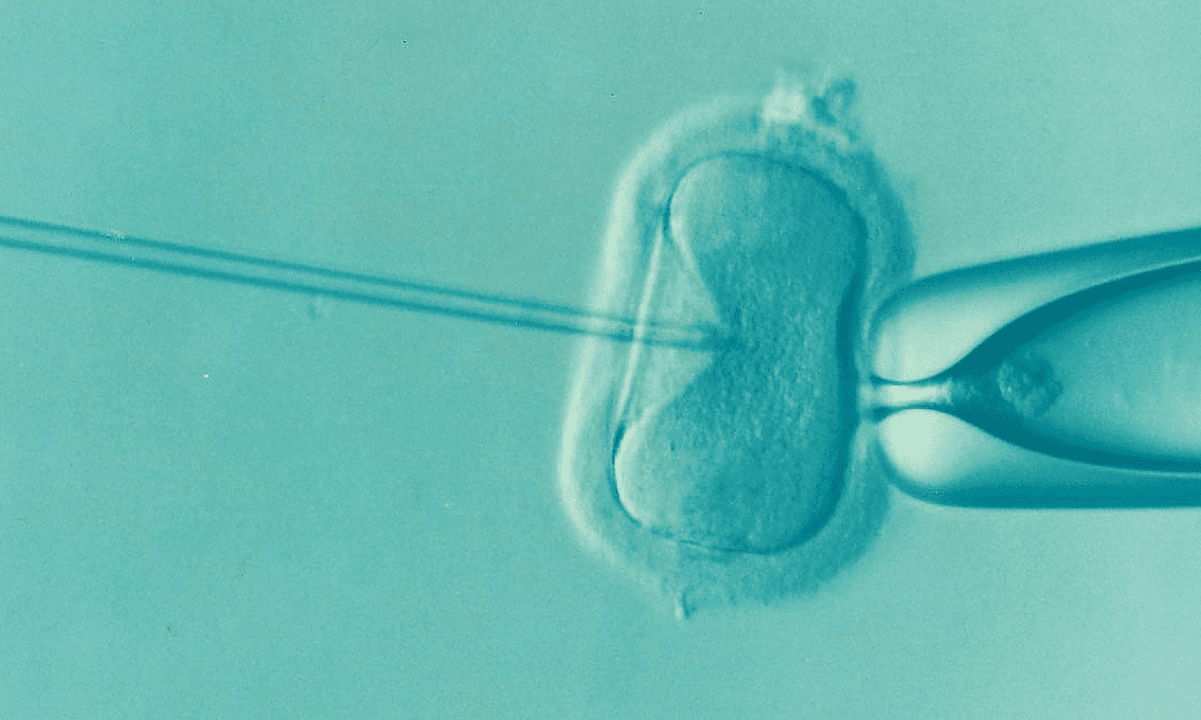
When questions are raised about the ethics of in vitro fertilisation, they tend to be focused on the plight of the married, infertile couple seeking medical aid to procreate. Because the desire for children is a good one, we have no concerns to raise about the couple’s aims in themselves. They just want a child to raise and love; why else would they contemplate the hard road of costly, arduous treatment that is IVF, with its price tag of thousands, its regime of testing and hormone treatment, its ordeal of egg harvesting and implantation, and the closely surveilled pregnancies that are full of promises which may yet fail to be delivered?
Although this is the most common way into IVF, I propose that it is not the best starting place from which to examine the practice if we want to have our moral lights well focused. Not all sin is equally and as obviously wicked, and the more common circumstances may yet be some of the most difficult places for discerning good and evil. Enmity between brothers is far more common than murder, but murder is more evidently wrong, and it takes wisdom to recognise, as our Lord would have us, that such enmity is forbidden because murder is forbidden. There is a way that leads to death; by taking care to look down the way, we can see where it leads. But the sinfulness of a given step, if we are only looking just in front of our feet, may be more difficult to discern. If Oliver O’Donovan is right to claim in Begotten or Made? that the wrong of practices adjoining IVF is not the “good old fashioned crime of killing babies,” but a “new and subtle crime” of a different nature, we may need to look further down the path of IVF to see good and evil clearly. [1]
Since Begotten or Made? was first published in 1984, six years after the birth of the first IVF child, IVF has grown to be a commonplace, and the range of procedures developed to enhance the practice have proliferated likewise. One of those procedures is Preimplantation Genetic Testing (PGT), a term which compasses a range of testing procedures, some aimed directly at decreasing the chance of miscarriage (with debated effect), and others aimed at garnering much broader information about the health of a potential child beyond birth.[2] One of these types of genetic testing, PGT-M (preimplantation genetic testing for monogenic/single gene diseases), is a particularly well-established clinical practice that has already created a new market of IVF patients who may in fact have had no trouble bearing children without the aid of IVF, had they wished to.
The Back Door
When a couple begins their journey toward conception, the guidelines for primary care physicians in Australia recommend that they be offered “carrier screening” for a trifecta of relatively common heritable diseases—Cystic Fibrosis, Spinal Muscular Atrophy, and Fragile X Syndrome.[3] Certain genetic variants in one or both parents are highly predictive of whether children of the couple will be born with one such disease (but not absolutely predictive; in all positive carrier cases for these diseases the probabilities of inheritance are in the order of 25%).[4] For a couple who receive a positive result from the carrier test, there is one clear path of action available to them: they may opt to employ IVF for the purpose of genetic selection by undertaking Pre-implantation Genetic Testing (in this instance, PGT-M), and implant only from the selection of embryos which do not have an identified genetic abnormality. As of November 2023, the carrier test has been added to the Medicare Benefits Schedule and made effectively free for all Australian residents through our federal public healthcare. No one is of course required to take the carrier test, or to do anything with the information it presents, but as such testing becomes increasingly routinised we can expect that a cohort of aspiring parents will be “helped” into the door of the IVF clinic—and the problem which IVF is solving for them is not infertility.
This is what I am calling the “back door” to IVF. Upon entering, these patients will be taken through much the same rigmarole as infertility patients. And, it should be noted, patients who enter by the “front door” of infertility will be offered the same genetic tests, even if these tests are not the prima facie reason for their arrival at the clinic. But let us now leave the infertility case aside, and consider the case of the couple who undergo IVF for the express purpose of employing PGT. What is it they are doing?
The standard procedure for PGT runs thus: After the woman’s eggs are fertilised in vitro, they are studied to observe whether blastocysts form, which blastocysts are then graded on three measures. Only average to high grade blastocysts are selected for the testing procedure. These blastocysts have a few cells removed from them before being frozen while the cells are tested, as results take 2-3 weeks to be returned. There is of course some risk of damage to the embryo from this procedure, though it is reported to be minimal, at less than 5%.[5] The results of PGT for the various embryos tested are presented to the IVF patients along with genetic counselling to enable an informed decision about which embryo/s will be implanted for pregnancy.
To speak of making an ‘informed decision’ is to invoke the virtue of prudence. Prudence, according to Aristotle, is knowledge of means. That is, given some end at which we aim, we are able to accurately judge the means for attaining it. PGT may indeed provide knowledge without which one could not effectively attain a certain end; let us grant that. But what is that end?
I suspect that for many couples who undertake PGT, the stated end would be something like “avoiding suffering”. This is the clear program of Mackenzie’s Mission, the campaign that successfully led to carrier testing being added to public healthcare in Australia (more on this to come).[6] But we must be more specific than that—many paths may be taken toward the end of “avoiding suffering”, and PGT and IVFnot necessarily the most direct! Sticking with the language of avoidance, we could articulate it as “avoiding bringing into the world a child with a disability which will cause suffering to both the child and the child’s family”. Or, expressed more positively, “bringing into the world a child with the lowest known risk of experiencing and eliciting great suffering”.[7]
Granting, for the sake of argument, that suffering is something that PGT can properly inform us about, PGT is a means for bringing a child into the world under some conditions, and not doing so when those conditions are unmet. But what it means to “bring a child into the world” under these conditions is to change the normative conditions under which children are born.
In the ordinary course of procreation, the normative condition for bearing children is marriage. Any child born into and in consequence of a marriage is “legitimate”. There are no grounds for accusing any of the responsible actors of wrongdoing. Indeed, we can go further and say that not only are children permissible under the condition of the parents’ marriage, they are an end, a telos, of that marriage.
PGT not only introduces a new normative condition (i.e. not having certain genetic diseases), it introduces a new kind of condition. The condition is some quality in the child, rather than in the relationship of the parents. The end at which PGT aims is not, like procreative intercourse, a child—it is a certain kind of child.
The corollary of aiming to bring into the world a certain kind of child through IVF is that there is another kind of child which one aims not to bring into the world. Indeed, for PGT, this is the more direct aim, as a “positive” test result applies to the identification of one of various types of genetic abnormalities. The end of PGT is to rule out implantation of these embryos, and therefore preclude their growth and their life.
For this reason, the argument that the suffering being avoided is the suffering of the child, and therefore avoided for the sake of the child, is misleading. Mackenzie’s Mission is so named after the infant Mackenzie Casella who passed away at seven months of age from the inherited condition Spinal Muscular Atrophy. Her brief life is a tragedy, but what are we to make of the alternative—if her parents had undertaken carrier testing and then PGT and IVF in response to the results? Mackenzie Casella would not have lived seven months. What we are contemplating here is most likely a completely different timeline in which she doesn’t live at all (or certainly, she wouldn’t have been born), and in which any embryos who are likewise affected with Spinal Muscular Atrophy are intentionally destroyed, or given over to experimentation and subsequent destruction.
If we want to say that PGT would be better for Mackenzie herself, or any of the destroyed embryos, then we would need to argue that, in their case, non-existence would have been better than Mackenzie’s brief and sad life. This is a difficult claim to make even in the hardest of cases, and it is worth remembering that not all cases are as hard as Mackenzie’s. One of the other conditions identified through carrier testing and PGT is Fragile X, the most common inherited form of intellectual disability. People with Fragile X Syndrome, while suffering intellectual impairment, will usually live lives of ordinary length and health.
When pressing the question of what exactly is the end of PGT, we must conclude that the suffering being avoided is that of the family, the friends, and—dare we say it aloud?—the society that, through its social welfare system, bears the burden of caring for the afflicted child. The condition under which a child may be brought into the world through PGT and IVF is this: that the child does not bear in her genes a sign of the suffering she will bring to those around her. She is certified free from such a defect, and therefore admitted to life. Those who bear the sign of suffering are given no such pass: We allow the use of a testing procedure which rules them “unfit for life”, while by our actions—in testing, in discarding— we reveal that it is we who have made life unfit for them.
Stepping Into the Logic of IVF
I hope that by now you are feeling an appropriate revulsion towards such a practice. If so, let us continue reasoning together.
Pre-implantation Genetic Testing is not a necessary component of an IVF procedure. In the same way, the discarding of unwanted embryos may not be necessary, in an absolute sense, for any single IVF cycle. But, by approaching IVF from the vantage of PGT, we can start to recognise that PGT is only a few steps further down the road we started on when the first human being was “conceived” in a test tube. No, PGT is not necessary for any single IVF cycle, but it is obvious. It is obvious because, in moving procreation from the bedroom to the laboratory, we have a) abstracted the advent of new life from the one-flesh union of marriage, b) replaced the initiatory event of the sexual act with an event of technical creation, and c) subjected this technical creation (like so many of our creations) to the norms of the economic market.
Consider that, before PGT occurs, the ordinary procedure for IVF is for the newly-formed embryos to be graded and given an order of priority for implantation. There is no judgement undertaken in such grading about the value of the life of these embryos. From the perspective of the laboratory technician, he is simply identifying which embryos exhibit signs of having the best chance at a successful pregnancy, and therefore the best chance of delivering on the patient’s expensive and arduous investment. In an industry that still only boasts a success rate of approximately 20-30% per cycle, even with such measures in place, it behooves them not to omit any step aimed at improving the odds.[8]
One could argue that this grading practice is an attempt to mimic the “choosiness” of natural procreation, in which it is well understood that not every fertilised egg-and-sperm match results in a live birth. Inescapably, however, the odds of live birth are fixed by what the laboratory technician decides. For the embryos that do not pass muster, the odds are zero—the guardian at the gate will take no risks on them. Yet in the ordinary course of procreation, no human beings make such choices; even the sexual act itself is not such a choice, for it can never guarantee that any child will result (never mind which child). Even at this stage of the IVF process, then, we can see that very different norms are governing human reproduction than those that govern natural procreation.
In the reproductive context that is the IVF clinic, we must admit that these new normative conditions make sense, and that a norm like “respecting the personhood of the unborn” does not. Imagine, if you will, insisting that the person inserting the pipette into the embryo treat the embryo as his patient’s daughter—or even as his patient! How could he possibly do that? For his very activity with the pipette is to a considerable extent determinative of whether the embryo will or will not become his patient’s daughter. He does not treat his patient’s daughter, he creates his patient’s daughter—and this unique collection of cells is, to him, simply the material cause of that creation. As O’Donovan so memorably writes, “when we start making human beings, we necessarily stop loving them.”[9] To which we can add, that when we start making human beings, we start deciding that some human beings ought not live at all.
We of course cannot admit that the norms of procreation have truly changed, as if the fact of IVF’s existence alone has wrought a change in the natural law which we must now accept as properly action-guiding. For we cannot actually change the metaphysical basis of the natural law—our created human nature. But can we get any closer to changing human nature than changing how we are conceived and born? For thus, in the union of man and woman, is our human life, and no other kind of life, transmitted. What kind of life is transmitted through IVF? Still human, to be sure, but—if we can at all sympathise with the vantage of the laboratory technician, we must admit that it’s just not so easy to be sure.
Because IVF necessarily introduces this ambiguity into the human nature which undergirds our moral reasoning, we must accept two consequences. First, that thinking through the morality of IVF will be difficult, and the proof-texting moral reasoning many evangelicals are accustomed to will not suffice. IVF imports a whole new set of conditions for the generation of human life, and if we already find ourselves habituated to these conditions (which is the case for many, Christian and non-Christian alike) we will struggle to recognise why a technology aimed at bringing human life into the world may in fact be on the road that leads to death. This implies that understanding and a certain leniency is due to the many ordinary Christians who have used IVF. Their sin is perhaps closer to the sin of Eve rather than that of Adam—they are deceived, not wilfully disobedient. But it also implies that an important and difficult burden to know good and evil still lies upon us, and especially upon those among us who would be teachers in our churches.
The second consequence is that we cannot put constraints on our own use of IVF (such as by only creating as many embryos as can be implanted) and think that in so doing we wash our hands of the wrongs of the practice as a whole. We must recognise that the host of more clearly unacceptable practices that go along with IVF are simply obvious and almost inevitable once we take that first step of making human beings in test tubes. IVF clinics will continue to expand the regime of testing that lies between a new embryo and the possibility of birth. They will consider the use of donor gametes routine. They will be undergirded by experimentation on human embryos. They will create many more embryos than could possibly be destined for birth. They will embrace new forms of reproductive technology that place at a further and further distance the advent of a human life from the loving embrace of a husband and wife.
There is no picking and choosing the elements of IVF we want to keep from the elements we must reject. If we will accept a change in our nature as deep as how we come to be born, we must expect that the norms which rest upon our birth—the norms of the human family, and of the gift-like character of each new human life—will not be upheld. If we wish to uphold these things, we must not actively undermine the conditions of life which render them explicable.
Finding the Way Out
A final encouragement for those who find themselves being escorted into the IVF clinic by the back door: The sign of suffering your future child may bear in her genes is not the last word. A genetic test result can eclipse many pleasant hopes with fears and shrink the future life of a child down to that ominous gene. In the face of such a future, we would do well to remember The Child born into the world bearing a sign of suffering, as the prophet Simeon saw it,
And Simeon blessed them, and said unto Mary his mother, Behold, this child is set for the fall and rising again of many in Israel; and for a sign which shall be spoken against; (Yea, a sword shall pierce through thy own soul also,) that the thoughts of many hearts may be revealed. (Luke 2:34-35)
I have sometimes wondered why Simeon told Mary so explicitly of her future suffering on account of her child. What has he given her but a cloud of foreboding to accompany her through the years ahead, well before the sign of her son’s cross could be visible on the horizon? For what purpose was she made to anticipate this; what good could come from such knowledge?
I do not have an answer to that question yet. But I am sure that at some point during her son’s earthly life—perhaps as early as when, just newly pregnant, she sang of God’s mercy to Israel—Mary understood that it was her child, and not the sign of death, that would be the last word.
Jemimah Wilson is a student of Arts free and domestic, and has an MA in Philosophy from Yale. She lives with her husband, Sean, in Armidale, NSW.