


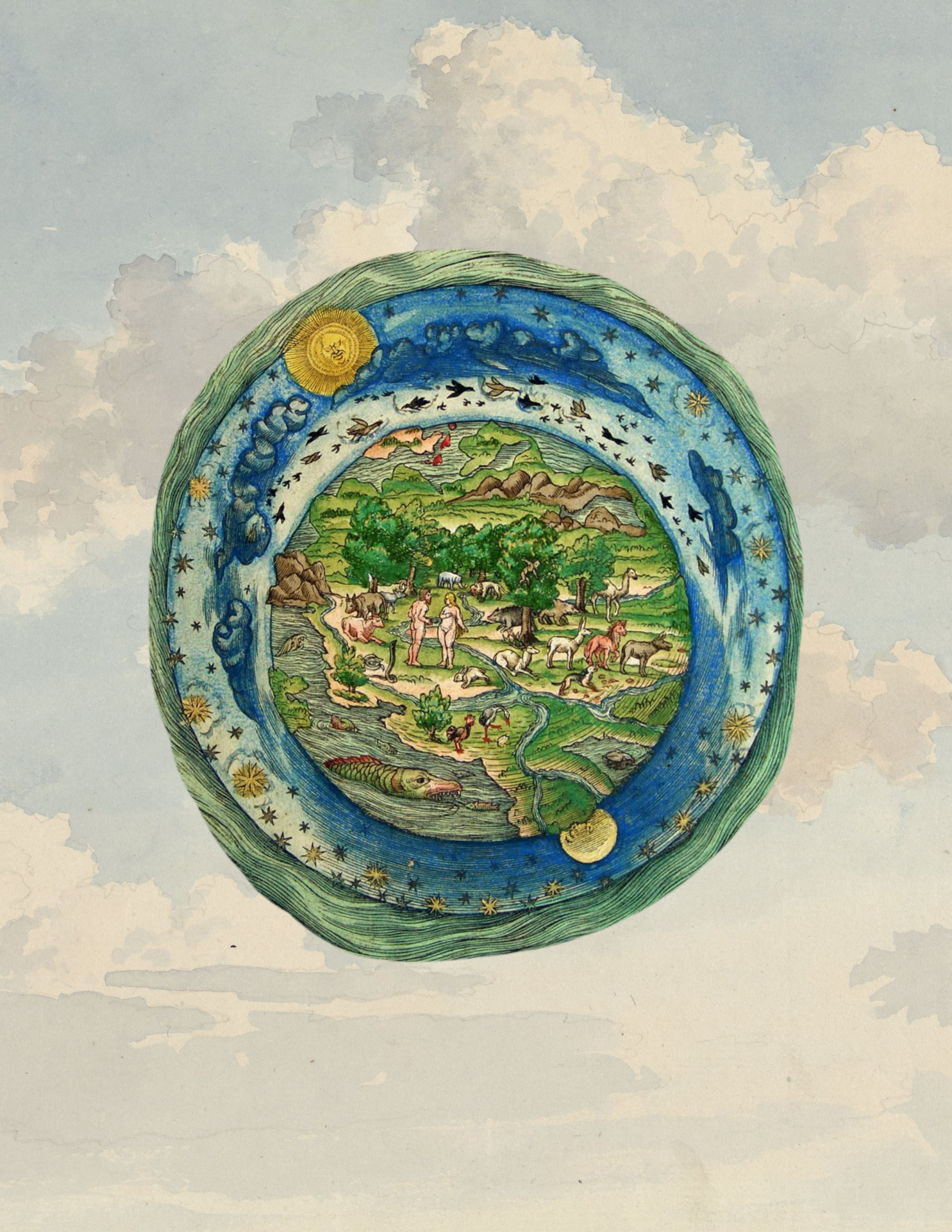
What is education for? Every school answers the question, though most never pause to ask it aloud. Carl Young and Patrick Timmis press it in these essays. Young traces it to its Greek and Roman roots but leaves it unresolved. Timmis answers from Jerusalem, with the good man speaking well. The honesty of Young’s essay is its gift. He makes a compelling case that the classical tradition never reconciled its aims, and I agree. But the question reaches even further back, to the fountain that flows from Eden.
The perennial question is older than the fountain that Young names. It begins at the beginning, in Eden, further back than both Athens and Jerusalem, in the garden where God set the first man to work the ground and keep it under his word. There, the first temptation came: a lure toward wisdom seized rather than received. The quarrel of the schools runs from there. Augustine fought it once in the ruins of a fallen Rome, and I take it up here at the two trees of the garden, the tree of life and the tree of the knowledge of good and evil.
My claim runs further back than either of theirs, and I will make the case as a man who was maker before I was a scholar. The purpose of education in Eden was to form a wise maker. The image bearer was to know, build, and worship. He was commissioned to fill and form the earth after the pattern of his Maker. What corrupted it, first in the garden and then again in Athens, was contemplation severed from worship. It was the eye that reaches for the highest things and yet will not bow. The consequence ran deeper than corrupted knowledge; it was a marred image, the maker bearing what he could no longer rightly bear.11. See Calvin’s Institutes 1.15.4. Its cure is the Master-craftsman who entered his own world as a carpenter, the image of the invisible God borne in flesh for redemption, reconciling what the defection had severed and restoring the wisdom of the tree of life.
The Master’s Garden
Eden had a Master, for God had made the world by wisdom, which stood beside him as a workman at the founding of the earth.22. Proverbs 3:19; 8:30 His first act with the man he had formed was to set him in the garden, to work it and keep it.33. Genesis 2:15 Before there was a school, there was a Master. The first curriculum was the work itself. Mind and hand were one vocation. The naming of the animals and the tilling of the ground were a single calling. The learning had a covenant: the man might eat freely of every tree but one.44. Genesis 2:16-17 So knowledge was a gift received under the Master, held in the fear of the Lord, which is the beginning of wisdom.55. Proverbs 9:10 Wisdom is the goal of education: the knowing, the keeping, the doing, and the bowing made one. This is the Hebrew word chokmah, the wisdom Scripture defines.
When the Master looked upon his work and called it good, the good was his verdict, not a quality the cosmos possessed apart from him.66. Genesis 1 He thought it before it was made, and spoke it into being by his Word, so it was true and knowable; the trees he had adorned were pleasant to the sight before ever they were good for food.77. Genesis 2:9 The true, the good, and the beautiful were his own attributes, belonging to the God who spoke the cosmos into being. He is the Maker, the Master-craftsman; man is the maker formed in God’s image, bearing his likeness and sent into the world to reflect it rather than ascend toward it. So, he did not set the man before the transcendentals to gaze. He placed him among them as a sub-maker, to take them up in his hands and fill and form the earth.88. Genesis 1:28 Here is the bedrock, laid in Eden, not in Athens. The transcendentals are the Master’s own, met by the hand that builds after him, not by the eye that merely gazes.
The First Rebellion
The first sin was contemplation without worship, a rebellion at the root of knowing itself. What did the serpent offer? A way of knowing outside the covenant, the creature made wise in his own eyes. You will be like God, knowing good and evil.99. Genesis 3:5 The woman, seeing that the tree was desirable for making one wise, reached for wisdom itself.1010. Genesis 3:6 That reach is the seed of every later refusal. It was a grab for the crown, treason from within the covenant, the vassal who would be like the King and never bow to him. Augustine named the root: the earthly city is built by the love of self unto the contempt of God.1111. See Augustine, The City of God, Book 14. It is the love that forsakes God, the fountain of living waters, to hew itself a cracked cistern that can hold no water.1212. Jeremiah 2:13 Every secular education since has been a variation on that hewing, promising to hold what only the living fountain can give.
Two trees stood named in the garden: one received as a gift from God, the other seized against him when the serpent lied, for wisdom herself is a tree of life.1313. Genesis 2:9; Proverbs 3:18 The fault was never the desire to know, which God had blessed. Rather, it was knowing torn loose from covenant, the one command refused, the eye that would not bow to the King. So, the fall was the first corrupted education, for what replaced wisdom was ascent. The transcendentals became objects above the creature rather than attributes of the God whose image he bore.
Athens and the Eye
Downstream, Athens took up the garden’s defection and refined it into a curriculum, crowning the very desire the tree had awakened. Plato called education the turning of the eye of the soul toward the light of the Good; Aristotle exalted theoria, contemplation, as the highest happiness, the work of the best thing in us. The gaze was noble, and yet at its height it repeated the garden’s mistake: seeing without bowing to the King. The quarrel is not with contemplation as such, which rightly ends in worship. Augustine contemplated and bowed. The distortion is contemplation short of worship. It is the eye that reaches the highest things and will not bow to the One it finds there, the gaze that grasps where it ought to receive.
And the eye, once crowned, had no room for the maker’s hand. Aristotle ruled that manual labor deforms the body and cramps the soul, so that the man who works with his hands can be neither virtuous nor a citizen.1414. Aristotle, Politics, 1337b; 1278a And yet, the masons who raised the academy’s walls would set the stone and never study within it. Athens had no category for the image-bearing laborer, and therefore none for the mandate he carried. The old refusal to obey now included contempt for the craftsman, the one God had commissioned to fill and form the earth.
Even today, a definition of Christian classical education such as the one provided by Andrew Kern of the CiRCE Institute—the cultivation of wisdom and virtue by nourishing the soul on truth, goodness, and beauty—is Athens baptized.1515. See https://circeinstitute.org/how-to-start-a-classical-school/ Kern himself would say that the transcendentals are God’s, and that wisdom is, finally, the knowledge of God. He would be right. The trouble is that this formula points the soul at the true and the good and the beautiful as splendors for the eye, not as the Master’s own to be taken up by the hand. The formula inherits from Athens both its gaze and its divide: it cultivates the liberal arts of the mind and leaves the mechanical arts of the hand outside the walls, as Athens left the mason.
The Deeper Fountain
I grant that Young’s fountain is real. But it is fed from a broken cistern, a thing hewn by human hands, and it leaks. He asks whether such an education can serve truth and form citizens at once. At his fountain, however, he rightly judges they cannot be held together without tension. How could they, when its truth has no throne and its city no heaven, so that nothing reigns over both? Augustine had answered this dilemma sixteen centuries before: the classical order was splendid yet insufficient because its virtues never referred to God, and its love was unwilling to bow. He reminds us that two cities are built by two loves: the earthly by the love of self, and the heavenly by the love of God.1616. Augustine, The City of God, Book 14 They are clearly distinguished by the object of their worship rather than by their learning.
Hence the deeper fountain holds what the cistern cannot. It is the bowing of the will to the King of the cosmos that resolves the deadlock. He is the Truth, so truth is served. He is the King whose Kingdom is the City of God, so the citizen is formed. The two are one motion, for one Lord reigns over both. The object of worship determines the shape of the curriculum. Therefore, here is the hard word for every school that calls itself Christian: a school may teach Latin and Euclid and the great books and still remain the earthly city’s school, so long as Christ is not confessed as King of the curriculum. The syllabus does not make an education Christian. Bowing to the King does. And the form that bow takes is the wise maker, the image bearer formed after the Master Carpenter’s pattern, who knows and builds and bows in one act.
The Missing Ground
As a maker, here is my second claim, and it stands with the first. The mandate was earthly: to fill and form the ground, to work the soil and the timber and the stone. Athens lost that ground when it crowned the gaze and ascended into abstraction. The mechanical arts recover it. I believe the two are reciprocally bound, each grounding the other, for both are necessary to form the whole person. Chokmah, the wisdom of the garden, integrates what Athens separates and gives the classical curriculum the ground it lacks. It binds knowing, understanding, and doing into one, for by wisdom a house is built, by understanding it is established, and by knowledge its rooms are filled.1717. Proverbs 24:3-4. Aristotle glimpsed as much in his phronesis, the practical wisdom that acts, but he kept it beneath theoria, where Hebrew wisdom will not leave it.
The image bearer was made not just to gaze but to reflect the transcendentals through the work of his hands and offer them back to God, whether that hand tills the soil, weaves the cloth, works the stage, tends the sick, fits the timber, or forms the line of a poem. The guild knew this before the academy did: wisdom of this kind is received, not ascended to. It comes from the master, from the material, from the rebuke of a joint that will not hold. I have learned this while timber framing, where the wood tells the truth about the work, and the mortise either takes the tenon or it does not. There, the maker discovers whether his wisdom is more than knowledge and understanding.
Yet this is not to set the mallet against the book. The great books belong to the wise maker’s formation, for all truth is the Master’s own, and Augustine was right that the Egyptian gold, the philosophy and rhetoric and logic of Greece and Rome, is carried home to the living God by those who receive it rightly.1818. Augustine, On Christian Doctrine, 2.40 Hugh of St. Victor moved toward the integration, though he still saw it through Greek eyes that ranked the mind above the hand. He was the key transition, recovering the mechanical arts as true learning even as he waited for a fuller reform. Yet he grasped the heart of it: the liberal and mechanical arts belong to one curriculum, and the image bearer was always meant to receive both. The maker who has never read is impoverished. And so, the reader who has never made is deficient.
Hugh’s model was the guild’s: the apprentice under the master, the journeyman earning his mark, the maker who has become a master. He knew that the Word made flesh had dignified what the fall had weakened, and that an education without the hand produces a knower who has merely thought, never made. Even today I see hopeful signs of the reform Hugh awaited, Christian institutions forming the wise maker. I see it in the work of Greystone Theological Institute, where seminary students learn to make furniture; at St. Dunstan’s Academy, where students will learn to farm; and at Iron Cross Robotics, where cohorts learn to manufacture frames and wire electronic circuits. The wise maker is formed after a pattern. And the pattern is a Person.
The Master Carpenter
When the Logos entered his own realm as the Master Carpenter, he did not count equality with God a prize to be seized.1919. Mark 6:3; Philippians 2:6 He let go where Adam had grasped. Emptying himself and taking the form of a servant, he learned the grain of the wood and did the Father’s will with his hands. He was lifted upon a worked piece of timber, so that the tree which brought death in the garden is redeemed by the tree from which life now flows.2020. Galatians 3:13 Christ is the image bearer who carried the mandate without the treason, the archetype in whom knowing and building and bowing are perfectly one, chokmah embodied in flesh.
So, education forms the image bearer after the archetype’s own pattern. He knows. He builds. And he bows. In that single formation, Young’s deadlock is resolved: truth is served because he knows, the earth is filled and formed because he builds, and the citizen is shaped because he bows to the King whose Kingdom is not of this world. His wisdom flows all the way to the hand, and he takes that hand to fill and form the earth under God, reflecting his image in praise. Lest we forget, this is the biblical pattern and purpose of education.
Soli Deo Gloria.


