


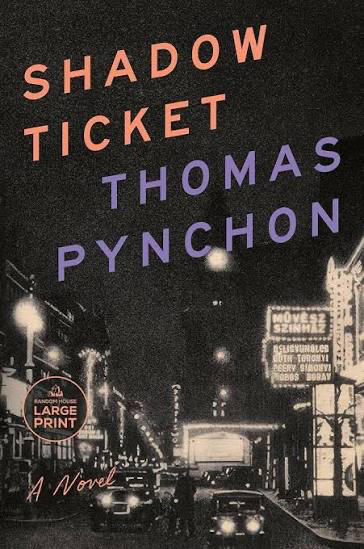

Shadow Ticket,11. Shadow Ticket by Thomas Pynchon. New York: Penguin Press. 2025. 304 pp. Hardcover. $30 by Thomas Pynchon (Penguin Press, 2025)
Thomas Pynchon has been having a renaissance over the last year. In October 2025, he published his first novel in twelve years, and it is a good one. The great American novelist, at 88, is still firing on all comic, critical, and creative cylinders. Two weeks earlier, Paul Thomas Anderson released his second movie based on a Pynchon novel, One Battle After Another, a loose homage to Pynchon’s Vineland (1990). It received wide critical acclaim, and won six Oscars. Thomas Pynchon is thinking about America, and America is thinking about him.
What does this mean for Protestant readers of great American novels? First, from his earliest work, Pynchon has been recognized as one of the postwar period’s major religious novelists. John McClure called him “the most exciting religious novelist of our time.”22. John McClure, “Postmodern/Postsecular: Contemporary Fiction and Spirituality”, Modern Fiction Studies 41.1 (1995): 153. Both The Crying of Lot 49 and Gravity’s Rainbow (perhaps Pynchon’s best-known novels) have been described as fundamentally religious in plot and structure.33. Edward Mendelson, “The Sacred, The Profane, and The Crying of Lot 49”, in Pynchon: A Collection of Critical Essays, ed. Edward Mendelson (Englewood, NJ: Prentice-Hall, 1978), 120; Dwight Eddins, “Orphic Contra Gnostic Religious Conflict in Gravity’s Rainbow”, Modern Language Quarterly 45.2 (1984): 164. Two years ago, in a fine review of Pynchon’s work, Alan Jacobs described him as “America’s theologian,” a title initially coined for Jonathan Edwards.44. Alan Jacobs, “The Far Invisible: Thomas Pynchon as America’s Theologian”, The Hedgehog Review, Summer 2023: 62. Second, Pynchon’s new novel continues to make clear that claims like this are true. Shadow Ticket examines the corruption of the world to its core, thoroughly refuses the secular narrative that there is nothing that transcends this world materially or temporally, and maintains a real hope (small though it may be) in the possibility of a personally redemptive encounter with that transcendent reality.
Shadow Ticket is the third in the series of Pynchon’s late novels, along with Inherent Vice (2009) and Bleeding Edge (2013), in which the master of the postmodern encyclopedic labyrinth turns primarily to detective fiction as a way to tell stories about the twenty-first century. Let’s begin with the plot (never a simple matter in a Pynchon novel). Shadow Ticket follows strikebreaker turned private investigator Hicks McTaggart from Depression-era Milwaukee to the political chaos of central Europe the year before Hitler becomes chancellor of Germany. The “ticket” his agency assigns him is a “matrimonial”: the wayward daughter of local multimillionaire and shady kingpin of the international cheese market Bruno Airmont, “The Al Capone of Cheese” (3), has run away with a clarinet player in a swing band called The Klezmopolitans. This is the “ticket,” Hicks’ assignment, and it is already a great story. But what the novel inexorably leads Hicks to is the “shadow ticket” of the title, the real assignment that he neither knew about nor wanted. This is a journey into the web of international market forces in which Bruno is a player, and the mutually related political chaos into which Europe, where Hicks is forced to pursue him, is falling. As Hicks realizes halfway through the novel, his assignment has changed “from a common or everyday skip [i.e. runaway case] to a skip into the current disarray of Central Europe” (186), with fascist groups of many kinds on the rise and war coming. As one European police operative tells Hicks, “We’re in for some dark ages, kid. Dim at least” (209).
So Hicks spends the second half of the novel in the company of British intelligence agents, spiritualists, gangsters, Hungarian parapsychologists, anti-Russian bikers, Croatian independence fighters, klezmer swing fusion music, Nazi dance cabarets, and “an authentic Czechoslovakian golem” called Zdeněk, whose left arm is a machine gun. This “shadow” world is the real world in the novel. The individual lives and stories of its characters are little more than the epiphenomena of the vast, opaque game that “They,” as Pynchon sometimes calls the incomprehensible forces that drive the world, have always been playing. Even Hicks’ mother is working for them (289). As his boss in the Milwaukee detective agency says, “There’s your wholesome Cream City, kid, mental hygiene paradise but underneath running off a heartbeat crazy as hell, that is if it had a heart which it don’t…” (35). This has always been Pynchon’s vision, and he has not changed his mind in this latest novel – wherever you look, at whatever time or place, there is an apparent world of light and a real world of shadow.
For the Christian reader, this is something like Pynchon’s portrayal of the fallen world. Like William Faulkner or Flannery O’Connor before him, his aesthetic vision plumbs human corruption to its depths, yet somehow also turns it into beauty. The concept of original sin is mentioned directly in the novel, when a federal agent offers to drop all charges against Hicks in exchange for cooperation, leaving him “pure as Ivory Soap.” As per the advertisements, Hicks comments that this is only 99.44% pure, which still leaves him not entirely guiltless. To which Special Agent O’Grizbee replies, “They don’t have Original Sin in Milwaukee?” (73). This is primarily a hard-boiled reference to a hard-boiled world. Neither Hicks nor the Special Agent profess belief in the doctrine of original sin. But they can see what the church has meant by it and why, as can Pynchon. While he too would no longer use the language of the Catholic faith of his youth, his novel is an aesthetically inspired portrayal of what the theology of original sin looks like in practice in the modern world.
The second way in which Shadow Ticket will strike Protestant readers as a profound portrayal of modern society is that Pynchon insists on leaving open doors (in an almost Narnian fashion) to transcendent realities beyond the corrupt (and beautiful) world in which his characters live. If by “postsecular” we mean a refusal to accept the post-Enlightenment narrative that human progress includes progress beyond religion, this novel (like all of Pynchon’s canon) is a thoroughly postsecular one. The supernatural is as real as the natural. Throughout the novel, we see the phenomenon of “asporting” and “apporting,” in which objects simply disappear from one place and appear in another. Sometimes this may be something science can study, sometimes it may be a sophisticated vaudeville trick, and sometimes it is just plain real. For example, as two characters fight over possession of a valuable object:
A deep rumbling felt more than heard passes through the invisible world and around the edges of this one. From beyond any zone of civic safety something has begun to pulsate, soul-strumming and growing louder, finishing with a great thump reaching citywide. (172)
The valuable (and tasteless) lamp over which they are fighting then disappears. Why does it do so? Because there is an invisible world around the edges of this one, which affects and interrupts our everyday lives. This is why there are ghosts haunting a former World War I hospital ship, “not to be explained away by corridor acoustics or the unceasing friction of the sea” (145). This is why the Russian government is interested in the paranormal, “in its potential role in modern warfare” (167). This is why the Milwaukee Police Department employs a former vaudeville mentalist to trace missing cash – “‘Strange thing,’ Uncle Lefty reluctantly admits, ‘but she seems to be the genuine goods’” (38). In Shadow Ticket, as in all of Pynchon’s work, a transcendent, unknown, and in itself unknowable world exists, presses up against the borders of this one, and constantly breaks through those borders into our experience. Sometimes, when the characters are most familiar with Christian language and tradition, it is even called “God.” Thessalie, the ex-vaudeville mentalist now employed by the police department, speaks this way. When Hicks asks her about the inexplicable disappearance from his hand of a weapon with which he was about to kill a man, she replies that it could have been:
Temporary amnesia, or ass and app [i.e. asporting and apporting]. Less likely, maybe something out there didn’t want you to commit the assault, some unnamed force. Grace of God, another technical term we use. (40)
The final way in which Protestant readers will find this novel a profound reflection on modernity is related to this insistence on the reality of a world that transcends this one. Not only is the grace of God a real possibility in Shadow Ticket, but we also see it working in practice. Encounter with that which transcends our ordinary experience changes people for the better. It does not always do so, of course, nor is everyone open to the possibility of such an encounter, but those who open themselves to the transcendent tend to live better as a result. Hicks has had something like a conversion experience in the novel. Back in his days as a strikebreaker, he was so angry at a labor agitator that he was about to kill him, but just as he swung the lead-filled sap he was holding to land the fatal blow, it disappeared from his hand. It asported. By the time he adjusts his mental and physical balance to this, “somehow mysteriously something has changed” (32). He feels “relief at not having killed somebody”; it seems “too much to hope for”; it is like “the kindliest judge out of the sappiest movie in history beaming over his eyeglasses, ‘Case dismissed’” (33). It is an experience, to use a word Pynchon uses more and more frequently in his fiction, of “grace.” This changes Hicks, and when he sees a matchbook cover on the sidewalk advertising, “Learn Oriental Attitude and regain control of your life,” he sends off for the instruction manual, which comes in “comic-book form full of speech balloons” (35). Whatever popular mishmash of Eastern religious principles he learns from this comic book, it works. He is less and less able to fight with strikers, more and more inclined to peace rather than violence, and cannot stop himself from being kind to people. His newfound attitude seems to be having the effect of “saving their lives, not to mention redefining his own” (36-37). There is a constant question throughout the novel whether Hicks’ more religious attitude will withstand the pressures of the cruel world in which he works, but it does. As hard-boiled a private investigator as he is, his encounter with the transcendent changes him permanently for the better. Pynchon is not certain that the Christian term “grace” is exactly the right one for this experience – it is one of many possible terms in the novel – but he is sure that it happens.
Perhaps the most specifically Protestant reference in the novel is the name of the Interpol chief who directs Hicks’ shadow ticket in Europe – Egon Praediger. He is a “slippery customer” and, joking about his morally questionable qualities, a German-speaking character says of him, “Ach, der Praediger” (279). Der Praediger, the Preacher. This is the term Martin Luther uses in his translation of the Bible for the speaker of the book of Ecclesiastes. Luther translates the Hebrew qohelet (“the Preacher” in the King James Bible) as “Der Prediger.” Hicks’ investigation is being run by someone deliberately reminiscent of Ecclesiastes. This is the theological note on which the novel ends, and appropriately so. As with Luther’s Prediger, “Es ist alles ganz eitel,” “all is vanity” in it. Pynchon expresses little hope for either the past or the future of Western society. Like Ecclesiastes, he sees it as structured irremediably by oppression, injustice, and futility. But also like Ecclesiastes, he portrays a world in which the divine, mysterious though it is, exists and calls to human beings. In the vain world he portrays so powerfully in Shadow Ticket, there is the real possibility of the grace of God and transformative moral action as a result. Like Raymond Chandler’s Philip Marlowe before him, Hicks McTaggart is hard-boiled only on the outside, in fact “choosing again and again not to cash in whenever a sure thing is handed to you on a plate, and continuing to believe against all evidence in true and faithful love” (24). There is just the slightest hope in this beautiful, chaotic, and hard-boiled twenty-first century novel that he may be right to do so.


