


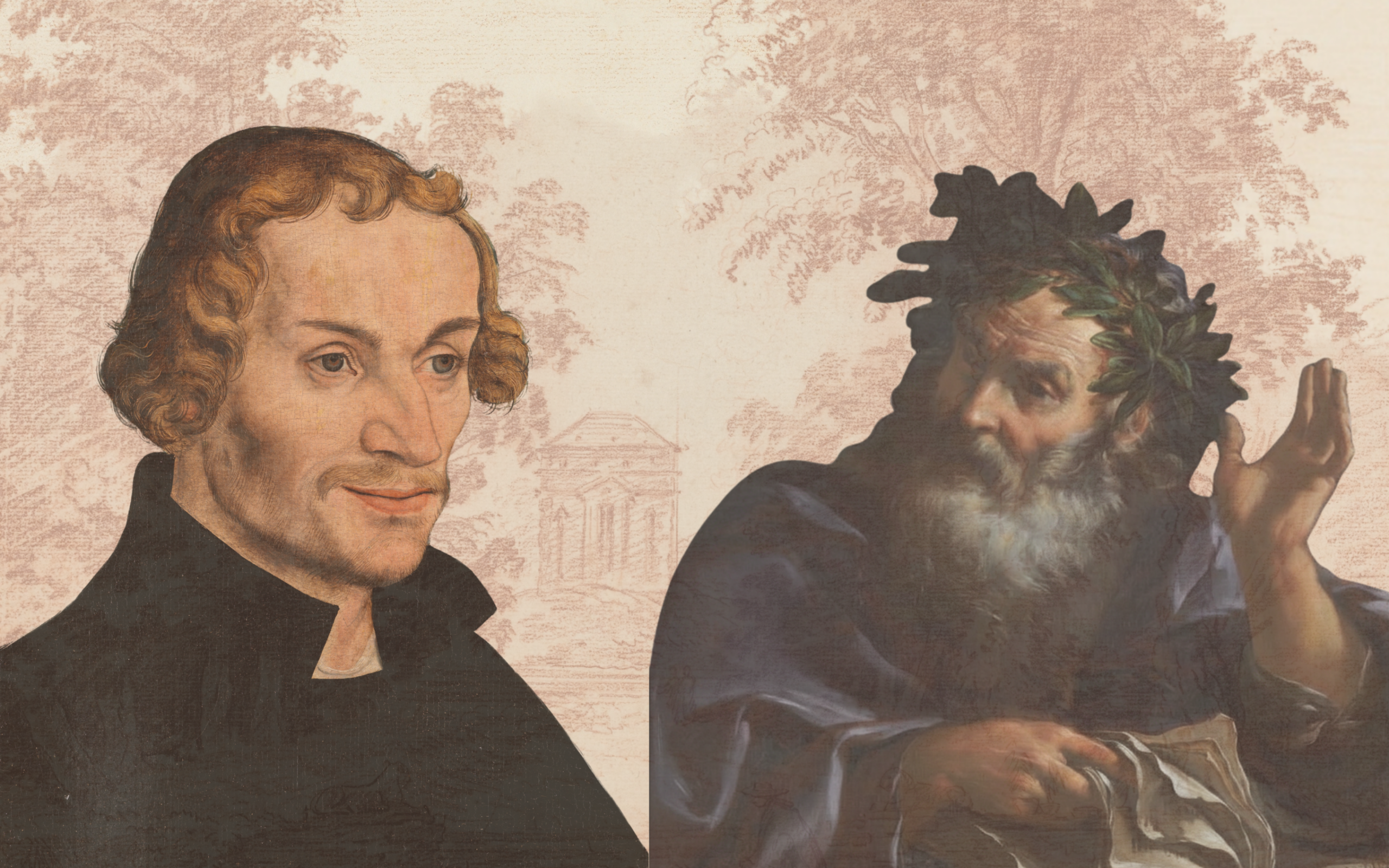
By the time Christopher Nolan’s The Odyssey reached theatres on 17 July 2026, the discourse had already been running for the better part of a year, and it had almost nothing to do with Homer. Nolan’s version—Matt Damon as Odysseus, Tom Holland as Telemachus, Anne Hathaway as Penelope, Zendaya as Athena—arrived as the most anticipated film of the year and, quickly, it’s the most polarizing. The flashpoints were predictable. Nolan cast the transgender actor Elliot Page and the rapper Travis Scott in undisclosed roles, and he cast Lupita Nyong’o as Helen of Troy, a woman Homer twice calls “white-armed.” Matt Walsh objected, claiming that Nolan feared being called a racist; Elon Musk agreed; a counter-mob called them bigots; and the whole thing settled into the familiar trench warfare of the culture war.11. On the film’s release and the casting controversies, see Nicholas Barber, “Why The Odyssey has caused so much controversy,” BBC Culture, 27 June 2026, https://www.bbc.com/culture/article/20260626-why-the-odyssey-has-caused-so-much-controversy.
I want to say something that will annoy nearly everyone: the casting critiques are not unwarranted. When a director sets out to adapt a text and then contradicts it, it is worth noting. Homer wrote what he wrote. Helen’s whiteness of arm is on the page; so is a great deal that Nolan has trimmed, reshaped, and reimagined. Fidelity is a legitimate category, and the people raising it are not imagining things.
But here is the part that should trouble us more than the casting: the overwhelming majority of people fighting over The Odyssey have never read it. They are arguing about Nolan. They speak as though Nolan wrote it. Ask a room full of educated young adults how the poem actually ends, what Odysseus does when he finally reaches his own hall, what the test of the marriage bed means, why the poem spends its final quarter not on monsters but on a household, and you will get silence.
This is the real scandal, and it is not Nolan’s fault. Nolan is doing what artists have always done with Homer: adapting him. The scandal is that adaptation is now the only access most people have, because the poem itself has dropped out of how we form the young, out of the schooling, reading, and shared culture that once handed it down. We have outsourced our imaginations to studios because we stopped reading the things studios adapt. And a culture that only meets Homer through Hollywood has no standing to be outraged when Hollywood changes Homer—because it has no idea what was changed.
For Christians deciding how to feel about a big, gorgeous, expensive Odyssey, this is the more useful question. Not “did Nolan get it right?” but “do we, the church, still know how to read the thing he is adapting, and do we know why our own tradition thought reading it mattered?” On that question, one of the best guides we have is a German schoolmaster who died in 1560.
The Man Who Put Homer in Front of Protestant Children
Philip Melanchthon (1497–1560) is remembered, when he is remembered, as Luther’s mild-mannered lieutenant, the systematizer who wrote the Loci Communes and drafted the Augsburg Confession. But sixteenth-century Germany gave him a different title: Praeceptor Germaniae, the Teacher of Germany. He earned it not from the pulpit but from the schoolroom. Melanchthon is the founder of higher education in Protestant Germany; Latin schools and universities across the German lands owed their establishment or reorganization to him, and when towns wanted to build a school, they wrote to him for the curriculum and teachers.
He arrived in Wittenberg in August 1518, twenty-one years old, to take the new chair of Greek, and four days later, he delivered his inaugural oration, De corrigendis adolescentiae studiis (On Correcting the Studies of the Young). It was a manifesto. He argued that the collapse of Greek learning in the West had ruined both secular scholarship and sacred piety at once, and that the only cure was to return to the sources—ad fontes—by reading the ancients directly rather than the medieval textbook digests that stood between students and the real thing. At the very front of that Renaissance, he placed one poet. Homer, he said, is the source of all the disciplines for the Greeks, as Vergil and Horace are for the Romans.22. Melanchthon, De corrigendis adolescentiae studiis (1518), in Corpus Reformatorum: Philippi Melanthonis Opera quae supersunt omnia, ed. C. G. Bretschneider and H. E. Bindseil (Halle/Braunschweig: Schwetschke, 1834–1860), vol. 11, col. 22. In his first year, his two teaching assignments were Homer’s poetry and Paul’s letter to Titus, side by side, and he saw no contradiction in that pairing at all.
Then he built the machine to deliver it. In the late 1520s, the Elector of Saxony sent out teams of inspectors, called “visitors,” to examine the parishes and schools across his territory and report on what was being taught and how poorly. Melanchthon wrote the educational half of the manual that emerged from this survey: the Unterricht der Visitatoren (the Instructions for the Visitors of Parish Pastors in Electoral Saxony). That document, along with the Wittenberg church-and-school ordinance of 1533 that he later helped shape, did something startling to modern eyes: it told teachers exactly what to teach, in what order, and in how few subjects. At its center was Melanchthon’s three-class Latin school—a graded ladder on which children climbed from letters and grammar, to reading the poets, and finally to dialectic and rhetoric.
Two features of this program indict our own. First, it was demanding. A Saxon schoolboy of ten was being marched through inflected Latin, memorized speeches, and moral commentary on pagan verse, the sort of labor most Western fifteen-year-olds now never attempt. Second, it was loud. Learning was oral: recitation, declamation, dialogue, disputation, the constant vocal handling of texts. Melanchthon’s schools were noisy with speech because speech was the whole aim. Compare the “quiet reading” of a modern classroom, where a child scans a screen in silence, retains a summary, and speaks to no one. Melanchthon would have seen a room of silent readers and concluded that nothing was being formed at all.
Why the Reforms Produced Sturdier Children
It is tempting, and a little too easy, to say the old system simply made “better” children. But the mechanism is worth naming precisely, because it is exactly the mechanism we have lost.
Melanchthon did not read the classics for information. He read them for formation. The goal of the curriculum was not a stocked mind but a shaped person, someone with judgment, eloquence, and virtue. In his Wittenberg Homer lectures, his central aim was to train students in literary and moral judgment and to make them fit for both government service and the ministry. The twin objectives were eloquentia and its “shadow,” prudentia—practical wisdom, the trained capacity to judge rightly in a real situation. You did not acquire prudence by being told to be prudent. You acquired it by living, in imagination, through the choices of Achilles and Odysseus, by weighing their speeches, by learning through their triumphs and their disasters what wisdom costs. Reading Homer was, in Melanchthon’s phrase, a kind of surrogate experience, a safe rehearsal of moral life.
This is why the reforms disciplined children in the deep sense of the word—not “made them quiet,” but formed them, gave them an interior shape. A curriculum built on the sustained, spoken, communal reading of great texts does three things at once that a modern feed of scrolling video and social media cannot. It lengthens attention, because the poem does not resolve in ninety seconds. It furnishes the imagination with genuine moral test cases, because Homer’s characters face real dilemmas and pay real prices. And it hands the student a working vocabulary of virtue and vice, honor and shame, loyalty and betrayal, the raw categories a person needs to make sense of his own life. Melanchthon’s pupil came out disciplined because he had spent years apprenticed to disciplined minds.
We should be honest that this reading of Homer was never merely secular. Melanchthon believed the good pagan poets were, in a real sense, moved by God: “That good poets are moved by God is a tale that is told true,” he wrote in a poem of the early 1520s; “it is God who stirs song in their virtuous hearts… Thus, it is a divine duty that we give recognition to Homer.”33. Melanchthon, epigram on poetic inspiration (early 1520s), translated in Hutchinson, “Homer in Wittenberg: A Review”; the Latin appears in his Epigrammata (“Est igitur pietas quaedam cognoscere Homerum, / cum bona de superum munera sede ferat”). See Weaver, Homer in Wittenberg, ch. 1. That is a bold sentence for a Reformer, and it is the theological engine of the whole project. If the true, the good, and the beautiful in Homer are gifts of the same God who gave the Gospel, then a Christian child can read Homer without apology—not as a rival scripture, but as a schoolmaster of the affections that the Gospel will later govern.
What Homer Actually Teaches, and Why Preachers Need It
So set the casting fight aside and ask Melanchthon’s question: what does a Christian gain by reading the Iliad and the Odyssey?
Melanchthon read the two poems almost as a matched pair, and in his later Preface to Homer (c. 1538), he did something audacious: he treated them as a single “poem” with a twofold theme: “The theme of the Homeric poem is twofold; one is entitled the Iliad, the other the Odyssey.”44. Melanchthon, Praefatio in Homerum (“Preface to Homer,” c. 1538), CR 11.397–413, at 11.404. The Iliad, on his reading, schools the martial virtues—courage, honor, the terrible cost of wrath. The Odyssey turns to civil life: Odysseus’s dedication to Ithaca as a model of patriotism, the marriage of Odysseus and Penelope as an image of love, unity, and fidelity, set deliberately against the ruined household of Agamemnon. Read this way, the poem most people think is about a man dodging monsters is really about a man fighting his way home to his wife and his household, which is, not incidentally, exactly the quarter of the poem that Nolan’s audiences do not know exists.
For Melanchthon, the payoff was concrete and pastoral. The sustained reading of Homer does at least three things a minister needs.
- It trains the imagination: the capacity to enter another’s situation, to picture consequences, to hold a whole moral world in the mind at once. A preacher who cannot imagine his hearers cannot reach them.
- It forms the affective range: the disciplined feeling that pastoral work demands. Homer stretches the reader across grief, terror, longing, joy, and homecoming. Melanchthon’s schools were producing men who would have to weep with the grieving and rejoice with the glad, and he understood that the affections, like the intellect, have to be exercised on great material before they are fit for real use.
- And it trains judgment through speech: the very heart of the reforms. Melanchthon’s students read Homer as a gallery of speeches, learning by imitation how a wise man addresses a hostile assembly, a grieving widow, a proud king. That is the daily labor of the pulpit and the visit. Melanchthon even came to see the reading of Homer’s speeches as a school for the most Protestant skill of all: distinguishing the voices of law and gospel, threat and promise, so that a preacher learns to “rightly divide” the word he handles.
The Point is not the Movie
Go see Nolan’s Odyssey or don’t. Complain about Helen’s arms or don’t. But notice what the whole quarrel reveals: a civilization arguing furiously about a poem it has not read, because it long ago decided that reading such things was optional. Melanchthon would not have been surprised that the casting is wrong in places. He would have been horrified that we no longer possess the poem well enough to say so with authority, and more horrified that the church, of all institutions, has forgotten why it once put Homer into the hands of its children in the first place.
Read the great texts slowly, read them aloud, read them in community, and read them for formation rather than information, so that the imagination is furnished, the affections are stretched, and judgment is trained. That was the making of sturdier, more disciplined, more articulate children in the sixteenth century. There is no reason it could not be again. The first step is embarrassingly simple, and it is the one thing the entire internet arguing about Nolan has skipped.
Read the Odyssey.


