


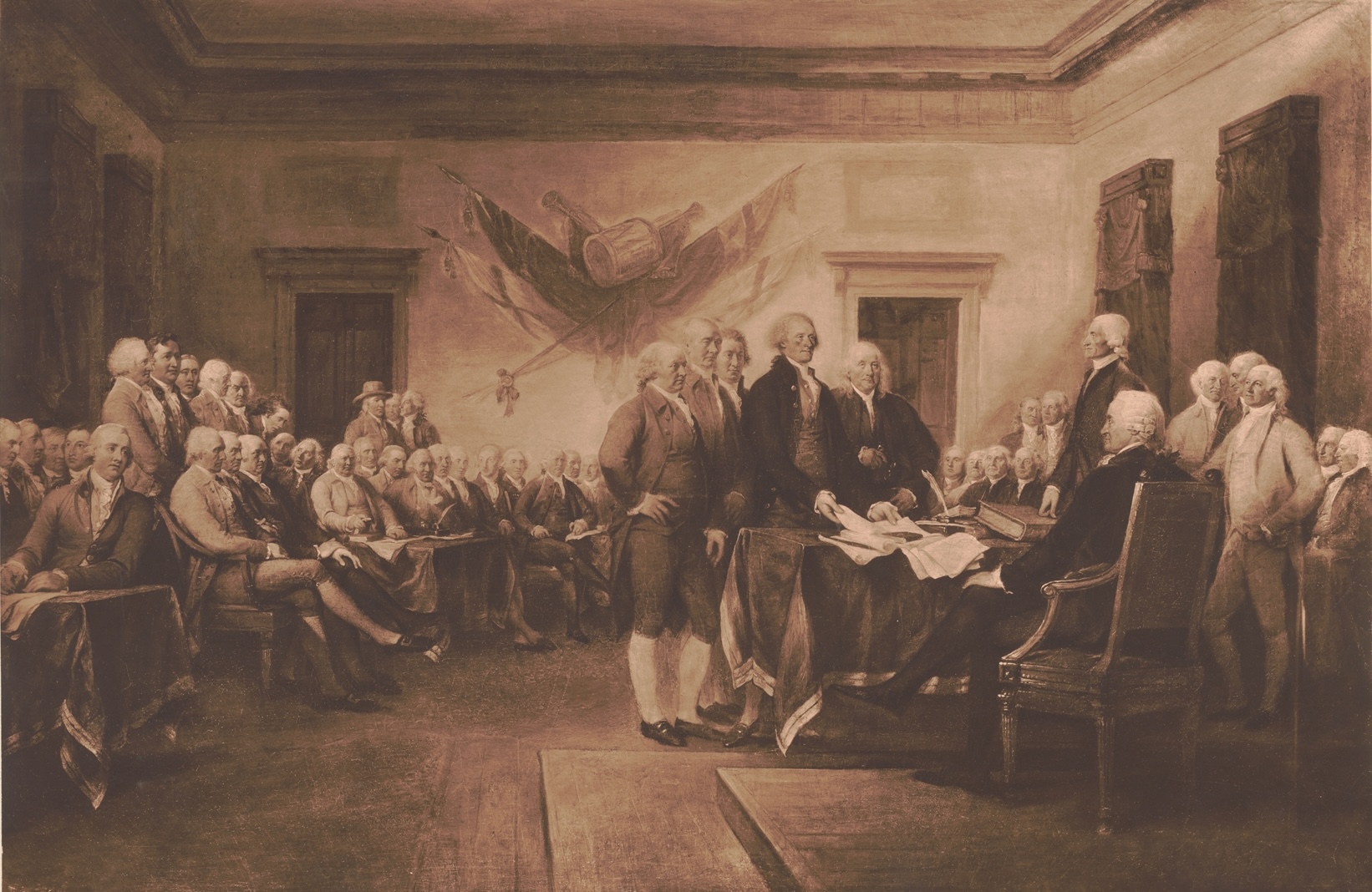
On the Declaration
It is the 250th anniversary of the Declaration of Independence. Why would that be of interest to an ecclesiastical publication?
Begin with the obvious thing. God appears four times in the text of the Declaration, once as each branch of government and once as the “Creator.” In Thomas Jefferson’s invocation of “the laws of Nature and of Nature’s God,” we see the legislative branch; “the Supreme Judge of the world” oversees the judiciary; “the protection of divine Providence” is a universal executive.11. From The Declaration of Independence (In Congress, July 4, 1776).
Men need government; the revolutionary leader James Madison would write that government itself is the “profoundest of all commentaries on human nature. If men were angels, no government would be necessary. If angels were to govern men, neither internal nor external controls on the government would be needed.”22. James Madison, Federalist Papers No. 51. Making the case against the king and his Parliament, the Declaration of Independence is emphatic that no single human being can be trusted with all these powers. That is for God alone.
An act of rebellion against a king, the Declaration of Independence is also therefore an act of reverence for a King, the highest King. It names King George III, a tyrant. It names God, “Divine Providence,” and places trust in Him. To the Founders, the Creator is superior to the creature. The king of Great Britain is a grand man, but only a man.
What did the Founders mean by the term “God?” Most of them were orthodox Christians, and they meant Jesus Christ, and His Father, and the Spirit that proceeds from Them. All of them meant the perfect and supreme being, the source of all rightful law, the judge of all justice, the guide of all action. To be God, God must have these attributes, and only such a one is entitled to rule without limit. No man is.
Because of this, they had left behind the idea that religious conviction and practice should be enforced by law. They did not think this a departure from the teachings of Jesus, whose kingdom is not of this world, and who is the only road to salvation for each individual according to his own belief. This is the stone with which the road to heaven is paved, not with good intentions, and not with laws.
Is Christianity then neutral as to forms of government? It may seem so from reading certain passages in the New Testament. There one learns that the rulers are “of God,” and they are to be obeyed.33. Romans 13:4 (ESV).
In other passages, the lawmakers give commands to the apostles to stop preaching Jesus. Many were beaten because of this, sometimes to death, and others were crucified, as was Jesus. The apostles did not obey these commands. Like the apostles, Thomas Jefferson rebelled.
Jesus says to “render unto Caesar the things that are Caesar’s, and unto God the things that are God’s.”44. Matthew 22:21 One cannot miss the respect this pays to Caesar, nor can he miss the limit it places on the power of Caesar. To Caesar, to place a limit on him is a killing offense, and many died for it. In the gospel accounts, Pilate appears to break down reluctantly to give Jesus over to crucifixion. In the Gospel of John, he does that at the moment when the crowd accuses Jesus of usurping the powers of Caesar.55. John 19:12-13 This charge was in one sense true: the offense most heinous to tyrants is to claim an authority above them, and Jesus claims authority over Caesar and everything else. For Pilate, as much as for Jesus or Peter or Paul, that claim is a capital offense.
Jesus does not give to any man the authority he limits in Caesar. Christianity therefore places limits upon political authority in matters of conscience and worship. This idea is captured beautifully by George Washington in his 1790 letter to some Jews who worshiped in Rhode Island. He wrote:
It is now no more that toleration is spoken of as if it were the indulgence of one class of people that another enjoyed the exercise of their inherent natural rights, for, happily, the Government of the United States, which gives to bigotry no sanction, to persecution no assistance, requires only that they who live under its protection should demean themselves as good citizens in giving it on all occasions their effectual support.66. George Washington, “Letter to the Hebrew Congregation of Newport, Rhode Island,” 1790.
Washington was neither Caesar nor Pilate: he would not interfere with the religious liberty of anyone. He asked only that citizens—not subjects— conduct themselves as “good” citizens who give their country their “effectual support”. On this condition, Washington continues with a special blessing:
May the children of the stock of Abraham who dwell in this land continue to merit and enjoy the good will of the other inhabitants—while everyone shall sit in safety under his own vine and fig tree and there shall be none to make him afraid.
As in the book of Genesis, this blessing upon Abraham’s stock is at the same time a blessing to all.
The doctrine of civil and religious freedom articulated by Washington is at the heart of the American Revolution and has given rise to a culture. It is a Christian revolution in this specific sense: it recognizes the freedom to worship, and it recognizes that the kingdom of the Ruler and Maker of all, the ultimate Sovereign, is not politically sovereign in this world. Rather, the ultimate Sovereign has endowed us with the authority and right to pick our political rulers. The power of this culture is evident, for example, in the founding document of the college where I work. Sixty-eight years after the Declaration of Independence, a group of New England preachers moved to the frontier to found a College. They were men and women of devout Christian faith. They established the aims of the college in the first sentence of the “Articles of Association”:
The denomination of Christians known as Free Will Baptist, along with other friends of education, grateful to God for the prevalence in the land of the inestimable blessings of civil and religious freedom and intelligent piety, and believing that the diffusion of sound learning is necessary to the preservation of these blessings, hereby endow and found a College…77. The Articles of Association of Hillsdale College (1844).
Such phrases echo throughout the American Revolution and the generations that followed it. Civil freedom—the rights that guarantee the unfettered pursuit of happiness—is bound together with religious freedom.
On Education
Notice that in the founding document of Hillsdale College, quoted above, “civil and religious freedom“ is parallel to “intelligent piety.” Why intelligent? Christianity calls believers not only to worship God but also to “know” Him, fear of Whom is the beginning of wisdom.88. Proverbs 9:10 Jesus is the Word, what God has to say. He invites us to listen and understand.
This fact implies a kind of education and its purpose. To know Christ even a little is to glimpse the structure of the universe and our place in it. This requires that one contemplate the laws of nature and of nature’s God. This requires that one builds the character and intellect to grasp those laws and to apply them to one’s life in all one’s actions. It demands, in short, the cultivation of all the virtues, moral and intellectual. Christianity demands this of its followers, just as the Declaration challenges it to our citizens. Our nation went to war and built itself to promote this cultivation and contemplation.
The culture and education that proceeds from the Declaration of Independence has been as resilient as its political system, more resilient than any other in the modern world. Today it is impaired and its decay is manifest. On the other hand, one reads of a revival of faith in the God of Abraham and of the apostles. Even the glimmer of this is welcome, and it is more than a glimmer.
The revival of classical education that is surely underway is a natural partner to this revival of faith. The rising of the heart and mind to the laws of nature and of nature’s God impels one to understand those things. That requires that one read the Good Book and also read as much as one can of the best books of the saints, the philosophers, the poets, and the scientists who have explained our world and our place in it.
But is classical education proper to Christianity? There is an obvious reason why not. The classical times to which classical education refers originate before the birth of Christ. They originate in two cities, Athens and Jerusalem, where universal philosophy and universal monotheism are born.
The classics, then, are pre-Christian at their root. Why are we reading pagans to prepare ourselves for the Christian life? Why are we reading the story of the ancient Jews and their times when they happened so long before the Savior?
Socratic philosophy was the first rational attempt to seek the good, the true and the beautiful simply, without regard to time and place, beyond the claims of law and custom. To read the philosophy of Socrates and his followers is to begin the quest to know what things are as they can be known to reason. That is the living legacy of Athens; in the West, we are still on that quest. Socrates is, to be sure, respectful of the gods, but he subjects them to inquiry, as he does to everything else. When God appeared to Abraham, he addressed a man surrounded by the religions of antiquity. There were many gods, including especially the gods of one’s own family and one’s own tribe and city. To read the Old Testament is to encounter an explanation of the eternal Source and Cause of everything. It is indeed to read predictions of the Messiah still to come. Jerusalem, the birthplace of Western monotheism over 2000 years before Christ, became the scene of that Messiah’s trial, execution, and resurrection.
In the first sentence of the Articles of Association, the founders of the college where I work took up the Socratic questions and the Messianic answers in the context of the Declaration of Independence’s America. They wrote that they were “grateful to God for the prevalence in the land of civil and religious freedom and intelligent piety.” They wrote that “the diffusion of sound learning was necessary to the preservation of these blessings.” Apparently then, civil and religious liberty are conjoined. Apparently together, they are conjoined with intelligent piety. Apparently piety, a word that comes from duty and means especially duty to God, is better when it is intelligent.
Civil and religious liberty are political goods. In the understanding of the founders of America and of the West generally, God is superior to politics as he is to everything else. Christians should devote themselves to the Declaration of Independence, not as much as they devote themselves to Jesus, but because they devote themselves to Him, even at the cost of their fortunes, their lives, and their sacred honor. Just as much, all Americans must do so. The laws of nature and of nature’s God cannot be repealed.


