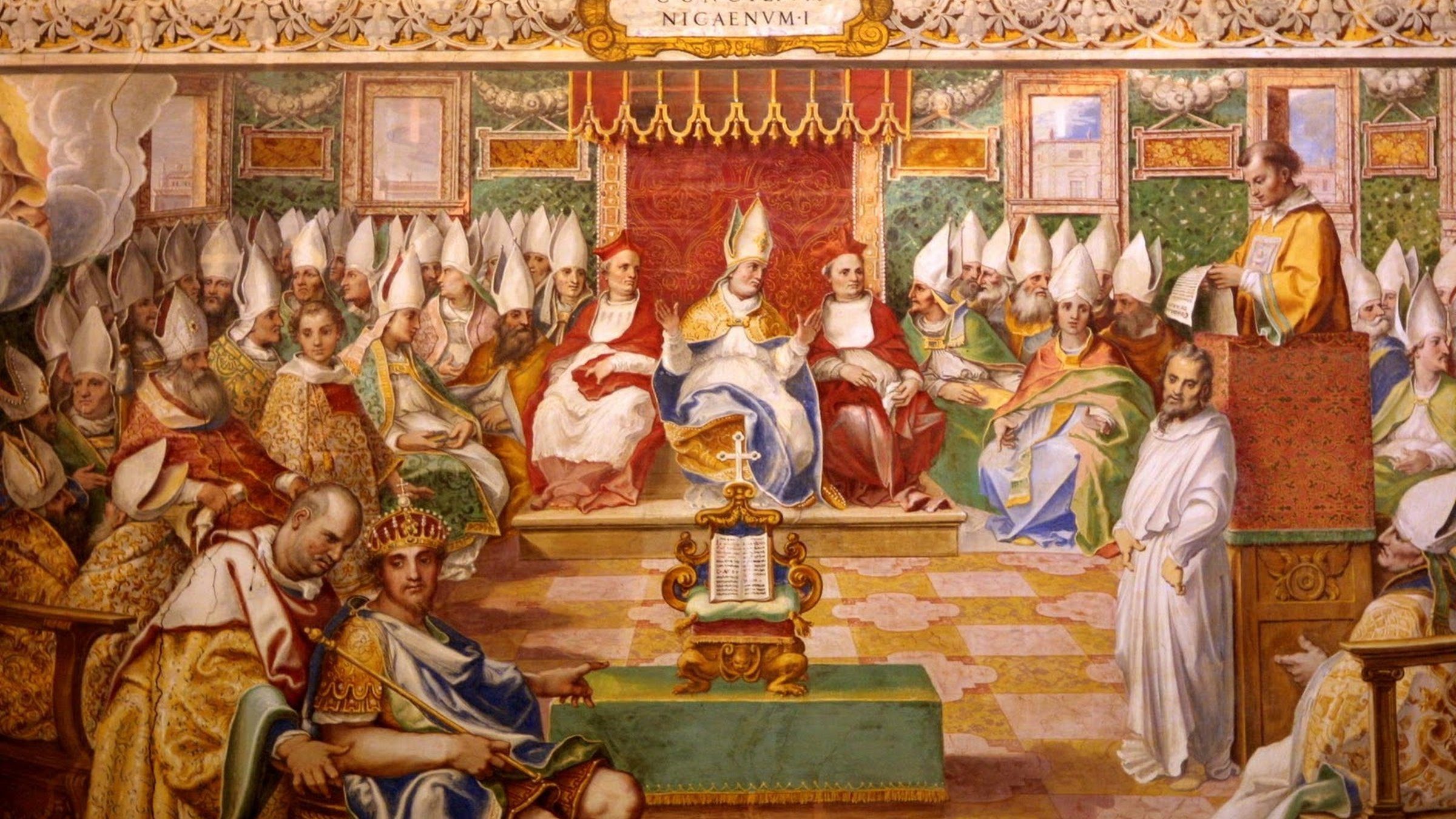
It might seem like faint praise to commend the Nicene Creed as a summary of the Christian faith. At best, it might register as repeating everyday common sense. In a year spent celebrating Nicaea’s 1700th anniversary, surely “summary of the faith” is little more than a bland introduction for an entry on any creed in any reference work. But if it strikes us that way, that may be a sign that we ought to give some fresh attention to the greatness and complexity of the task represented by the deepest kind of effective summarizing. Nicaea (for our purposes, either 325 or 381) makes it look easy. But to have canvassed, collated, and synthesized the message of Scripture is to have accomplished something of astonishing import. Perhaps we need a stronger word than “summary,” since what Nicaea accomplishes is no mere abbreviation or condensing.[1] Rather, in many ways and using many strategies, Nicaea has traced the message of Scripture back to its actual principles, and then fashioned from those principles a tool for effective catechizing.
Let us consider this in four phases: first, the patristic background of the collational strategies that coalesced at Nicaea; second, the form they took in the classic creedal text itself; third, the Protestant appreciation of this accomplishment; and fourth, its ongoing benefits for the task of teaching the faith.
I. Patristic Collational Practices
The earliest Christian theologians made a practice of reading the most important texts of Scripture not in isolation from one another but in close connection. Any text of Scripture that made large claims about major doctrines seemed to draw similar texts into its orbit, with the result that Christian readers would view them as a complex unit of thought whose full meaning was distributed across multiple locations. Theological interpretation of Scripture, in this formative phase, meant reading key texts together and letting them mutually interpret each other.[2]
Consider the opening chapters of Genesis (“In the beginning God created the heavens and the earth”), the Gospel of John (“In the beginning was the Word,”) Hebrews (“God . . . spoke in his Son, through whom he made the world”), and Colossians (“He is the image of the invisible God, the firstborn of creation, for by him all things were created”). From the reading of these four texts side by side there emerges a complex interplay of multiple doctrines: Divine being, divine action, creation, the Son, revelation. Nor can we specify just which doctrine is located in which passage, since they are mutually reinforcing and mutually interpretive. In fact, the cluster God-Son-Creation-Revelation is a kind of primal “first theology,” and we might speak of it not so much as a cluster as a single, vast, underlying doctrine whose parts are breaking the surface at various points of Scripture.
When they read these passages collationally, were early Christian theologians imposing external connections onto them, or were they intuiting linkages actually immanent to the texts themselves? Perhaps both are happening, although the priority of Genesis does dictate that the New Testament authors are consciously producing a kind of theological commentary on it in light of Christ. And even in the absence of literal intertextual influence, when multiple inspired texts speak of the same reality, they exert magnetic force toward each other.
Irenaeus of Lyons, whose arguments from Scripture often seem straightforward and almost naïve, was in fact a master of this collateral hermeneutic. Steven Presley has traced how “the reception of any particular passage of Scripture in Irenaeus necessarily includes the reception of theologically and hermeneutically interrelated passages. Irenaeus receives and interprets texts in relationship.”[1] In a striking contrast to modern biblical criticism, whose tools “naturally disconnected the texture of the scriptural networks in attempts to extract isolated sources from isolated texts,”[2] Irenaeus used a whole battery of strategies to discern unities: Presley catalogs “literary readings, typological readings, prophecy and fulfillment, verbal connections, organizational functions, illustrative applications, narratival or creedal, prosopological interpretations, and general-to-particular connections.”[3]
With this kind of collational reading culture at work in the early church, it is no wonder that the theologians of the Nicene period were well versed in holistic hermeneutics. Consider this creed-like passage from a letter from Gregory of Nyssa explaining the Christian faith:
We believe in the Father of our Lord Jesus Christ (1 Pet. 1:3) who is the fountain of life (cf. Ps. 36:9), and in the only-begotten Son of the Father (John 3:14, 18) who is the Author of life, as the Apostle says (Acts 3:15), and in the Holy Spirit of God, concerning whom the Lord said, it is the Spirit who gives life (Jn. 6:40).[4]
Nyssa’s collational strategy is striking: Taking as his keyword “life,” and knowing from Matthew 28:19 that God is Father, Son, and Holy Spirit, Nyssa looks through Scripture to find passages where each person of the Trinity is linked to life. What he finds is the Father as fountain, Son as source, and Spirit as giver. Nyssa is in the business of demonstrating the orthodoxy of his doctrine of God, and simultaneously explaining how the reality of salvation depends on a well-ordered doctrine of the Trinity.
Andrew Radde-Gallwitz has provided a name and a definition for this interpretive technique:
This passage contains an example of what might be called “coordinating exegesis,” a mode of interpretation that is ubiquitous in pro-Nicene authors. An exegesis is coordinating when an interpreter cites passages containing the same or a similar predicate for each of the three hypostases with the intention of demonstrating a close connection among them. Here, the giving of life is ascribed to the three persons, not through Gregory’s own words, but by stringing together three citations that contain such a predicate with the three distinct subjects.[5]
When Radde-Gallwitz calls it “coordinating exegesis” he especially draws attention to the way Matthew 28:19 is a privileged passage that serves as a template for the task. Readers begin with the trinitarian baptismal formula as a given, “Father, Son, and Holy Spirit,” to which they add a thematic prompt (life, in this case), and then move out to identify passages from anywhere else in Scripture that coordinate with the formula.
II. Nicene Theology’s Collational Form
The similarity between Nyssa’s coordinating exegesis and the Nicene Creed is obvious on two levels. Most immediately, Matthew 28:19 simply is the three-point outline of the Nicene Creed. But secondly, Nyssa enables us to see the Nicene Creed as an extended project of coordinating exegesis, as the three-point outline is filled out by material from far beyond the final verses of Matthew’s gospel. The Creed opens up the short baptismal command and inserts associated material under the headings of each person of the Trinity. Thus “Father” from Matt. 28:19 is coordinated with “maker of heaven and earth” from Genesis 14:19, and so on.
“Perhaps we need a stronger word than “summary,” since what Nicaea accomplishes is no mere abbreviation or condensing.”
Nicaea’s collational strategy is even bolder in the central, second article, where “I believe in the Son” is expanded by coordination with three important blocks of material. The first block is a series of Christological titles: Lord, Jesus, Christ, Son, and only begotten. These titles are assembled from elsewhere in the New Testament and now aggregated in the highly hospitable context of the baptismal command. Again, Nicaea makes it look so easy that it takes some imagination to picture these titles as having been brought here for the first time.
The second block of material is the theology of sonship. It is one thing to confess faith in one who is the Son, but Nicaea elaborates on the meaning of sonship quite extensively. “The Son is the only-begotten, who was begotten from the Father before all ages, light from light, true God from true God, begotten, not made, the same-in-substance with the Father.” There are perhaps seven specifications of sonship gathered from all around Scripture. And all of this gathered theology of sonship serves as background, establishing of the Son’s identity before describing what he has done: He is the one “through whom all things came to be, who for us humans and for our salvation came down from the heavens.”
This brings us to the third block of material by which Nicaea expands the baptismal formula: By a condensed narrative of the life of Jesus, from his conception by the Holy Spirit to his return in judgment. This narrative has broadly the structure of any synoptic Gospel, but in fact it tracks more closely with a moment of apostolic kerygma, specifically Peter’s speech in Acts 10. The collational move is to open up the central name (“Son”) of the triadic baptismal formula and insert a condensed reminder of the Gospel story into it.
But possibly the most far-reaching collational strategy of the Nicene Creed is the way it makes explicit how Father, Son, and Holy Spirit are linked to each other. Earlier creeds, such as the “Old Roman Symbol” or the various local baptismal confessions in use for believers, were content to name the three persons in order following Matt 28:19. The Apostles’ Creed, based on these earlier forms, likewise collects all three persons of the Trinity in its confession. But the Nicene Creed includes an account of how the three are related: the Son is begotten of the Father; the Holy Spirit proceeds from the Father. This is the heart of Nicaea’s uniqueness. Earlier creeds collect the persons; Nicaea connects the persons. This conceptual connecting work is the hallmark of Nicaea’s depth summarization. What it shows is that Nicaea has grasped “the pattern of sound words” (2 Tim 1:13), traced that pattern back to its principles, and then used those principles as rallying points for gathering in truth.[6]
When we view Nicaea as a successful deep summary, attending to its collational strategies, we begin to see the richness of pro-Nicene theology. Pro-Nicene theology is not just a matter of affirming three equal persons in one being, but a matter of inseparable operations, consubstantiality, relations of origin, and so on.[7]
III. Protestant Appreciation
The theology of the Reformation, of course, stands in continuity with this pro-Nicene theology; the doctrine of God was not a point of contention between Roman Catholic and Protestant confessions. It was rather a point of vital convergence. But approaching Nicaea as a consummately collational accomplishment enables us to see it from an angle that is strikingly conducive to Protestant priorities. Even as we celebrate Nicaea as a breakthrough in theological understanding, we should also recognize that Nicaea stands out in the history of doctrine as the most significant instance of doing Christian theology modestly, simply by gathering a doctrine from its scattered locations in Scripture. Protestant theologians easily recognized their interests as represented by this Nicene methodology.
“Theological interpretation of Scripture, in this formative phase, meant reading key texts together and letting them mutually interpret each other.”
Consider Italian Reformer John Diodati (1576-1649), whose Bible commentary, under the charming title Pious Annotations, shows remarkable methodological clarity about how Bible and doctrine are related. Diodati described method in general as a dispositive exercise, or one that “rangeth [i.e., arranges] things into their due and proper places.” In particular, the kind of method called “Analyzing” (or, as we would say, analytic) operates by “contracting the subject about which it is conversant into a lesse modell, but into more order.”[8] This “lesse modell,” or smaller summary, has the advantage that it “renders the sense of the whole more obvious, and gives no small advantage to the memory of the Reader.” Eager to insist that analytic commentary is not materially improving on Scripture, Diodati explains why analysis is a good servant of the inspired writings:
The Pen-men of the several portions of Holy Writ, do not tie themselves exactly to the rules of Art, but upon design often follow the Method of Prudence, whereby they transpose some parts of their discourse, and omit others: They do not always follow the Topickes of invention, but those only that best serve for their present purpose, and intendment… Now all these that lie thus scattered, here, and there, as in a large field, as best served for the intent and purpose of the Holy Ghost, those doth the art of Analysing sort, and turn to their proper Channels.[9]
To sort the scattered arguments into “proper Channels,” gathering them from a large field into a smaller model, is the task of deep summary. That this aligns Protestant concerns with Nicene strategies could be demonstrated by a host of other Protestant witnesses, but consider William Perkins’s (1558-1602) influential preaching manual, The Arte of Prophesying. “The analogy of faith,” he writes, “is a certain abridgement or sum of the Scriptures, collected out of the manifest and familiar places.”[10] Lest “abridgement or sum” suggests simple shortening, Perkins indicates the doctrinal judgements that are essential in the process of collecting: “Collections ought to be right and sound, that is to say, derived from the genuine and proper meaning of the Scripture: If otherwise, we shall draw any doctrine from any place.” He goes on to describe the Arian heresy as an example of improper collection or false collation: “The Arians collect very wickedly, that the Son was created.”[11]
IV. Catechetical Pedagogy
Having considered Nicaea’s collational strategy in its patristic roots, in its classic Nicene virtuosity, and in its Protestant methodological reception, we can conclude by throwing it into a different register of terminology. In the field of modern psychology of education, educational theorists speak of bundling information, retrieving information, and automaticity of retrieval.[12] The terms are not too technical to be fairly transparent: Learners “bundle” information when they aggregate or clump together bits of data into a meaningful set rather than a list. Learners need to have that information readily available for mental “retrieval” in order for it to count as operational knowledge. And the retrieval of that information occurs along a spectrum of cognitive effort. At one end is information that demands focused attention or heavy lifting to locate and bring up into use; at the other end is information so readily on tap in the active memory that it seems effortlessly available. That effortless availability is “automaticity.” When students have put important skills and information into the region of automaticity, they no longer need to expend the cognitive labor of conscious reflection in order to perform these mental tasks. They can move on, conserving their hard cognitive labor for more advanced tasks. Automaticity sets them free to think well about higher-level topics.[13]
“When we return to the particular kind of learning that Nicaea has in mind, we should call it catechesis, but with the caveat that it is designed specifically to reach a higher level of catechizing for the benefit of teachers.”
The application to theological understanding is fairly direct. In Christian theology, one of the greatest aids to automaticity is precisely the kind of work done by Nicaea. By collating scattered information (the titles of Christ; the theology of sonship; the central events of Jesus’ ministry), Nicaea bundles them significantly. By setting them within the larger structure of the baptismal formula of Matthew 28:19, Nicaea stages this theological information for retrieval. Retrieval is, of course, currently a term of art in theological method, indicating approaches that seek to “rehabilitate classical sources of Christian teaching and draw attention to their potential in furthering the theological task.”[14] The task of theological retrieval should not be dumbed down to mean simply exercising the memory to recall older forms of theology. On the other hand, it should never mean less than that, and contemporary theology often suffers from epochal lapses of memory. At any rate, Nicaea makes available for theological cognition the classic resources of reflection on God and the gospel, and we might say that creed-toughened systematicity aids in automaticity. Without it, learners continually loop around low-level learning tasks, always learning but never able to come to a steady knowledge of the truth (2 Tim. 3:7).
When we return to the particular kind of learning that Nicaea has in mind, we should call it catechesis, but with the caveat that it is designed specifically to reach a higher level of catechizing for the benefit of teachers.[3] Earlier creeds were more directly based on baptismal confessions of faith, but Nicaea was hammered out in controversy by bishops, for bishops. Nicaea, especially in its perfected form in the Creed of 381, is perched between a higher and lower level of catechizing, serving the lower but geared toward the higher. This is because its collational strategy makes it immediately open to being read as an apparently simple summary of Scripture, while also doing serious work as an organizing instrument for advanced theological understanding.
We began by calling Nicaea a summary of the Christian faith, and wondered briefly if “summary” is too weak a word to describe what Nicaea accomplishes. Perhaps the word will serve if we enrich it with the adjective deep: “deep summary.” In describing Nicaea’s various strategies of deep summary, we have swapped in various other words, such as collation, gathering, reduction to principle, and so on. But we can conclude by calling to mind how the notion of summary functions in the New Testament. In Romans 13:9, Paul says that “the commandments, ‘You shall not commit adultery, You shall not murder, You shall not steal, You shall not covet,’ and any other commandment, are summed up in this word: ‘You shall love your neighbor as yourself.’” They are summed up: the Greek word he uses is anakephalaioo. That is the same word used more famously and resonantly in Ephesians 1:10, where we are told that all things are summed up, or united, or recapitulated in Christ. In Romans the “summing up” functions in a more directly literary or rhetorical manner, gathering many scattered things under one heading or chapter. In Ephesians we recognize that the summing up is more expansively theological, referring beyond scattered writings to scattered realities. All things find their summary in this one. Nicaea perches between the literary sense, Scriptural summary, and the theological sense, confessing the one in whom all things are comprehended. To summarize deeply is a big deal: on an accurate and effective summary hangs everything (Matt. 22:40).
Fred Sanders is a theologian whose primary focus is on the doctrine of the Trinity. Since 1999, Fred has taught in the Torrey Honors College, an undergraduate program in the great books, at Biola University. He has a PhD from the Graduate Theological Union in Berkeley, CA. He and his wife Susan are members of Grace Evangelical Free Church in La Mirada, CA. They have two adult children. Fred’s most important books are The Deep Things of God: How the Trinity Changes Everything (Crossway, 2010); The Triune God (Zondervan, 2016); and Fountain of Salvation: Trinity and Soteriology (Eerdmans, 2021).