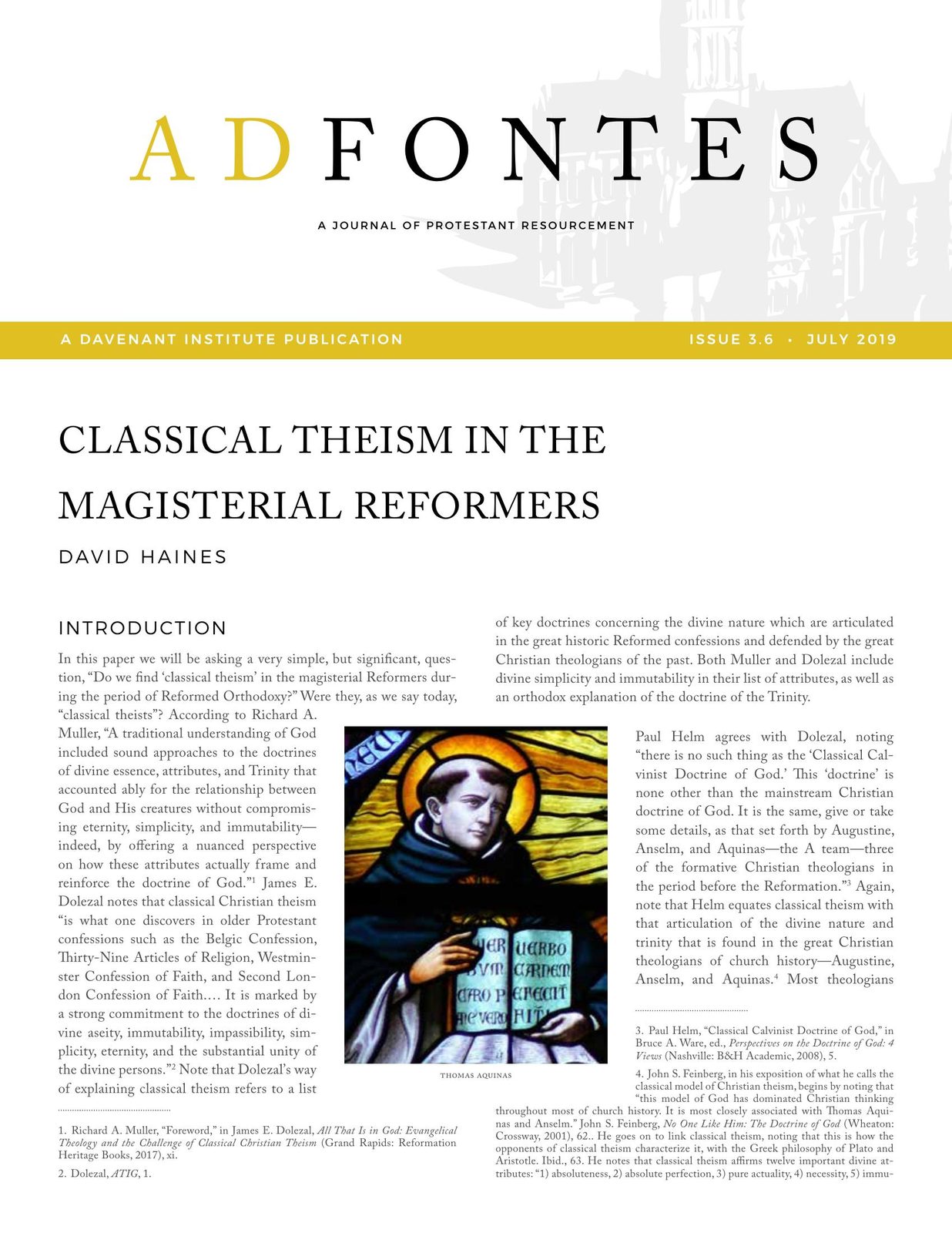
A DAVENANT INSTITUTE PUBLICATION ISSUE 3.6 • JULY 2019 ADFONTES A JOURNAL OF PROTESTANT RESOURCEMENT CLASSICAL THEISM IN THE MAGISTERIAL REFORMERS DAVID HAINES INTRODUCTION In this paper we will be asking a very simple, but significant, question, “Do we find ‘classical theism’ in the magisterial Reformers during the period of Reformed Orthodoxy?” Were they, as we say today, “classical theists”? According to Richard A. Muller, “A traditional understanding of God included sound approaches to the doctrines of divine essence, attributes, and Trinity that accounted ably for the relationship between God and His creatures without compromising eternity, simplicity, and immutability— indeed, by offering a nuanced perspective on how these attributes actually frame and reinforce the doctrine of God.” 1 James E. Dolezal notes that classical Christian theism “is what one discovers in older Protestant confessions such as the Belgic Confession, Thirty-Nine Articles of Religion, Westminster Confession of Faith, and Second London Confession of Faith.… It is marked by a strong commitment to the doctrines of divine aseity, immutability, impassibility, simplicity, eternity, and the substantial unity of the divine persons.” 2 Note that Dolezal’s way of explaining classical theism refers to a list 1. Richard A. Muller, “Foreword,” in James E. Dolezal, All That Is in God: Evangelical Theology and the Challenge of Classical Christian Theism (Grand Rapids: Reformation Heritage Books, 2017), xi. 2. Dolezal, ATIG, 1. of key doctrines concerning the divine nature which are articulated in the great historic Reformed confessions and defended by the great Christian theologians of the past. Both Muller and Dolezal include divine simplicity and immutability in their list of attributes, as well as an orthodox explanation of the doctrine of the Trinity. Paul Helm agrees with Dolezal, noting “there is no such thing as the ‘Classical Calvinist Doctrine of God.’ This ‘doctrine’ is none other than the mainstream Christian doctrine of God. It is the same, give or take some details, as that set forth by Augustine, Anselm, and Aquinas—the A team—three of the formative Christian theologians in the period before the Reformation.” 3 Again, note that Helm equates classical theism with that articulation of the divine nature and trinity that is found in the great Christian theologians of church history—Augustine, Anselm, and Aquinas. 4 Most theologians 3. Paul Helm, “Classical Calvinist Doctrine of God,” in Bruce A. Ware, ed., Perspectives on the Doctrine of God: 4 Views (Nashville: B&H Academic, 2008), 5. 4. John S. Feinberg, in his exposition of what he calls the classical model of Christian theism, begins by noting that “this model of God has dominated Christian thinking throughout most of church history. It is most closely associated with Thomas Aquinas and Anselm.” John S. Feinberg, No One Like Him: The Doctrine of God (Wheaton: Crossway, 2001), 62.. He goes on to link classical theism, noting that this is how the opponents of classical theism characterize it, with the Greek philosophy of Plato and Aristotle. Ibid., 63. He notes that classical theism affirms twelve important divine attributes: “1) absoluteness, 2) absolute perfection, 3) pure actuality, 4) necessity, 5) immuthomas aquinas
2 tend to agree that the term “classical theism” refers to a certain articulation of the divine nature that has been held by the great majority of Christian thinkers throughout the centuries, defended in their theological writings, and codified in the great creeds and confessions. For this paper, I will use the term “classical theism” to refer to that approach to the doctrine of God which makes the following claims concerning the divine nature and how it is known by us: 1. “We all believe with the heart, and confess with the mouth, that there is one only simple and spiritual Being, which we call God; and that he is eternal, incomprehensible, invisible, immutable, infinite, almighty, perfectly wise, just, good, and the overflowing fountain of all good.” 5 2. “We know him by two means: first, by the creation, preservation, and government of the universe; which is before our eyes as a most elegant book, wherein all creatures, great and small, are as so many characters leading us to contemplate the invisible things of God, namely, his eternal power and Godhead, as the Apostle Paul saith (Rom. i. 20). All which things are sufficient to convince men, and leave them without excuse. Secondly, he makes himself more clearly and fully known to us by his holy and divine Word; that is to say, as far as is necessary for us to know in this life, to his glory and our salvation.” 6 3. “According to this truth and this Word of God, we believe in one only God, who is one single essence, in which are three persons, really, truly, and eternally distinct, according to their incomtability, 6) impassibility, 7) timelessness, 8) simplicity, 9) omniscience, 10) omnipotence, 11) creation ex nihilo, and 12) incorporeality” (Ibid., 64). Edward Feser summarizes classical theism as follows: “classical theism is committed to a conception of God as that which is absolutely metaphysically ultimate–that is to say, as that which is ultimate in principle and not merely in fact–where this is taken to entail divine simplicity and thus divine immutability, impassibility, and eternity; to a doctrine of divine conservation on which the world is radically dependent on God for its existence at every instant; and (in the case of Thomists, anyway) to the doctrine that the terms we apply both to God and to the created order are to be understood in analogous rather than univocal senses. Its commitment to divine simplicity and to the implications of divine simplicity sets classical theism at odds with theistic personalism, ‘open theism,’ deism, process theology, and other more anthropomorphic conceptions of God” (Ed Feser, “Classical theism,” http:// edwardfeser.blogspot.com/2010/09/classical-theism.html). He later claims that classical theism is articulated by “classical writers like Plato, Aristotle, Plotinus, Augustine, Maimonides, Avicenna, Aquinas, and Scotus” and contemporary “writers like Barry Miller, David Braine, John Haldane, Brian Davies, David Conway, William Vallicella, David Oderberg, Christopher Martin, James Ross, and other writers in the Aristotelian, NeoPlatonic, and Thomistic and other Scholastic traditions.” D. Stephen Long summarizes the key doctrines of classical Christian theism as follows: “God is simple, perfect, immutable, impassible, infinite, eternal and one, who is revealed in three persons, Father, Son and Holy Spirit. God’s essence is one, yet each person is the essence. The Father is the essence. The Son is the essence and the Spirit is the essence. The Father, Son and Spirit are also the essence. Nonetheless, there is only one essence and three persons. The persons are distinguished by their relations” (D. Stephen Long, The Perfectly Simple Triune God: Aquinas and His Legacy [Minneapolis, MN: Fortress Press, 2016], xix). He goes on to note that classical theism, though often associated with Aquinas, is not unique to Aquinas. Rather, “Aquinas did not invent this answer; he developed it from authorities, especially Holy Scripture, Augustine, Dionysius, Hilary, John of Damascus, Boethius, Lombard, and others. He also drew on philosophers such as Aristotle, Plotinus, and Proclus. The answer is found throughout the Christian tradition, among Catholic, Orthodox, and Protestant theologians and confessions” (Ibid., xix–xx). 5. The Belgic Confession (1561), in Philip Schaff, The Evangelical Protestant Creeds, With Translations, vol. 3 of The Creeds of Christendom, 4th ed. (New York: Harper & Brothers, 1877), 383–84. 6. Belgic Confession, in Schaff, EPC , 384. municable properties; namely, the Father, and the Son, and the Holy Ghost. The Father is the cause, origin, and beginning of all things, visible and invisible; the Son is the Word, Wisdom, and Image of the Father; the Holy Ghost is the eternal Power and Might, proceeding from the Father and the Son.” 7 The purpose of this paper is primarily historical. We will show that the key magisterial Reformers from the 1500s to the 1700s adhered to, took for granted, and defended the key doctrines of classical theism as we have described them above. We will look specifically at how they understood the doctrine of divine simplicity and the personal relations in the Trinity. There are two key sources for this endeavor: (1) the Reformed confessions and catechisms composed in the sixteenth and seventeenth centuries, and (2) the writings of the Reformed thinkers of that period. The confessions and catechisms are particularly useful, as they were written to clearly articulate what the authors considered to be necessary doctrines for Christian orthodoxy. DIVINE SIMPLICITY AND THE TRINITY The doctrine of divine simplicity, simply put, is the negation of all composition in the divine nature, and the claim that the divine nature cannot enter into composition with any created thing (no created thing can be a composite part of the divine nature). As Aquinas puts it, God is (1) not corporal (he is not a body, and cannot be said to possess any of the types of composition which are predicated of bodies); (2) not composed of form and matter; (3) not composed of essence and subject (i.e., not an individual instantiation of some essence of which there could be many instantiations, as in “humanity” and “this particular human we call Socrates”); (4) not composed of essence and being or existence; (5) not composed of genus and specific difference; and (6) not composed of subject and accidents. He is, in fact, absolutely simple, 8 and does not enter into composition with any created thing. Aquinas articulates this conclusion as follows: “It is clear that God is in no way composed, but is absolutely simple.” 9 The doctrine of the Trinity affirms that there is one God, one divine essence or nature, in which are three persons: the Father, the Son and the Holy Spirit. The Father is God, the Son is God, and the Holy Spirit is God. Each person is distinct according to personal relation, but one according to essence. These two doctrines of simplicity and Trinity have sometimes been thought to contradict each other. How can God be absolutely simple and triune at the same time? 10 In what follows, we will consider how the early Reformers talked about these two doctrines, showing 7. Belgic Confession, in Schaff, EPC , 389. 8. It is interesting to note that the authority to which Aquinas appeals in his answer to the question, “whether God is absolutely simple,” is Augustine, who is quoted as saying, “God is truly and entirely simple.” 9. Thomas Aquinas, ST I, q. 3, a. 7, resp. My translation. In Latin: manifestum est quod Deus nullo modo compositus est, sed omnino simplex. 10. In fact, John Frame, in a recent book on natural knowledge of God, makes some claims which seem to compromise the absolute simplicity of the divine nature, in an attempt to make room for the Trinity. He says, “Of course, the Oneness must itself be many in some ways…the One cannot be a mere oneness, a conceptual blank, like the singular deities of Parmenides, Aristotle, the Gnostics, and Plotinus. For the One to be able to do this job, the One must be a great complexity of powers and thoughts, thoughts about THE KEY MAGISTERIAL REFORMERS FROM THE 1500S TO THE 1700S ADHERED TO, TOOK FOR GRANTED, AND DEFENDED THE KEY DOCTRINES OF CLASSICAL THEISM
3 that they thought the two doctrines needed to be affirmed together in order to maintain a coherent doctrine of God. THE EARLY REFORMERS ON DIVINE SIMPLICITY AND TRINITY Girolamo Zanchi Most early Reformers seem to have simply accepted the doctrine of divine simplicity as true and necessary for orthodoxy (especially for an orthodox articulation of the doctrine of the Trinity). Two early Reformers who have much to say on the subject are Girolamo ( Jerome) Zanchi (1516–1590) and John Calvin (1509–1564). We will begin with a brief consideration of Zanchi’s work on simplicity, as it will set the stage for Calvin’s thoughts about divine simplicity. Zanchi, in his De Religione Christiana Fides, provides a clear articulation of the early Reformed doctrine of God, illustrating how early Reformed theologians held divine simplicity and Trinity together. “Being then taught of God in the holy scripture,” Zanchi writes, “which is his word, we believe that there is but one God, that is, one most simple, indivisible, eternal, living, and most perfect Essence, subsisting in three Persons, to wit, the Father, the Son, and the Holy Ghost, being distinguished from each other, but yet without all manner of division. The author and cause of all things.” 11 In this short section we are told that the Holy Scriptures clearly teach that God is a “most simple, indivisible” essence “subsisting in three persons.” This reflects Zanchi’s argument in De Natura Dei that the doctrine of divine simplicity is necessary to protect against tritheism: 12 in an orthodox view of Trinity, the persons are distinct, but without any manner of division in the divine nature. In De Natura Dei, Zanchi begins his section on divine simplicity by noting that there are two questions we must discuss in relation to this doctrine, and he divides his analysis of divine simplicity accordingly: 13 other things, as well as of himself.” John Frame, Nature’s Case for God (Bellingham, WA: Lexham Press, 2018), 34. 11. Hieron Zanchius, The Whole Body of Christian Religion, trans. Ralph Winterton (London: John Redmayne, 1659), 13–14. 12. Hieronymi Zanchii, De Natura Dei, liber secundus, caput II (1576), 56. Here he states, “Ne verò quis putet, hanc de simplicitate Dei disputationem, supervacaneam atque inutilem esse: sciendum est, hanc doctrinam maximè necessariam esse, ad probandam unitatem divinae essentiae: eoque unum duntaxat esse Deum. Si enim probatum fuerit, essentiam divinam esse simplicissimam modis omnibus: necessariò efficientur, eam esse modis omnibus unam, & non plures.” 13. Zanchii, De Natura Dei, 56. “Primum, an Deus ita simplex fit, ut nulla prorsus in eum cadat compositio.” And, “Deinde, An Deus, praeterquam quòd causa est rerum omnium efficiens: in ipsarum etiam rerum compositionem, si non tanquam materia, saltem ut forma aliqua, veniat.” (1) whether God is truly simple, and (2) whether God enters into composition with created things. His answer for the first question is affirmative: “God is altogether (absolutely) simple, so that we cannot say he is in any way able to be composed.” 14 Zanchi answers the second question: “God does not enter into composition with the things he created For that reason, he is not the form of the heavens, nor of the whole world, much less is he the formal existence of any sort of thing.” 15 This twofold division of the question of divine simplicity clearly follows Thomas Aquinas’s approach in the Summa Theologiae, where he first demonstrates that God is absolutely simple, and then asks whether God enters into composition with any created thing. In support of his response to the first question, Zanchi first explains what is meant by simple and composed. 16 He begins by distinguishing two ways simplicity can be predicated: (1) properly and (2) figuratively or metaphorically. 17 Simplicity is properly attributed to something when that thing is not composed of different things, or is not at all composed. 18 However, says Zanchi, all things but God are composed of, at very least, act and potency, being and essence. 19 In the second sense, we say that things are said to be simple or composed in comparison with other “more composite” things. 20 For example, compared to human beings, angels are simple. Simplicity, therefore, is metaphorically or figuratively said of something when it is are simple in comparison to other things. 21 He discusses different ways in which simplicity is predicated metaphorically in Scriptures (whether it be in virtue, goodness, or sincerity), and says that God can be said to be simple in all of these ways. He goes on to argue that God is simple not only in these ways, but in every way. Zanchi turns our attention to John 4:24, which says that God is spirit. This, says Zanchi, not only determines how we should worship God, but also teaches us that the divine nature is spiritual and simple. 22 The link between spirituality and divine simplicity is one that will be found in just about every single Reformed articulation of divine simplicity. From this, says Zanchi, we learn that 14. Zanchii, De Natura Dei, 56. My translation. In Latin we read, “Deus ita prorsus est Simplex: ut nullo modo sit, aut dici possit compositus.” 15. Zanchii, De Natura Dei, 62. “Deus non venit in rerum, à se conditarum, compositionem: ac proinde neque est forma coeli, neque totius mundi: multò minùs est esse cuiusque rei formale.” 16. Zanchii, De Natura Dei, 56–57. 17. Zanchii, De Natura Dei, 56. 18. Zanchii, De Natura Dei, 56. “Simplex propriè dicitur, quod compositum ex diversus non est: & quò quid minus est compositum, eò etiam simplicius est, & appelatur.” 19. Zanchii, De Natura Dei, 56. 20. Zanchii, De Natura Dei, 57. 21. Zanchii, De Natura Dei, 57. 22. Zanchii, De Natura Dei, 57. In his discussion of divine simplicity, in De Religione Christiana Fides, Zanchi affirms that this doctrine is taught by Holy Scriptures. Cf. Hieron Zanchius, The Whole Body of Christian Religion, trans. Ralph Winterton (London: John Redmayne, 1659), 13–14. girolamo Zanchi
4 it must not be said of God that He is (or has) a body. From this it can be shown that God is not in any way composed: not composed of parts, nor of matter and form, nor of subject and accident. These are ways in which bodily things are said to be composed. 23 But, God is not corporeal, so He is not composed in these ways. He then notes that, as Paul says in Romans 1:19, the Gentiles had some knowledge of God. 24 The pagans knew, says Zanchi, that God was pure act, and, thus, without any composition. 25 He goes on to provide a number of arguments from reason which purport to demonstrate that God is absolutely simple. For the sake of space, we will only look at his first argument, which is based upon the relationship between parts and the composite whole. Zanchi begins with the claim that in any composite thing, the parts are prior to the composite. Now, no composite being can be the unifying cause of its own composite unity —of itself; for a thing cannot be the efficient cause of itself, as this would require it to be prior to itself. 26 God is eternal, which implies that there can be nothing prior to Himself. Therefore, God cannot, in any way, be composed of parts.27 Note how divine eternity is used to demonstrate divine simplicity. Zanchi, in De Religione Christiana Fides, states, furthermore, that the doctrine of divine simplicity entails that there is no real difference between the divine essence and his essential properties, and that the doctrine of divine simplicity protects the doctrine of the absolute distinction between the Creator and creation. “For we acknowledge, that in God, by reason of his simplicitie, his Essential Properties do not really differ from his Essence; and therefore that they cannot without this be communicated to any creature: And therefore, that no creature is, or can be truly said to be simply…omnipotent, good, just,” 28 and so on. Thus, from one point of view, divine simplicity must be affirmed in order to properly affirm other truths about God. From another perspective, thinks Zanchi, there are some doctrines which, if they are denied, compromise the truth of divine simplicity (which would entail the denial of the doctrines mentioned above). In his treatise known as The Doctrine of Absolute Predestination, Zanchi notes that all passions must be denied of God; otherwise, the simplicity, perfection, and independence of God are destroyed. “When love is predicated of God, we do 23. Zanchii, De Natura Dei, 57. “Quare hac dictione exemit Deum ab omnibus corporibus: atque ita demonstravit, eum non esse compositum, neque ex partibus integralibus, neque ex materia & forma, neque ex subjecto & accidente. Tales enim sunt compositiones omnium corporatarum.” 24. Zanchii, De Natura Dei, 57. “Denique Apostolus ad Rom. Probat cognitionem, quam Gentes habuerunt de Deo.” 25. Zanchii, De Natura Dei, 57. “Ethnici autem nouerunt, Deum esse actum purum, ab omni compositione prorsus remotum.” 26. This point actually seems to entail not only temporal priority, but ontological priority as well. 27. Zanchii, De Natura Dei, 57. “Si Deus non est prorsus simplex, sed aliquo modo compositus : ab aliquo compositus fit, ac proinde componente fit posterior, necesse est. Nihil enim seipsum componit : quia nihil potest sui ipsius esse efficiens causa : alioqui prius effet seipso. Est autem Deus ita aeternus, ut ante ipsum nihil fuerit, aut etiam fuisse excogitari possit : iuxta illud Iesaiae : Ante me nullus fuit, & post me non erit Deus. ” 28. Zanchius, WBCR, 15–16. not mean that he is possessed of it as a passion, or affection. In us it is such; but if, considered in that sense, it should be ascribed to the Deity, it would be utterly subversive of the simplicity perfection, and independency of his being.” 29 Zanchi also argues that double predestination must be affirmed in order to avoid denying God’s simplicity, which would overturn his very existence. 30 The doctrine of divine simplicity, of course, seems counter-intuitive. After all, as some have noted, power and grace are conceptually distinct attributes, and yet both are predicated of God. If divine simplicity is true, some might suggest, this seems to imply that in God the attributes “are” the same (in an absolutely simple being, all “qualities/ properties” must be identical with the essence, thus, God is his goodness, is his justice, and is his power), or, at the very least, the terms must “mean” the same thing (what is meant by “goodness” must be the same as what is meant by “the divine nature”)—which seems to create a conceptual problem. Zanchi explains that “although the great and everblessed God is a being absolutely simple, and infinitely remote from all shadow of composition: he is, nevertheless, in condescension to our weak and contracted faculties, represented in scripture, as possessed of divers[e] properties, or attributes, which, though seemingly different from his essence, are in reality essential to him, and constitutive to his very nature.” 31 The point, here, being that though there is no real distinction between the properties and the divine essence (God is his goodness, his justice, his power, etc.), it is by divine condescension that God predicates them of Himself in Holy Scriptures. The preceding considerations lead Zanchi, in his articulation of Christian doctrine, to condemn as heretical any claim which explicitly or implicitly introduces composition into the divine essence, as to do so either compromises the unity of the divine nature, or the Creator/creature distinction, and, thus, the very existence of God. “To conclude, we condemn also the errors of those, who separate the essential Properties of God from his divine essence: which they seem to us to do, whosoever do teach that they may be communicated to any creature, without the communication of essence, or indeed rather which teach that they are communicated already.” 32 John Calvin Though Calvin never discusses the doctrine of divine simplicity in any great depth, it does play a major role in his explanation of the doctrine of the Trinity, as he is concerned to properly define the doctrine of the Trinity in order to avoid the accusation that the simple divine nature is torn into three by the claim that God is triune. He says, “Again, lest anyone imagine that God is threefold, or think God’s simple essence 29. Jerom Zanchius, The Doctrine of Absolute Predestination Stated and Asserted, trans. Augustus Toplady (New York: George Lindsay, 1811), 107. 30. Zanchius, DAP, 119–20. 31. Zanchius, DAP, 69. 32. Zanchius, WBCR, 19–20. john calvin
5 to be torn into three persons, we must here seek a short and easy definition to free us from all error.” 33 For Calvin, therefore, the doctrine of divine simplicity must accompany the doctrine of the Trinity as a safeguard against tritheism. He understands divine simplicity as follows: “The essence of God is simple and undivided, and he contains all in himself, without portion or derivation, but in integral perfection.” 34 It is worth pointing out the conjunction of the terms “simple” and “undivided.” In some early Reformers, we do not always find them using the term “simple” to speak of God, but we frequently find the term “undivided” used in the same sense as simple. 35 Among later Reformers, we find other terms used to convey the same notion such as “purity,” “sincerity,” “uncompoundedness,” and lack of “mixture.” 36 Other early Reformers, such as John Knox, clearly affirmed divine simplicity and used it to protect against heretical portrayals of the divine nature. 37 The early Reformed theologians may not have developed an in-depth doctrine of divine simplicity, but they did see it as essential for maintaining Christian Monotheism and the Christian doctrine of the Trinity. Indeed, this doctrine, for Calvin, is a necessary part of Reformed Orthodoxy, as we learn from a letter to the King of France in which Calvin briefly lays out a Reformed confession of faith, saying, “In the first place, we believe in one God, of a simple essence, and yet, in which there are three distinct persons, as we are taught in the Holy Scriptures, and as the doctrine has been laid down by ancient councils.” 38 Though Calvin does not go into the same detail as Aquinas, it is evident that his view of divine simplicity is essentially the same as that which was expounded by Augustine and Aquinas, and other early and medieval church theologians. 39 33. John Calvin, Institutes of the Christian Religion, bk. 1, ch. xiii, 2, trans. Ford Lewis Battles, ed. John T . McNeill (1960; repr., Louisville, KY: Westminster John Knox Press, 2006), 1:122. 34. Calvin, ICR, bk. 1, ch. xiii, 2, 1:122. 35. Cf. Heinrich Bullinger, The Decades of Henry Bullinger: The first and second decades, trans. H. I., ed. Thomas Harding (Cambridge: The University Press, 1849), 24–25. Here, Bullinger says, “Openly professing the unity in the Godhead; neither confound we the persons, nor divide the substance” (my italics). Martin Luther also uses similar terminology to talk of God: “There are not three Gods, nor three substances, as three men, three angels, three sons, three windows, &c. No: God is not separated or divided in such manner in his substance, but there is only and alone one divine essence, and no more. Therefore, although there be three persons, God the father, God the Son, and God the Holy Ghost, yet notwithstanding, we must not divide or separate the substance: for there is but only one God, in one only undivided substance” (my italics). Martin Luther, The Table Talks of Martin Luther, trans. and ed. William Hazlitt (London: H. G. Bohn, 1857), 75. See also John Jewell, The Apology for the Church of England (New York: Henry M. Onderdonk, & Co., 1846), 31. 36. Cf. John Flavel, The Righteous Man’s Refuge, in The Whole Works of John Flavel (Lon don: W. Baynes and Son, 1820), 3:376. 37. Cf. Knox argues, for example, that “as God in his eternal Godhead is simple and one, so is his will in respect of himself from all beginning simple and one.” John Knox, On Predestination, in vol. 5 of The Works of John Knox, ed. David Laing (Edinburgh: Johnstone and Hunter, 1856), 314. 38. John Calvin, “Letter CCCCLXXX—to the King of France, October 1557,” in Letters of John Calvin, ed. Jules Bonnet, trans. Marcus Robert Gilchrist (Philadelphia: Presbyterian Board of Publication, 1858), 3:373. 39. Kurt Anders Richardson notes, concerning Calvin’s doctrine of the Trinity, that “the section in the Institutes (I.13) on the Holy Trinity reflects the late medieval, scholastic background…Calvin reflects the Western tradition of the doctrine in embracing as normative formulations by Augustine, Hilary, and Jerome.” Kurt Anders Richardson, “Calvin on the Trinity,” in Sung Wook Chung, ed., John Calvin and Evangelical Theology: Legacy and Prospect (Louisville, KY: Westminster John Knox Press, 2009), 33. Wilhelm Yet, we might ask, should we not also reform the doctrine of God? Calvin goes on to explain why it is important to maintain the same or similar terms which were used by the ancient theologians who defended the doctrine of the Trinity against heretics. He begins by warning, “If, therefore, these terms were not rashly invented, we ought to beware lest by repudiating them we be accused of overweening rashness.” 40 Having noted that even the church fathers did not necessarily agree concerning the best terms to use in discussing the Trinity,41 Calvin warns that we need to be careful not to fall into an ancient heresy from the desire to use novel terms or ways of talking about God. 42 He concludes that it is better to use the traditional, more precise language, than to give in to those who wish to use novel but more ambiguous and untested terms to speak of God. He says, “But I have long since and repeatedly been experiencing that all who persistently quarrel over words nurse a secret poison. As a consequence, it is more expedient to challenge them deliberately than speak more obscurely to please them.” 43 For Calvin, then, there is no reforming of this doctrine, nor of the terms we use to articulate and defend it. 44 Indeed, “Therefore, let those who dearly love soberness, and who will be content with the measure of faith, receive in brief form what is useful to know: namely, that, when we profess to believe in one God, under the name of God is understood a single, simple essence, in which we comprehend three persons, or hypostases.” 45 Niesel says, “Calvin does not use his knowledge of Scripture to produce any original description of the being of God.” (Wilhelm Niesel, The Theology of Calvin, trans. Harold Knight [London: Lutterworth Press, 1956], 54). Niesel say, later, “Calvin took over from the early church fathers the doctrine of the Trinity with all the theological equipment which accompanied it.” (Ibid., 56). Though Calvin gave ultimate priority to the Bible, in the formulation of doctrine, he did not neglect the writings of those theologians that came before him. Rather, as John H. Leith has noted, “Calvin read Scripture at least in part as the church had read it before him. He counted it theological wisdom to take seriously the judgment of great theologians and more particularly the great church councils, however subordinate they were to the authority of Scripture” ( John H. Leith, “Calvin’s Awareness of the Holy and the Enigma of his Theology,” in E. J. Furcha, ed., In Honor of John Calvin, 1509–64: Papers from the 1986 International Calvin Symposium: McGill University [Montreal: International Calvin Symposium, 1987], 223). Richard A. Muller notes that though there has been some debate about whether or not Calvin’s doctrine of God is indeed in line with the traditional doctrine of God, the evidence weighs heavily on the side of those who see Calvin as adhering to and teaching the classical doctrine of God, as found in the church fathers, and especially in Augustine and Aquinas. Richard A. Muller, “Calvin on Divine Attributes: A Question of Terminology and Method” ([Westminster Theological Journal 80 (2018)]: 199–218). He specifically notes the important place given by Calvin to divine simplicity (Ibid., 216). Richard Stauffer also notes that, despite his stance towards tradition, when it comes to the doctrine of God and the Trinity, “il traite le dogme trinitaire d’une manière qui est tout à fait conforme aux definitions de l’Eglise ancienne.” Richard Stauffer, Dieu, la création et la Providence dans la prédication de Calvin ([Bern, Frankfurt, Las Vegas: Peter Lang, 1978], 158). Stauffer notes that he affirms both divine simplicity and Trinity. Note, also, B. B. Warfield’s comments concerning the language Calvin uses when talking about the Trinity. B. B. Warfield, “The Doctrine of the Trinity,” in Calvin and Calvinism, vol. 5 of The Works of Benjamin B. W arfield, ed. John E. Meeter ([Grand Rapids: Baker, 2000], 211). 40. Calvin, ICR, bk. 1, ch. xiii, 5, 1:125–26. 41. Calvin, ICR, bk. 1, ch. xiii, 5, 1:126–27. 42. Calvin, ICR, bk. 1, ch. xiii, 5, 1:127–28. 43. Calvin, ICR, bk. 1, ch. xiii, 5, 1:128. 44. Richardson notes, concerning the doctrine of the Trinity and related doctrines, that Calvin “would not countenance any hint of defection from these doctrines” (Richardson, “Calvin on the Trinity,” 32). 45. Calvin, ICR, bk. 1, ch. xiii, 20, 1:144. THE TRADITIONAL DOCTRINE OF GOD—THAT GOD IS ABSOLUTELY SIMPLE AND TRIUNE—IS TO BE ACCEPTED AS SUCH, AND MUST BE ACCEPTED AS SUCH, IN ORDER TO AVOID HERESY.
6 The traditional doctrine of God—that God is absolutely simple and triune—is to be accepted as such, and must be accepted as such, in order to avoid heresy. “Indeed, if we hold fast to what has been sufficiently shown above from Scripture—that the essence of the one God is simple and undivided, and that it belongs to the Father, the Son, and the Spirit; and on the other hand that by a certain characteristic the Father differs from the Son, and the Son from the Spirit—the gate will be closed not only to Arius and Sabellius but to other ancient authors of errors.” 46 It should be clear that Calvin accepts the doctrine of divine simplicity as such—God is not in any way composed— because, for Calvin, it is a necessary defense against tritheism and the ancient heresies of Arius, Sabellius, and others. EARLY CONFESSIONS ON DIVINE SIMPLICITY It is worth noting that though explicit articulations of the doctrine of divine simplicity are somewhat scarce in the writings of the early Reformers, this is not an indication that they rejected this doctrine. Rather, even a brief look at the early confessions that were written by or under the authority of these early Reformers reveals that they all held this doctrine in high esteem— as, in fact, necessary for orthodoxy. The Augsburg Confession (1530), reflecting the authoritative teaching of the Lutheran churches, prepared by Philip Melanchthon, and approved by Martin Luther, states “that there is one divine essence which is called and is God, eternal, without body, indivisible [without parts].” 47 The French Confession of Faith (1559), prepared by John Calvin and his associates, says, “We believe and confess that there is but one God, who is one sole and simple essence, spiritual, eternal, invisible, immutable, infinite, incomprehensible, ineffable, omnipotent; who is all-wise, all-good, all-just, and all-merciful.” 48 The ThirtyNine Articles of the Church of England (1562) begins with the statement, “There is one living and true God, eternal, incorporeal, without parts, impassible, immensely powerful, wise and good: the creator and preserver of all things visible and invisible. And in the unity of this divine nature are three persons, the same in essence, power, and eternity, Father, Son, and Holy Spirit.” 49 These three confessions represent 46. Calvin, ICR, bk. 1, ch. xiii, 22, 1:147. 47. The Augsburg Confession, a. 1, in Philip Schaff, Evangelical Protestant Creeds, vol. 3 of The Creeds of Christendom, 4th ed. (New York: Harper & Brothers, 1877), 7. Italics are mine. 48. The French Confession of Faith, a. 1, in Philip Schaff, Evangelical Protestant Creeds, vol. 3 of The Creeds of Christendom, 4th ed. (New York: Harper & Brothers, 1877), 359–60. Italics are mine. 49. The Thirty-Nine Articles of the Church of England, 1, in Philip Schaff, Evangelical Protestant Creeds, vol. 3 of The Creeds of Christendom, 4th ed. (New York: Harper & the Reformed Churches aligned with Calvin, the Lutheran churches, and the Church of England. Later Protestant confessions, such as the Belgic Confession (1561), Helvetic Confession (1566), Irish Articles of Religion (1615), The Westminster Confession (1647), the Second London Baptist Confession (1689). and others, continued to hold together the doctrines of divine simplicity and Trinity. We observe, in this short survey of important Protestant confessions of faith from the sixteenth and seventeenth centuries, (1) that the main early magisterial Reformers—as they summarized their theology in the Augsburg Confession, the French Confession, and the Thirty-Nine Articles—clearly adhered to divine simplicity and thought that it was a necessary part of the orthodox articulation of the divine nature. The later confessions show (2) that the later representatives of the magisterial Reformation did not innovate the doctrine of divine simplicity but remained faithful to the articulation of the divine nature that the earlier Reformers passed on to them. It is worth noting that from the 1530s on, we begin to see more and more in-depth articulations of divine simplicity and the importance it plays in the affirmation of Christian monotheistic trinitarian theology. 50 A short list of key protestant thinkers, aside from Calvin, Luther, Bullinger, Jewell, and Knox, who affirmed both a strong doctrine of divine simplicity and an orthodox articulation of Trinity, would include: Peter Martyr Vermigli (1499– 1562), 51 Zacharias Ursinus (1534– 1583, the primary author of the Heidelberg Catechism), 52 Philippe de Mornay (1549–1623), 53 Richard Hooker (1554–1600), 54 William Brothers, 1877), 487-8. Italics are mine. My translation. In Latin we read, “Unos est vivus et verus Deus aeternus, incorporeus, impartibilis, impassibilis, immensae potentiae, sapientiae ac bonitatis: creator et conservator omnium tum visibilium tum invisibilium. Et in Unitate huius divinae naturae tres sunt Personae, eiusdem essentiae, potentiae, ac aeternitatis, Pater, Filius, et Spiritus sanctus.” 50. This may be partially due to the fact that the early Reformers did not have time to deal with these doctrines, focused as they were on the doctrines of soteriology and ecclesiology. This may also be partially due to the fact that they did not see this doctrine as controversial, accepting the various ways in which it was articulated by the late medieval theologians. 51. Vermigli emphasizes that there is a difference between the being of God in itself, and how it is understood by men, when he notes that “even so men, after a sort, do perceive the nature and infinite substance of God by these parts and titles to know him by, not that there be any parts in God, but because that we only by such effects & parts may gather of his power & infinite greatness.” Pietro Martyr Vermigli, The Common Places, trans. and ed. Anthonie Marten (1574), 99–100. 52. Zacharias Ursinus, The Commentary of Dr. Zacharias Ursinus, on The Heidelberg Catechism, trans. G. W. Williard, 4th ed. (Cincinatti, OH: Elm Street Printing Co., 1888), 131–32, 138. Cf. Lyle Bierma, “The Heidelberg Catechism,” Tabletalk (Apr. 1, 2008). https://www.ligonier.org/learn/articles/heidelberg-catechism/. 53. Cf. Philippe de Mornay, A Woorke Concerning the Trewnesse of the Christian Religion, trans. Philip Sidney Knight and Arthur Golding (London: Thomas Cadman, 1587), 16, 48, 57. 54. Cf. Richard Hooker, Ecclesiastical Polity, bk. 1, sect. 2, in The Ecclesiastical Polity and Other Works of Richard Hooker, ed. Benjamin Hanbury (London: Holdsworth and Ball, 1830), 1:72–73. Richard Hooker, Ecclesiastical Polity, bk. 5, sect. 51, in The Ecclesiastical martin luther
7 Perkins (1558–1602), 55 Richard Sibbes (1577–1635), 56 Thomas Adams (1583–1652, an important and eloquent Puritan theologian), 57 Edward Reynolds (1599–1676, Westminster Divine and Puritan theologian), 58 Edward Leigh (1602–1671, Anglican theologian), 59 Nathaniel Culverwell (1619–1651, a Puritan theologian and natural law theorist), 60 Thomas Watson (1620–1686), 61 Francis Turretin (1623–1687), 62 Stephen Charnock (1628–1680), 63 John Flavel (1630– 1691),64 Thomas Ridgley (1667–1734), 65 and many more. These are some of the key Protestant theologians from the first generation of Reformers to the middle of the seventeenth century. Polity and Other Works of Richard Hooker, ed. Benjamin Hanbury (London: Holdsworth and Ball, 1830), 2:172–73. 55. Cf. William Perkins, An Exposition of the Symbole, or the Creed of the Apostles, in The Works of William Perkins rev. ed. (London: John Legatt, 1635), 1:121, 128, 130. William Perkins, The Golden Chaine, in The Works of William Perkins, rev. ed. (London: John Legatt, 1635), 1:11, 14. 56. Cf. Richard Sibbes, “Commentary on 2 Corinthians, ch. 1, v. 12,” in The Complete Works of Richard Sibbes, ed. Alexander Balloch Grosart (Edinburgh: James Nichol, 1862), 3:230, 233. Richard Sibbes, “Bowels Opened,” in The Complete Works of Richard Sibbes, ed. Alexander Balloch Grosart (Edinburgh: James Nichol, 1862), 2:79. 57. Thomas Adams, Meditations upon the Creed, in The Works of Thomas Adams (Edinburgh: James Nichol, 1862), 3:97. Here he says, “God is an essence spiritual, simple, infinite, most holy…(2) Spiritual: he hath not a body, nor any parts of a body, but is a spirit, invisible, indivisible. (8.) Simple, we are all compounded; God is without composition of matter, form, or parts.” Cf. Adams, Meditations upon the Creed, 3:117, 132, 148. 58. Edward Reynolds, The Staves of Beauty and Bands, in The Whole Works of Edward Reynolds, ed. B. Riveley (London: B. Holdsworth, 1826), 5:421. Here he says, reflecting the Thomistic enumeration of the ways in which God is not composed, “as God is one by the absolute simplicity of his nature, without any diversity of part and part, power and act, matter and form, subject and accident, being and not being.” 59. Edward Leigh, A Treatise of Divinity in three volumes (London: E. Griffin, 1646), 1:2. He discusses contemplative theology, noting, “That part of Theology which treateth of God and his Nature, of his Simplicity, Eternity, Infinitenesse, is altogether contemplative.” Cf. Leigh, TD , 2:2, 19, 22, 24. Leigh also seems to rely on Aquinas’s approach to simplicity: denying, of God, a body or corporality, essence and faculties, subject and accident, nature and qualities. Cf. Leigh, TD , 2:24. Later, confirming this observation, Leigh says the following, “God is most simple, Ens Simplicissumum. Simplicity is a property of God, whereby he is void of all composition, mixtion and division, being all essence; whatsoever is in God, is God. Simpleness is the first property in God, which cannot in any sort agree to any creature. This is proved that God is Simple, by removing from him, all kinds of composition, which are five. 1. Of quantitative parts, as a body. 2. Of essential parts, matter and form, as a man consists of soul and body. 3. Of a genus and difference, as every species. 4. Of subjects and accidents, as a learned man, a white wall. 5. Of act and power, as the Spirits” (Leigh, TD , 2:26). Leigh goes on affirm absolute simplicity and support it from Scripture and to use divine simplicity as a motivation to personal holiness and purity of heart (Leigh, TD , 2:26–27). 60. Nathaniel Culverwell, Of the Light of Nature: A Discourse, ed. John Brown (Edinburgh: Thomas Constable and Co., 1857), 276. Here he refers to “that most simple and pure essence of God himself.” 61. Cf. Thomas Watson, A Body of Practical Divinity (Glasgow, Edinburgh, London: Blackie & Son, 1859), 27, 28, 590. 62. Cf. Francis Turretin, Institutes of Elenctic Theology, trans. George Musgrave Giger, ed. James T . Dennison Jr. (Phillipsburg, NJ: P&R Publishing, 1992), 1:191–94. In Francis Turretin we find clear definitions of what is meant by divine simplicity, and a number of arguments by which he seeks to establish the truth of divine simplicity. His dependence on the Thomistic development of divine simplicity is evident. 63. Stephen Charnock, The Existence and Attributes of God, in The Works of Stephen Charnock (Edinburgh: James Nichol, 1864), 1:264ff. Charnock is one of those theologians who, like Turretin, dedicates a great deal of time to articulating and defending the doctrine of divine simplicity. That God is Spirit (a truth claim found in John 4:24), implies, for Charnock, that God is not composed of any bodily or quantitative parts. Exodus 3:14 is used to introduce the notion of simplicity. Simplicity, for Charnock, is intimately related to divine infinitude. 64. Cf. John Flavel, A Treatise of the Soul of Man, in The Whole Works of John Flavel (London: W. Baynes and Son, 1820), 2:492. John Flavel, The Righteous Man’s Refuge, in The Whole Works of John Flavel (London: W. Baynes and Son, 1820), 3:376. John Flavel, Antipharmacum Saluberrimum, in The Whole Works of John Flavel (London: W. Baynes and Son, 1820), 4:524. 65. Cf. Thomas Ridgley, A Body of Divinity, ed. John M. Wilson (New York: Robert Carter & Brothers, 1855), 1:86, 128–32, 143–48. CONCLUSIONS CONCERNING DIVINE SIMPLICITY AND THE TRINITY There can be no doubt, therefore, that the great majority of Magisterial Reformers of the 1500s to the 1700s affirmed divine simplicity and divine Trinity. In our introduction, we noted that classical theism refers to a certain articulation of the divine nature which includes, at least, divine simplicity and Trinity. Thus far the magisterial Reformers fit clearly within the classical theistic framework. A key theme among the early theologians, writing in the early sixteenth century (Zanchi, Calvin, Bullinger, Luther, Knox, and Jewell) is that the doctrine of divine simplicity is a necessary protection against tritheism, and against any other heretical claim which might insert composition into the divine nature (e.g., Knox notes the error of some who use divine simplicity to suggest two distinct wills in God). Most of these early Reformers simply accepted divine simplicity as true, without argument, and included this doctrine in their confessions. Zanchi, goes into greater detail than most of the others, presenting numerous arguments, both from Scripture and from reason, to demonstrate that God is absolutely simple. When we turn to those theologians who were writing near the end of the sixteenth century and throughout the seventeenth century, we begin to see clearer articulations of just what is meant by divine simplicity (Turretin, Leigh, and Charnock, for example, give robust explanations of the doctrine), of its use in theology, and defenses of the doctrine. Different theologians saw divine simplicity as interrelated with different divine attributes, such as spirituality (sometimes expressed as immateriality or incorporeality), perfection, infinitude, eternity, and immutability. Some of these theologians note that the doctrine of divine simplicity, though not explicitly stated in Scripture, can be supported by some Scriptural references. They also note that we know divine simplicity through rational reflection on created things. Some theologians also used the doctrine of divine simplicity to motivate personal sanctification and purity—as there is no mixture in God, there should be no mixture of evil in us. David Haines (PhD. in philosophy, Universit é Laval) lives with his wife and their 4 children in Qué bec. David is associate professor of philosophy and religion at VIU, associate professor of ethics at SEMBEQ, and has taught history of Christian Apologetics at FTE-Acadia. He is also the founding president of Association Axiome, an association of French Evangelical scholars, and the Christian Philosophy and Apologetics Center. His academic research focuses on Ancient and Medieval metaphysics, C. S. Lewis, Thomism, and natural theology. THERE CAN BE NO DOUBT, THEREFORE, THAT THE GREAT MAJORITY OF MAGISTERIAL REFORMERS OF THE 1500S TO THE 1700S AFFIRMED DIVINE SIMPLICITY AND DIVINE TRINITY.
8 FORMING MANLY CHARACTER WITH SAMUEL COLERIDGE SHANE WALKER There is a swirling constellation of thoughtful friends who write appreciatively of Samuel Taylor Coleridge (1772–1834). This include the likes of W. G. T . Shedd (1820–1894), brilliant Congregationalist systematic theologian turned extremely light-handed Presbyterian; C. S. Lewis, whom I strongly suspect wrote Till We Have Faces from a suggestion of Coleridge; and then C. Fitzsimons Allison, former Bishop of the Episcopal Diocese of South Carolina. 1 I thus picked up Aids to Reflection in the Formation of a Manly Character, on the Several Grounds of Prudence, Morality, and Religion: Illustrated by Select Passages from our Elder Divines, Especially from Archbishop Leighton, written by Coleridge.2 You should do the same. It’s brilliant, witty, memorable, and as far as I can tell almost completely sound in broad outline. Coleridge is best known as the author of the Rhyme of the Ancient Mariner and being a laudanum addict. He limited his opium intake and, through a series of non-poetic works written before his death, recorded his insights in traveling from a pantheistic Unitarian as a young man to a mostly evangelical Anglican at the end of his life. Aids to Reflection was designed to assist young philosophically oriented pastors and lay leaders in the Church of England to overcome modernity and believe and teach “the faith once handed down to the saints.” Yet, Coleridge never quite got over being one of the enfants terribles of English verse. There’s a streak of self-indulgent obscurantism in the aging bard. Contemporary poet Lord Byron commented acidly in Don Juan, “Coleridge, too, has lately taken wing… Explaining metaphysics to the nation—I wish he would explain his Explanation.” 1. C. Fitzsimons Allison, The Rise of Moralism: The Proclamation of the Gospel from Hooker to Baxter (Vancouver: Regent College Publishing, 2003), 195. Bishop Allison’s The Rise of Moralism finally pushed me over to read Coleridge seriously. The Rise of Moralism traces how liberals become self-righteous prigs and conservatives become legalist ticks—we do so by denying the evangel and adopting moralism. Allison mentions Coleridge as one of the few theologians who noticed the decline in Anglicanism and traced the retrograde to incipient forms of Socinianism found in the writings of folks like Jeremey Taylor and George Bull (see Allison, ibid, 192-3). 2. Samuel Taylor Coleridge, Aids to Reflection and the Confessions of an Inquiring Spirit (London: G. Bell and Sons, Ltd., 1913). Coleridge excused or defended his obscurity as a virtuous exercise in character building. Thus, the Formation of a Manly Character requires side steps into complex meditations and explanations on grasping figurative language in the Bible, the relationship between understanding and animals, quirky and possibly accurate lexical conclusions on the New Testament Greek and how concursus functions, a roughshod critique of Hegel’s dialectic in the footnotes (I think), and at least one joke or insult for or at his reader buried in a four page long footnote.3 Regardless of the accuracy and brilliance of Coleridge’s philosophical and theological sagacity, he was not at all a systematic builder. He must be read in the light of Shedd’s warnings in Literary Essays, 4 because there are scattered problems on the inspiration of Scripture and how he describes the Trinity and the atonement—none of which kept him from confessing the orthodox creeds within the Church of England, but not at all edifying if held systematically. Aids to Reflection was designed for a particular kind of reader. And Coleridge was willing to force you to become that reader or give up the project. There is a method, but it is based on the heuristic device of aphorisms. Below is my attempt to organize Coleridge into a system independent of the aphorisms. I’ve done so to tempt you to become Coleridge’s reader and to justify my own high praise as well as that of other much better men than myself. HISTORIC IMPORTANCE OF THE WORK Shedd describes Coleridge as, “the first Englishman at the beginning of the century, to combat the materialism of Hartley, Priestly, and the French Encylopaedist; and at the close of the century, the distinctions which he laid down, and the positions which he maintained, are still 3. Ibid., 148–152. 4. William G. T . Shedd, “Coleridge as a Philosopher and Theologian,” in Literary Essays (reprint, 1999; Charles Scribner’s Son, 1878). samuel taylor coleridge