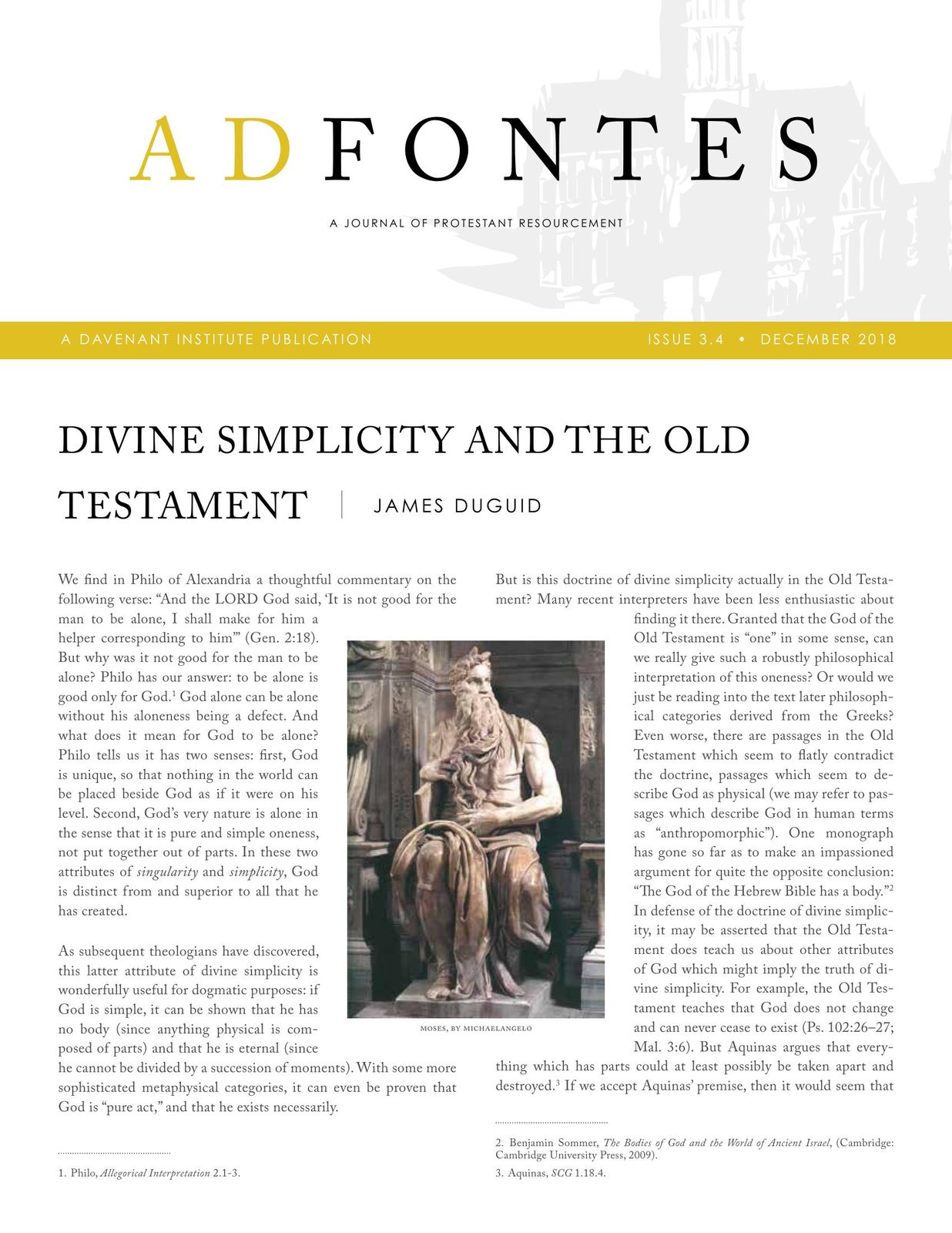
A DAVENANT INSTITUTE PUBLICATION ISSUE 3.4 • DECEMBER 2018 ADFONTES A JOURNAL OF PROTESTANT RESOURCEMENT DIVINE SIMPLICITY AND THE OLD TESTAMENT JAMES DUGUID We find in Philo of Alexandria a thoughtful commentary on the following verse: “And the LORD God said, ‘It is not good for the man to be alone, I shall make for him a helper corresponding to him’” (Gen. 2:18). But why was it not good for the man to be alone? Philo has our answer: to be alone is good only for God. 1 God alone can be alone without his aloneness being a defect. And what does it mean for God to be alone? Philo tells us it has two senses: first, God is unique, so that nothing in the world can be placed beside God as if it were on his level. Second, God’s very nature is alone in the sense that it is pure and simple oneness, not put together out of parts. In these two attributes of singularity and simplicity, God is distinct from and superior to all that he has created. As subsequent theologians have discovered, this latter attribute of divine simplicity is wonderfully useful for dogmatic purposes: if God is simple, it can be shown that he has no body (since anything physical is com posed of parts) and that he is eternal (since he cannot be divided by a succession of moments). With some more sophisticated metaphysical categories, it can even be proven that God is “pure act,” and that he exists necessarily. 1. Philo, Allegorical Interpretation 2.1-3. But is this doctrine of divine simplicity actually in the Old Testa ment? Many recent interpreters have been less enthusiastic about finding it there. Granted that the God of the Old Testament is “one” in some sense, can we really give such a robustly philosophical interpretation of this oneness? Or would we just be reading into the text later philosoph ical categories derived from the Greeks? Even worse, there are passages in the Old Testament which seem to flatly contradict the doctrine, passages which seem to de scribe God as physical (we may refer to pas sages which describe God in human terms as “anthropomorphic”). One monograph has gone so far as to make an impassioned argument for quite the opposite conclusion: “The God of the Hebrew Bible has a body.” 2 In defense of the doctrine of divine simplic ity, it may be asserted that the Old Testa ment does teach us about other attributes of God which might imply the truth of di vine simplicity. For example, the Old Tes tament teaches that God does not change and can never cease to exist (Ps. 102:26–27; Mal. 3:6). But Aquinas argues that every thing which has parts could at least possibly be taken apart and destroyed.3 If we accept Aquinas’ premise, then it would seem that 2. Benjamin Sommer, The Bodies of God and the World of Ancient Israel, (Cambridge: Cambridge University Press, 2009). 3. Aquinas, SCG 1.18.4. Moses, by Michaelangelo
2 if God cannot be destroyed, he cannot have parts either. But if this is true, what should we do with all these passages that speak of the power of God’s “strong arm” (Ex. 13:9), or his feet (24:10), or de scribe him like an old man (Dan. 7:9)? The traditional answer, from Aristobulus to Augustine to Calvin, is to say that these passages are metaphorical. God is not like us: the full reality of who God is towers above our ability to understand it, and so if we read two passages, one of which says that God is like us in some way, and the other which says that God is not like us in the same way, the first must be metaphorical and the second literal. This in no way implies that these metaphors are to be dispensed with: indeed, since God is always beyond our comprehension, we will always need these meta phors to understand how he relates with the world. But we should not understand them in a way that contradicts what the negative passages have to say about how God is different from us. We may refer to this interpretive strategy as the “metaphor strategy.” This defense of divine simplicity runs into two important objections. First, one can ask whether the pas sages cited in defense of traditional divine attributes such as immutabil ity deserve such a strong interpreta tion: perhaps the prophets did not wish to claim that God was abso lutely immutable, but just that he has an unchanging character. Here the specter of philosophy and the Bible raises its head: is the text really making strong metaphysical claims, as later readers have interpreted it to do? Second, we may wonder what justifies the interpretive strategy of taking certain passages as metaphor ical. Is this not simply a betrayal of the text? Doesn’t the text teach both that God doesn’t change (Mal. 3:6), and that he sometimes changes his mind (e.g., Gen. 6:6–7)? Doesn’t it teach that he has no visible form (Deut. 4:12), but also that he appeared to many Old Testament saints (e.g., Genesis 18)? Who says we should read the Bible ac cording to this interpretive strategy? At its strongest, this objection becomes the claim that there is no one coherent theology in the Old Testament at all, simply a collection of contradictory viewpoints. It would be naive to think that the debate over divine simplicity could be solved simply through careful study of the Old Testament. This goes both for those who would defend divine simplicity as well as those who would refute it—either way, it is not simply a matter of reading what the text says, but of finding a principled way to harmonize the texts, and to work out their implications in rigorous ontological terms. A complete discussion of divine simplicity would require: ⑴ the witness of the New Testament, not least because it includes some very handy proof texts for the construction of a clas sical doctrine of God, ⑵ an understanding of the dogmatic develop ment of the doctrine of the Trinity in the face of numerous heresies, without which the Christian doctrine of divine simplicity could not have become what it is, and ⑶ an elaborated metaphysics, not in deed as a principle governing Scripture, but worked out in submis sion to Scripture as a tool to understand its full implications. This is beyond the scope of this article. What I hope to accomplish instead is to show ⑴ that the claims made about God in the Old Testament are quite strong indeed, and that it is reasonable to take them in a metaphysically serious way, and ⑵ that already in the Old Testa ment itself we find authors reflecting on the tensions mentioned above, and adopting something like the “metaphor strategy.” To see this, we will also need to tell the story of God’s singularity or uniqueness in the Bible: we will be unable to understand what sort of God we find in the Bible unless we grapple with the unprecedented claim that there is really only one of him. We might approach the question of God’s uniqueness in the Old Testament by listing some of the strongest claims made about his nature. So we might start with the divine name given to Moses, expressed in the four letters YHWH, together with the explication of this name in Exodus 3:14 as “I am that I am,” or “I am the one who I am.” Admittedly, the meaning of the verb here is ambiguous, leading to the claim that it could be translated “I will be what I will be,” or even “I will become what I will become,” meanings which seem less conducive to the idea of an im mutable God. But these proposals do not give due weight to the same idea expressed in an entirely verbless construction in Deuteronomy 32:39 (translated by the ESV as “I, even I, am he,” but correctly understood and translated by the Septuagint as “I am”). Since there is no verb in this construction, it seems best to inter pret the idea in both cases as one of continuous existence, without any implication of time or process. We should be careful about immediately filling this mysterious “I am” revelation of God with all the content of “Being” on a Parmenidean or Platonist construal. Nevertheless, this construction does ascribe existence to God’s nature in some special way, unconditioned by any other predicate, and the idea that God is in some sense more really and truly existent than other things doesn’t seem too far off the mark here. In addition to this language, we also have the description of God as one: “Hear O Israel, the LORD our God, the LORD is one” (Deut. 6:4), or alternatively interpreted, “the LORD is our God, the LORD alone.” We also find language expressing God’s uniqueness through the claim that no other god is like him: “Who is like you, O LORD, among the gods?” (Ex. 15:11). Furthermore, we find language stating that there is no god with or beside God, i.e., on his level (Deut. 32:39). However, it is not enough simply to cite these formulae to under stand what biblical monotheism is. Readers may be surprised to know that all the above phrases have good parallels in polytheistic literature predating the composition of the whole Old Testament. “Who is like you?” is a frequent refrain in Ancient Near Eastern hymns, language of the god as “one,” “unique,” and “without equal” are abundant in Egyptian texts, and even the phrases “I am as my
3 self ” and “I am the one who is” are attested.4 If these phrases can be used in openly polytheistic contexts, perhaps they are just hyperbole, and we should not understand them as strong claims in the Bible either? But here as everywhere, context is vital. While these formulae exist, and indeed were probably invented as hyperbolic claims in polythe istic texts, they have the potential to be understood literally in the Bible. That this is so can be seen by putting these formulas in the wider context of how God is understood in the Old Testament. In this respect, what is not said, and what is claimed not to be the case, is as important or even more important than what is said to be the case. Most importantly, the God of the Old Testament has no backstory and no personal his tory. He was not born, and there is no story about where he came from. When one reads a text like Genesis 1, the first question that should spring to mind is “What was God doing before he created the world?” And the fact that we do not get an answer to this is one of the main points of the passage. Most other creation stories in the Ancient Near East are theogonies as much or more than cosmogo nies—they tell us not just where the world came from, but where the gods came from. But the God of the Bible does not come into existence, he does not even bring himself into existence (as the Egyptian sun god is sometimes said to have done). Likewise, the God of the Bible does not die, as Ancient Near Eastern gods such as Baal Hadad or Osiris some times did. Just as importantly, the God of the Old Testament has no wife. This is all the more striking when we consider that the pantheons of sur rounding nations were modeled on the family, with a god-goddess pair from whom the other gods were produced. In these pantheons, there may be one god who is most venerable or most powerful, but he accomplishes his tasks with the aid of a whole society of gods who surround him, upon whom he is dependent. But the God of the Old Testament is removed from this matrix of social relationships, and does not need the help of other gods to create the world or maintain his supremacy. 4. For language of uniqueness in Egyptian religion, see Jan Assmann, Egyptian Solar Religion (London: Kegan Paul International, 1995), pp. 68-70, 111-2, 134-6; Erik Hornung, Conceptions of God in Ancient Egypt: The One and the Many (Ithaca: Cornell University Press, 1982), 184-185; Jan Assmann, Moses the Egyptian (Cambridge Mass.: Harvard University Press, 1997), 168-207. The phrase “I am as myself ” is attested in the Book of the Heavenly Cow (see Charles Maystre, Le livre de la vache du ciel dans les tombeaux de la vallée des rois, BIFAO 40 (1940), p.84), and the phrase “I am the one who is” is attested in the Papyrus of Nu (see Günther Lapp, Catalogue of Books of the Dead in the British Museum I: The Papyrus of Nu (BM EA 10477) (London: Trustees of the British Museum, 1997), pl. 56). While we will have more to say about whether God has a body be low, we should note that unlike other Ancient Near Eastern gods, the God of the Bible does not eat or drink, he does not sleep (Ps. 121:4), nor does he grow weary (Isa. 40:28). And perhaps most strik ingly, God does not have a penis. It may never have occurred to the reader to be surprised at this fact, but gods like El from Ugarit or AmunRe most certainly do have penises, very large ones in fact. The sexuality of the gods plays an important role in their understanding in the Ancient Near East, and yet the God of the Old Testament is completely de-sexualized. We might also note that terms like “flesh” and “blood” which can be attributed to gods in the Ancient Near East (along with several other bodily fluids) are never attributed to God in the Old Testament. Perhaps the most important context for the formulas of God’s uniqueness, though, is that these formulas occur in the context of a radical demotion of the other gods. We see this first of all in the claim that God has triumphed over the gods of the nations in the exodus (Ex. 12:12), and it is in this context that we find the claim, “Who is like you, O LORD, among the gods?” ( 15:11). While the gods of Egypt are still referred to with the word ‘god,’ their inferiority to the LORD has been powerfully demonstrated. This demotion is dramatized in Psalm 82. The psalm begins with God stand ing in the divine council, among all the other gods. So far there is nothing here to distinguish this scene from what we might find in the context of any other Ancient Near Eastern pantheon—the language of God standing, rather than sitting on throne, might even lead one to believe that he is just another member of the assembly, rather than supreme over it! Let me suggest that this is quite inten tional on the part of the author—he is preparing us for the surprise in verse 6. After God takes his stand to denounce the injustice of the gods, we find out in verses 6–7 that these gods will die like mortal men! Rather than just being another god, albeit an unusually power ful one, God is so exalted above the other gods that they look like men in comparison to him. We could say that the distance between God and the other gods is even greater than the difference between mortal men and these powerful heavenly beings. The development of this theme reaches its strongest pitch in Isaiah 40–55, where the gods turn out not even to be worthy of the label “god.” This word must only be applied to the true God (44:6; 45:5, 21). In all this, the supreme evidence of God’s supremacy is that he is the one who has created the world (vv. 11–12, 18). The God who created the whole world without the help of others also reigns supreme over every thing he has made. THE GOD OF THE OLD TESTAMENT HAS NO BACKSTORY AND NO PERSONAL HISTORY.
4 In light of these contrasts, we should appreciate that the formulas about God being one and unique and without equal are not simply borrowed from the surrounding cultures as hyperbolic compliments, but are placed in a context where they can be understood for the first time in their full force. We should also notice that these ideas are connected to each other. So in Isaiah, the “I am” formula oc curs several times (43:4; 46:4; 48:12) in the same context with the language about God’s uniqueness as God, as well as language about the fact that God alone is the Creator of the world. And in Psalm 102:25–27, we find a similar phenomenon. The phrase often trans lated “You are the same” in verse 27 is just another example of the “I am” construction, only here in the second person: “you are.” So here in these verses, we find several ideas connected: that God is the Creator, that he is the one who really exists, and that in contrast to the world, God endures without changing or end. Remarkably, the equation between “true being” and changelessness, so often credited to the Greek philosophers, seems already to have been made here in the Old Testament. To summarize our discussion so far, we al ready see in the Old Testament an associa tion of several themes: God as Creator, God as unique, God as independent, God as the one who truly is, God as enduring forever without change. These themes are associated with each other in the context of a shift in the understanding of God that understands him as categorically unique, beyond com parison to other so-called “gods.” All of this argues for a strong interpretation of the for mulas used to describe this God. It doesn’t predetermine that they should be understood in line with every assumption of, say, an Aristotelian account of be ing. But it does open up the possibility of putting them in dialogue, and suggests that in at least some cases—especially the association of changelessness and being—there might be room for some agree ment. But what about the passages where God seems to have a body? Can they really be explained by appeal to a “metaphor strategy”? Let’s start by looking at the evidence. We may leave aside passages which use clearly metaphorical tropes like God’s “strong arm”—such tropes are metaphorical even when used of humans. Rather, we should fo cus on what Old Testament scholars call “theophany”—an actual appearance of God. Mark Smith distinguishes three different “bo dies” of God which can be found in Old Testament theophany. 5 In the first category, we have passages which speak about God as if he just had a normal human body. The most significant example is Genesis 18. In verse 1, we are told that “the LORD appeared” to Abraham, but in verse 2 we read that Abraham lifted up his eyes and saw “three men.” There is no indication that there is anything strange about these three “men” which would tip Abraham off to the fact that one of them is God; he must discover this in the course of their conversation. 5. Mark Smith, “The Three Bodies of God in the Hebrew Bible,” in Where the Gods Are: Spatial Dimensions of Anthropomorphism in the Biblical World (New Haven: Yale University Press, 2016). In the second category, we have descriptions of a superhuman body of exceptional size. In Isaiah 6, we are given no clear picture of God, but we are told that he is seated on a throne, and that the train of his robe fills the whole temple. In Exodus 33:22, God’s “hand” is said to be large enough to cover Moses’s body in the cleft of a rock. Smith distinguishes this from a third category where God’s body takes on cosmic dimensions. “Heaven is my throne, and the earth is my footstool” (Isa. 66:1)—this implies a far greater scale than the vision of God in Isaiah 6, which merely filled the whole temple. Something on this scale is also envisioned by Ezekiel 1, where the figure of God towers above the firmament of the heavens. Furthermore, there is diversity in what these “bodies” look like. In Genesis 18, it would seem that God looks like a regular man; in Daniel 7:9, like an ancient man with white hair; and in Ezekiel 1, as a luminous figure like fire and glowing metal. And then of course there are passages where no human-like form is seen at all, merely a pillar of cloud and fire (Ex. 13:21), or what is simply described as the “glory,” like fire and cloud (24:17; 40:34–35; 1 Kings 8:10–11). The point to notice is the incongruity of all these different images if they are taken liter ally. If God does have a body, what size is it? Does it contract or expand at will? Or rather, as Sommer suggests, does God have multi ple bodies? Or is the incongruity a clue that none of these visions of God’s “body” should quite be taken at face value? On top of all this, some passages seem to as sert that there are no spatial limitations on God’s presence at all. In his prayer at the dedication of the temple, Solomon says, “But will God really dwell on earth? Look, the heaven and the highest heavens cannot contain you, how much less this house which I have built?” (1 Kings 8:27). And we read in Psalm 139, “Where shall I go from your Spirit? And where shall I flee from your presence? If I should go up to heaven, you are there, if I should make my bed in Sheol, there you are. If I should take the wings of the morning, and dwell at the end of the sea, even there your hand shall lead me, and your right hand shall hold me” (vv. 7–10). If these passages do not quite say that God’s presence cannot be circumscribed in defined limits, they come close. There is another important reason to think that visions of God might not portray him as he literally is, and that is the insistence of Deuter onomy 4:12 to the people of Israel that at Mount Sinai: “You did not see a form, only heard a voice.” Now, this verse is sometimes taken as a plain denial that God has a form at all, but it is at least imaginable that God could have a form which the people are never allowed to see. There are good Egyptian parallels for the idea of a god with a secret name and form, without implying that the god does not have a name or a form at all. 6 However, the assertion of Deuteronomy 6. See Jan Assmann, Egyptian Solar Religion (London: Kegan Paul International, 1995), pp. 70-72. IT IS DIFFICULT TO INTERPRET THIS PASSAGE IN A WAY WHICH DOES NOT CALL INTO QUESTION THE LITERALNESS OF EVERY THEOPHANY IN THE OLD TESTAMENT.
5 4:15 takes on its most pointed meaning when it is put side-by-side with the account from Exodus 24:9–11, which states that the elders of Israel did in fact see God on Mount Sinai. The reference to God’s “feet” in verse 10 make it clear that this was an anthropomorphic vision. But if Deuteronomy 4:15 is to have any force, these elders cannot have beheld God in his true form. Indeed, the argument of Deuteronomy 4:15–16 that Israel should not try to make an image of God since they have never seen his form would lose all its force if the vision in, say, Daniel 7 could be considered a revelation of God’s true form, and thus a pattern for image-construction. It is difficult to interpret this passage in a way which does not call into question the literalness of every theophany in the Old Testament. So we have a real tension between these passages which describe the vision of God in something like a human form, and Deuteronomy 4:12, 15–16, which insists that the Israelites have not seen God’s form. It might help us if we could appeal to the “metaphor strategy,” if we could see a certain di vine irony at work in God’s appearances as man. Is there any evidence from the Old Testament itself to suggest the appropriateness of such an interpretation? Indeed there is. Later au thors of the Old Testament were aware of some of the tensions in their Bible and worked to understand them. For instance, Genesis 6:6 and Exodus 32:4 say that God relented from or regretted a past decision. But Numbers 23:19 insists that “God is not a man, that he should lie, or the son of man, that he should relent.” And 1 Samuel 15 brings these two statements together: verses 11 and 35 bracket the story with the claim that God relented from making Saul king over Israel. But in the middle of the passage, in verse 29, Samuel insists that “the Glory of Israel cannot lie and cannot relent, for he is not a man that he should relent.” Some interpreters have claimed that Samuel is sim ply wrong, as admittedly prophets sometimes are in the Bible. But not only is Samuel just quoting Moses here, this is also as good an example as you can get of fulfilled prophecy: Samuel says that God will not change his mind about removing the kingdom from Saul, and sure enough, the kingdom is removed. It seems that the author wants us to take Samuel’s prophecy seriously: while the author him self has told us and will tell us again that God relented, he wants us to know that God doesn’t actually relent, because he is not a human being. It is only a short step from here to the conclusion that when the author says that God has relented, he is describing him as if he were a man, although in fact he is not. Returning to the theme of God’s embodiment, or lack thereof, there is good evidence that this is best understood as metaphor too. One interesting observation is that different rules are in play for poetry than for prose. While we do have visions of God which look like a human, it is striking that we never see God portrayed in prose with animal features. However, it is alright to compare God to, say, an eagle in poetry (Ex. 13:2; Deut. 32:11). And even the image of a bull’s horns, which would be dangerously close to the bull-idolatry which always tempted Israel, is acceptable in the form of a simile: “God is the one who brings them out of Egypt, like the horns of a wild ox for them” (Num. 23:22). We must also mention metaphor, or more exactly simile, in con nection to Ezekiel 1. While this theophany does describe God as if he had a human form, every effort is made to distance this vision from straightforward literal ness. What the passage actu ally says is that Ezekiel sees “a likeness as an appearance of a man” (v. 26); he describes what is above “the appear ance of his loins” as “like the appearance of fire” (v. 27), and the whole vision is char acterized as “the appearance of the likeness of the glory of the LORD” (v. 28). Ezekiel refuses to commit himself to the literalness of his vi sion of God, and in his use of “like/as,” “likeness,” and “appearance,” he is perhaps the first to deploy the meta phor strategy to deal with the problem of God’s embodied theophany. There is one last Old Testament text which bears most heavily on the question of divine irony: Exodus 33–34. In this text we find the highest experience of God anywhere in the Old Testament. That’s not just my opinion. Num bers 12:6–8 tells us, “If there should be a prophet among you, it is in a vision that I shall make myself known to him, in a dream that I shall speak to him. Not so my servant Moses, in all my house he is faithful. Mouth to mouth I speak with him, clearly, and not in riddles; he beholds the form of the LORD.” Here the clarity and di rectness of Moses’s relationship with God is extolled above all other Old Testament prophets. While the Israelites may not have beheld God’s form on Mount Sinai, Moses has. Here we have, on the Old Testament’s own terms, the clearest vision of God in its pages. What then does this vision consist in? In Exodus 33, Moses asks God that he may see his glory. God agrees, but he says, “You cannot see my face, for man may not see my face and live” (v. 20). Moses is permitted to stand in the cleft of the rock, and to be covered with God’s hand. Only after God’s glory The g iving of T he l aw on MounT sinai, fro M Doré’s english b ible 1866
6 has passed by will he be allowed to see God’s back. As a cloud covers the mountain and God passes by, he calls out the Old Testament’s basic creed: “The LORD, the LORD, a compassionate and gracious God, slow to anger, and abounding in mercy and truth, who keeps covenant love for thousands, who forgives iniquity and transgression and sin, who will certainly not acquit the guilty, who avenges the iniquity of the fathers on the children and on the children’s children to the third and fourth generation” (34:6–7). We often hear from the advocates of an embodied God the appeal to return to the plain, literal meaning of the text. But here, in the clear est and most distinct perception of God in the Old Testament, we find thick cloud, hiddenness, and a glance at the back of a disappear ing glory. What we have more clearly is the divine word, a promise that this God we can barely comprehend is a God of love and justice. If we allow this passage to control our theology of the Old Testa ment, perhaps we will be more open to the idea that the experience of God in the Bible is submerged in irony. God is, after all, “a God who hides himself ” (Isa. 45:15). We cannot see God as he is, and so he comes to us speaking baby-talk, wrapping his glory in the cloud so that we are not consumed. It is not some passages and some theophanies which are so masked, but every theophany and every passage. If some visions of God seem much clearer, such as that of Abraham by the oaks of Mamre, where God appeared like a regular man, this may be because Abraham saw God much less clearly than Moses, not because he saw him better. Moses, the greatest prophet of the Old Testament, should teach us not to be to confident that we have truly seen and grasped God’s form within its pages. We may conclude by asking just what we are supposed to do with the Old Testament. What shall we do with this book of glory and cloud, of majesty and riddles? The easy answer here—too easy—is to fragment it into the contradictory theologies of a merely human authorship. With this answer, every text means precisely what it says, provided we have the grammar and the history to figure it out. But suppose it is all one God talking? Then the same God who is “I am,” changeless and eternal, is the same God who disguised Himself as a human to catch Abraham and Sarah by surprise, the same God who would only let Moses see his back through a cloud, the same God who showed himself to Ezekiel in the likeness of an appearance. What should we do if there is such a God, and the Old Testament is his letter to us? Probably be ready for some surprises. Be ready to talk in metaphors and poetry about something that is too big to comprehend. Maybe even be ready for the biggest surprise of all: that this God should become precisely the opposite of what he is, by taking on a human nature. That God should become a man, while all the while remaining just as much God, is either the most ironic thing he has ever done, or the least ironic—depending on how you look at it. But we won’t be ready for this irony at all unless we can learn from the Old Testament that this God of ours is not so dull and literal as to be bounded by our experience of him. He is always more than the parts we would have him play. He is beyond anything to which we might compare him. He is outside the horizons we try to set him against. He evades the lines with which we would divide him. Hear O Israel, the LORD our God, the LORD is one. James Duguid (MDiv, Westminster Theological Seminary) is a PhD stu dent in Semitic and Egyptian Languages and Literatures at the Catholic University of America, and a candidate for ministry of the Presbyterian Church in America.
7 What follows is part 1 of a translation of Moïse Amyraut’s (1596– 1664) Dissertatio de oeconomia trium personarum in operibus di vinis…, or, A Dissertation on the Economy of the Three Persons in the Divine Works, one of four texts Amyraut published in his (in) famous Dissertationes theologicae quat uor (Saumur, 1645) 1 as a direct response to Frederich Spenheim the Elder’s (1600– 1649) Disputatio de gratia universali (Leiden, 1644). The well-known history of the ensuing debate, with its polemic, need not be recounted here; the text below, as a translation of a primary source, may stand on its own merits or otherwise. I hope, Lord willing, to translate the remaining portion of this dissertatio in a forthcoming part 2. —RM Hurd (1) 2 Though it’s true—and theological schools generally accept it—the works of the divine 3 that occur external to the di vine’s essence4 are common to the three persons, still, it’s likewise most espe cially true that some distinction among the works the persons carry out comes into play in their production. 5 This was the reason our churches’ Confession assigned these works to each of these persons—as it were, their roles in the deed about to be done. 6 The Confession reads, “The Father is the first cause, principium, and origin of all things; the Son, his Word and eternal Wisdom; the Holy Spirit, his strength, 7 power, and efficacy.” So, because there are chiefly three 1. I have, for purposes here, remained unconcerned about making this a translation of anything like a critical edition. The text I have used, dated 1715 and prepared by Joachim Lange (1670–1744), professor of theology at Halle (1709–1744), is available at the everhelpful prdl.org. 2. Tr. note: The paragraph numbers throughout this piece are original. 3. Opera Numinis. Tr. note: Throughout I have rendered “numina” as “divine”; it occurs quite frequently. 4. Extra ipsius essentiam. 5. Intercedere. 6. Veluti partes in operando. 7. Virtus. notable works of God, and such are those to which all God’s works are referred—namely, creation, the liberation of the Israelite people from Egypt, and finally redemption, together with their respec tive covenants these individual works are attendant to—thus, it’s worthwhile to know what the concept of this distinction 8 in all these works is. It’s this concept that lies between 9 the works of the divine persons according to their economy. (2) To begin with the first work, we can consider the work of creation (a) either as it has become known to us from reve lation that occurred by the Word of God, or (b) as it could become known from right reason’s use, if one has brought himself well and fittingly to contemplate this subject absent any help from revela tion. If we consider the work of creation in the first way, we can easily discern the following. First, the world was created by the Father, seeing that 10 he, having been stirred forth out of his good will, 11 undertook to donate existence 12 to the world, existence it didn’t have before. Second, we note the world was framed 13 by the Son, inasmuch as he’s the Father’s eternal Wisdom, whose council—like in leadership and administration—on the world to be framed was both wisely taken and fittingly ordered for execution. Finally, we discern the Holy Spirit was so skilled 14 in his creation that the Spirit’s infinite force and power actually brought into effect 15 the counsel arranged and administrated by Wisdom. The Father’s work in that admirable, 8. Ratio discriminis. 9. Quod…inter divinarum personarum operationes interest. 10. Quatenus. Tr. note: Could be “insofar as,” or the equivalent. Sic throughout the next several lines. 11. Bonae suae voluntatis impulsu. 12. Esse. 13. Esse conditum. 14. Versatum esse. 15. Effectum revera daretur. A DISSERTATION ON THE ECONOMY OF THE THREE PERSONS IN THE DIVINE WORKS BY MOÏSE AMYRAUT, TRANSLATED BY RYAN HURD Por TraiT of Moïse aMyrauT , ar Tis T unKnown
8 incomprehensible dispensation was such that it’s fitting we consider him as principium and first cause, the origin these things flow forth from. Solomon witnesses the Son’s work was what it was, when he called him “Wisdom” (Proverbs 8)—as it were, he who presided over the framing of all things. The apostle John witnessed likewise; obviously considering the beginning of Genesis so frequently re minds us God spoke so that this or that came to be, John termed the Son the Λογος, without whom absolutely nothing was made that’s said to be made. Finally, it’s plainly the case the Holy Spirit’s work in creation was such because (a) he’s said to move about over the waters like birds who nest their eggs usually do and because (b) all the extraordinary, miraculous works and those in which some un usual, infinite power bares itself—all these the Scripture throughout attributes to the Spirit of God as their cause, by whose assistance God works all things. (3) Now, per certain parts of revelation, though creation is common to the three persons, it’s still referred to the Father by a specific, particular concept. 16 Further, with respect to that 17 act of divine will by which force18 God’s first led such that he deems to create the world, whatever the Son per formed in this creation as Word and Wis dom, this he did in some way dependently on the Father. 19 This is why Hebrews 1:1 says the Father created the world through the Son. We see likewise what the Holy Spirit worked in creation, in that he acted not only dependently on the Father, but the Son also. This is because we can say either person created the world through the Spirit; but nobody ever said the Son or Spirit didn’t frame the world through the Father. For this reason, if one’s mind 20 is to respond to the question, “who created the world,” through some thought or, as they say, through some concept, which is ac curately referred to this economy, then it’ll be absolutely necessary for that concept to have different parts or different moments. The first and most remarkable of these will rightly go to the Father, and the remaining two that pick out the Son and Holy Spirit will only follow and as it were depend on the first antecedent part. (4) But, if we leave to one side the revelation of sacred Scripture and consider the creation of the world insofar as the matter could become known absolutely by right reason contemplating it, then I don’t think there will be anybody who denies that the world’s frame 21 exhibits some indubitable arguments for the divine attri butes, as we usually see causes in their effects; however, no certain 16. Praecipua quadam ratione. 17. Quod. 18. Vi. 19. Praeterea quod enim actus ille voluntatis divinae, cuius vi Deus primum inductus est, ut mundum creare designaret, quicquid Filius in eo egit, quatenus λογος est & Sapientia, id egit aliquo modo dependenter a Patre. 20. Animus. 21. Machinam. marks22 of the distinction of the divine persons exists therein. Now I’m not ignorant of the fact that among older and more recent theologians and their discoveries there were once and even now can be found some who try to discover quite a lot of images of the most blessed Trinity in the nature of things. Despite this, if you consider the case a bit more carefully, you’ll easily notice almost everything they observed in this category (whatever it is) isn’t just not based on a solid foundation, but doesn’t have even the appearance of truth. 23 For that reason, we ought to hold this exercise much more as a game smart people play, toying by no means circumspectly enough about a matter that ought strictly to be handled with particular rever ence, rather than as serious, weighty reasonings some certain, firm knowledge is supported by. Furthermore, even if something by these reasonings in this category were found that would have founda tion in the nature of things, there’s still such an immense difference between these two: finding some images in the nature of things of the teaching you already learned from the revelation of the divine word; and arriv ing, without this revelation, at knowledge of this teaching with the help and assistance of contemplation alone of things that pres ent some obscure simulcra of the teaching rather than actual evidences. 24 Take to be the case it’s not foreign to the truth that the figure of a square has such proportion with a circle that they may be comeasured between themselves, and permit that some one were indulged to come upon knowledge of this proportion by some inspiration or other extraordinary revelation. If both these two stand, I think it’d by no means be hard for them to deduce— after a painstaking work—whatever pertains to this knowledge in the method or reasoning, partly by having insisted upon Euclidean principles, and partly from drawing out conclusions from them. This would be such that it’d finally be obvious the one who espe cially excels would leave off the geometry of that hopeless truth like seeds in some proposition of theirs. 25 (5) If before Adam sinned or received the promise of redemption he’d been taught from revelation something of the mystery of the Trinity, then he possibly gathered some evidences of this mystery in the nature of things. Should he have been without this “something,” it seems to me utterly certain and beyond doubt such a mystery would escape his intelligence and wisdom no matter what study in contemplating things he’d have engaged in. So whatever he could know about the nature of the divine from contemplating the na ture of other things, all this was compiled as his knowledge of the 22. Nullos certos…characteres. 23. Speciem quidem ullam…veritatis. 24. Documenta. Tr. note: Sic throughout. 25. Tr. note: This is a tough section to understand and grapple with, not to mention translate. What Amyraut is saying here, in modern terms, is if we came upon a mathematical method by a stroke of (divine!) genius for doing something we didn’t think was possible before, then after this discovery it probably wouldn’t be hard to see that older ways of thinking were disposable like seeds—at least for those smart enough to notice! And, the key, we’d then dispose of those outdated methods, or at least not backtrack and use them gleefully instead of our new super-method. NOW, PER CERTAIN PARTS OF REVELATION, THOUGH CREATION IS COMMON TO THE THREE PERSONS, IT’S STILL REFERRED TO THE FATHER BY A SPECIFIC, PARTICULAR CONCEPT.