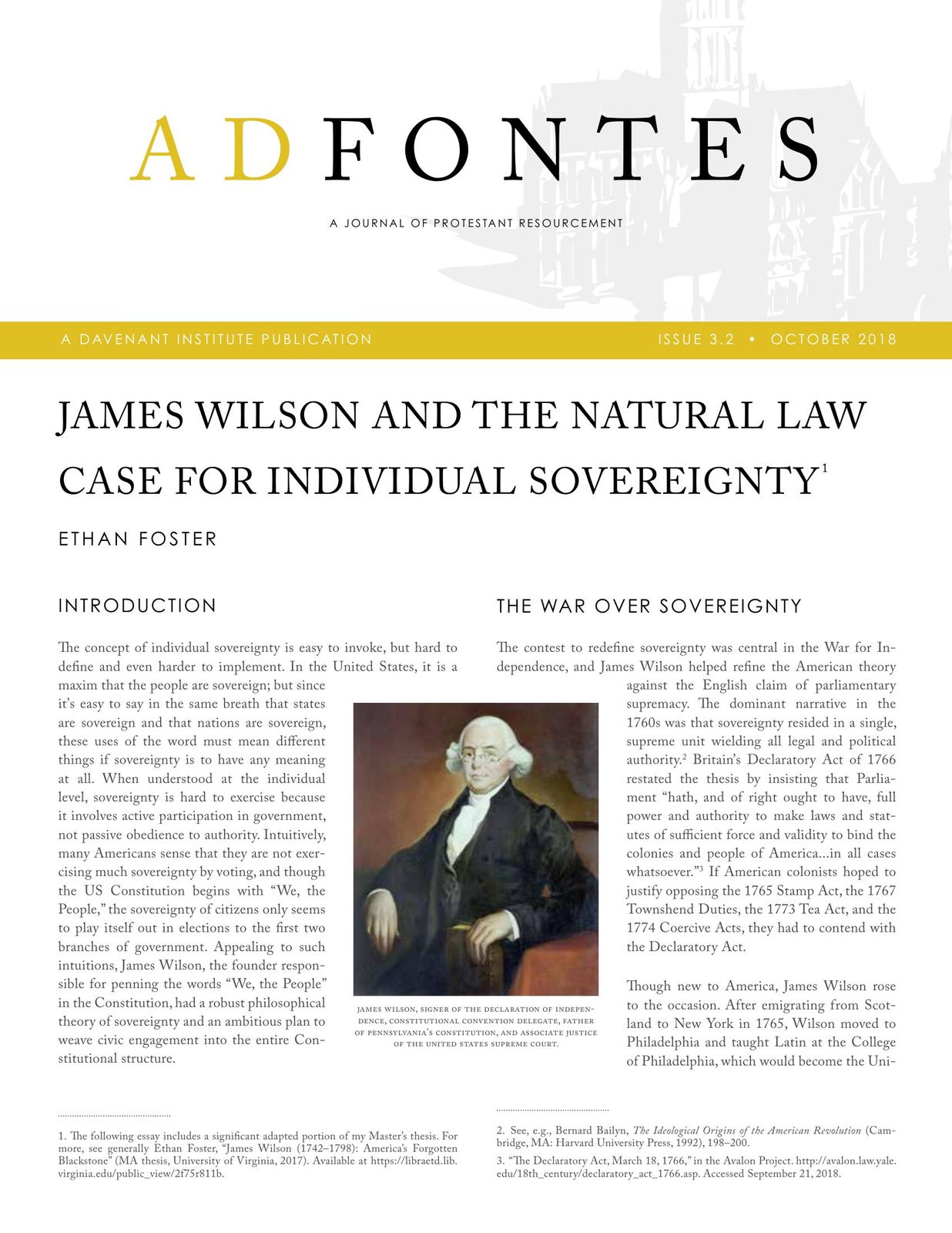
A DAVENANT INSTITUTE PUBLICATION ISSUE 3.2 • OCTOBER 2018 ADFONTES A JOURNAL OF PROTESTANT RESOURCEMENT JAMES WILSON AND THE NATURAL LAW CASE FOR INDIVIDUAL SOVEREIGNTY 1 ETHAN FOSTER INTRODUCTION1 The concept of individual sovereignty is easy to invoke, but hard to define and even harder to implement. In the United States, it is a maxim that the people are sovereign; but since it’s easy to say in the same breath that states are sovereign and that nations are sovereign, these uses of the word must mean different things if sovereignty is to have any meaning at all. When understood at the individual level, sovereignty is hard to exercise because it involves active participation in government, not passive obedience to authority. Intuitively, many Americans sense that they are not exercising much sovereignty by voting, and though the US Constitution begins with “We, the People,” the sovereignty of citizens only seems to play itself out in elections to the first two branches of government. Appealing to such intuitions, James Wilson, the founder responsible for penning the words “We, the People” in the Constitution, had a robust philosophical theory of sovereignty and an ambitious plan to weave civic engagement into the entire Constitutional structure. 1. The following essay includes a significant adapted portion of my Master’s thesis. For more, see generally Ethan Foster, “James Wilson (1742–1798): America’s Forgotten Blackstone” (MA thesis, University of Virginia, 2017). Available at https://libraetd.lib. virginia.edu/public_view/2f75r811b. THE WAR OVER SOVEREIGNTY The contest to redefine sovereignty was central in the War for Independence, and James Wilson helped refine the American theory against the English claim of parliamentary supremacy. The dominant narrative in the 1760s was that sovereignty resided in a single, supreme unit wielding all legal and political authority. 2 Britain’s Declaratory Act of 1766 restated the thesis by insisting that Parliament “hath, and of right ought to have, full power and authority to make laws and statutes of sufficient force and validity to bind the colonies and people of America…in all cases whatsoever.” 3 If American colonists hoped to justify opposing the 1765 Stamp Act, the 1767 Townshend Duties, the 1773 Tea Act, and the 1774 Coercive Acts, they had to contend with the Declaratory Act. Though new to America, James Wilson rose to the occasion. After emigrating from Scotland to New York in 1765, Wilson moved to Philadelphia and taught Latin at the College of Philadelphia, which would become the Uni2. See, e.g., Bernard Bailyn, The Ideological Origins of the American Revolution (Cambridge, MA: Harvard University Press, 1992), 198–200. 3. “The Declaratory Act, March 18, 1766,” in the Avalon Project. http://avalon.law.yale. edu/18th_century/declaratory_act_1766.asp. Accessed September 21, 2018. James Wilson, signer of the Declaration of inD epen Dence, constitutional convention D elegate, father of p ennsylvania’s constitution, anD a ssociate Justice of the u niteD s tates supreme court.
2 versity of Pennsylvania. 4 He then studied law under John Dickinson and was admitted to the bar in 1767. 5 Wilson then became a successful lawyer and penned an early critique of parliamentary sovereignty in defense of the Revolution in 1774. 6 Wilson’s essay predated the Declaration of Independence, but it had similar language: “[a]ll men are, by nature, equal and free: no one has a right to any authority over another without his consent: all lawful government is founded on the consent of those who are subject to it: such consent was given with a view to ensure and to increase the happiness of the governed, above what they could enjoy in an independent and unconnected state of nature.” 7 Such rhetoric was useful for the Revolution, but the “consent of the governed,” taken to an extreme, defied efforts to establish a new government. When the time came to forge a new government, the rhetoric of the Revolution was levelled against the Constitution’s ratification. 8 Opponents favored a confederation that maximized the power of states at the expense of a strong government. In their view, sovereignty resided with the states, and so they took offense to the Constitution’s preamble. As Patrick Henry asserted, “[T]he question turns, sir, on that poor little thing—the expression, We the people, instead of the states of America.” 9 Rather than accommodate or moderate his revolutionary rhetoric, however, Wilson spoke his Scottish mind and continued praising consent-based governance as nothing less than the “Revolution Principle,” a principle he believed was based in natural law and served as a litmus test for the legitimacy of any legal or political institution. 10 Wilson argued the best way to reconcile the American Revolution with a stable government was not to minimize the Revolution, but to place the Revolution at the center of American law and politics in the form of a principle captured by the Declaration of Independence: “the sovereign power residing in the people; they may change their constitution and government whenever they please.” 11 JAMES WILSON’S CRITIQUE OF BLACKSTONE For Wilson, the American Revolution was fought over the question of sovereignty. His greatest explanation came in a series of Lectures on 4. Pauline Maier, Ratification: The People Debate the Constitution (1787–1788) (New York: Simon and Schuster, 2010), 77. 5. Maier, Ratification, 77. 6. Maier, Ratification, 77. 7. James Wilson, Considerations on the Nature and Extent of the Legislative Authority of the British Parliament (1774), in Collected Works of James Wilson, ed. Kermit L. Hall and Mark David Hall (Indianapolis: Liberty Fund, 2007), 1:4–5. 8. See, e.g., Gordon Wood, The Creation of the American Republic (1776–1787) (Chapel Hill: University of North Carolina Press,1998), 257–383. 9. Patrick Henry, “Speech Before Virginia Ratifying Convention” (Richmond, Virginia, June 5, 1788). http://teachingamericanhistory.org/library/document/patrick-henry-virginia-ratifying-convention-va/. Accessed September 21, 2018. 10. James Wilson, Lectures on Law, in Collected Works, 1:442. 11. Wilson, Lectures on Law, in Collected Works, 1:443. Law that he gave in 1791. At the outset of his first lecture, Wilson avoided giving a “regular definition of law.” 12 Instead, he decided to review the definition supplied by Sir William Blackstone in his Commentaries, 13 which contained the assertion that law comes from a sovereign whose sovereignty is based on superiority. 14 Blackstone defined law as a rule “prescribed by the supreme power of a state.” 15 Wilson did not disagree that law had to come from a sovereign source, but he disagreed that sovereignty came from superiority. 16 Wilson acknowledged that many legal scholars had accepted the concept of sovereignty-as-superiority. But Wilson believed these scholars came in two varieties: some believed superiority-as-power justified the exercise of authority over others. 17 Such writers included Hobbes, Plutarch, Dionysius, and Brennus the Gaul. 18 The other, more nuanced sort alleged that superiority-as-excellence conveyed the right to rule. 19 Such writers included Cicero and possibly Aristotle. 20 Whichever claim Blackstone preferred, he was in the company of great minds. But Wilson was convinced that such powerful opinions throughout history were not based on historical facts. 21 Wilson’s arguments aimed to refute the alternative claims that superiority was the basis of sovereignty, and that superiority might be conferred by God or men to establish sovereignty. 22 First, Wilson explained that superiority could come in the form of strength, excellence, and divinity. With respect to strength, Wilson insisted it was an “absolutely false” justification for sovereignty, noting that even an unenforceable command might be followed as a matter of conscience. 23 Though some writers had argued that force justified claims of sovereignty, Wilson gave a characteristically Scottish answer: “Resistance to such force is a right; and, if resistance can prove effectual, it is a duty also.” 24 To those who maintained that sovereignty derived from superior excellence, Wilson answered that excellence only deserved praise and recognition, but it did not follow as a “necessary consequence” that such rec12. Wilson, Lectures on Law, in Collected Works, 1:465. “It may, perhaps, be expected, that I should begin with a regular definition of law. I am not insensible of the use, but, at the same time, I am not insensible of the abuse of definitions. In their very nature, they are not calculated to extend the acquisition of knowledge, though they may be well fitted to ascertain and guard the limits of knowledge, which is already acquired.” 13. Wilson, Lectures on Law, in Collected Works, 1:467. 14. See, e.g., Wilson, Lectures on Law, in Collected Works, 1:474, 483. 15. Wilson, Lectures on Law, in Collected Works, 1:549; William Blackstone, Commentaries on the Laws of England in Four Books, ed. George Sharswood (Philadelphia: J.B. Lippincott Co., 1893), 1:14. http://oll.libertyfund.org/titles/blackstone-commentaries-on-thelaws-of-england-in-four-books-2-vols. Accessed September 21, 2018. 16. Wilson, Lectures on Law, in Collected Works, 1:443. 17. Wilson, Lectures on Law, in Collected Works, 1:474. 18. Wilson, Lectures on Law, in Collected Works, 1:474–75. 19. Wilson, Lectures on Law, in Collected Works, 1:475–76. 20. Wilson, Lectures on Law, in Collected Works, 1:474. 21. Wilson, Lectures on Law, in Collected Works, 1:476. “Decent respect for authority is favourable [sic] to science. Implicit confidence is its bane.” 22. Wilson, Lectures on Law, in Collected Works, 1:501. 23. Wilson, Lectures on Law, in Collected Works, 1:501–2. 24. Wilson, Lectures on Law, in Collected Works, 1:502. WILSON ARGUED THE BEST WAY TO RECONCILE THE AMERICAN REVOLUTION WITH A STABLE GOVERNMENT WAS NOT TO MINIMIZE THE REVOLUTION, BUT TO PLACE THE REVOLUTION AT THE CENTER OF AMERICAN LAW AND POLITICS
3 ognition should take the form of obedience. 25 Only God commanded obedience by virtue of His excellence. In God alone, power, goodness, and wisdom combined in an infinite source, fulfilling the archetype for authority. 26 Second, if superiority did not exist by inherent merit, it might be derived from another source. Uncertain whether Blackstone’s “sovereign” was superior by merit or appointment, Wilson mocked Blackstone by quoting him: 27 By the Author of the Commentaries, this superior is announced in a very questionable shape. We can neither tell who he is, nor whence he comes. “When society is once formed, government results of course”—I use the words of the Commentary—“as necessary to preserve and to keep that society in order. Unless some superior be constituted, whose commands and decisions all the members are bound to obey, they would still remain as in a state of nature, without any judge upon earth to define their several rights, and redress their several wrongs. But as all the members of the society are naturally equal, it may be asked”—what question may be asked? The most natural question, that occurs to me, is—how is this superior…to be constituted?… But how suddenly is the scene shifted!… The person announced was a dread superior: but the person introduced is a humble trustee. For, to proceed, “it may be asked, in whose hands are the reins of the government to be intrusted?” Wilson was astonished. Blackstone had avoided an obvious question by redescribing the dread sovereign as a mild trustee. Implicitly, the superior attained superiority by common assent. Wilson assured his audience that “[i]f the information, how a superior is appointed, be given in any other part of the valuable Commentaries; it has escaped my notice, or my memory.” 28 Regardless, Wilson thought that derivative superiority made as much sense as pouring water uphill. The conceptual problem with derivative superiority was that a lower class of men could not create a greater class of men; and, if they could, “the attempt to make one person more than man” would ensure that “millions must be made less.” 29 Even if God interfered to make some superior, such activity would have made the rest of mankind less. 30 25. Wilson, Lectures on Law, in Collected Works, 1:502. 26. Wilson, Lectures on Law, in Collected Works, 1:502–3. 27. Wilson, Lectures on Law, in Collected Works, 1:484. 28. Wilson, Lectures on Law, in Collected Works, 1:484. 29. Wilson, Lectures on Law, in Collected Works, 1:487. 30. Wilson, Lectures on Law, in Collected Works, 1:490. Wilson also criticized Blackstone’s pseudo-historical explanation of how society forms. According to Blackstone’s model of sovereignty, all kinds of government were formed by the subjects’ exchange of natural rights for the security that government offered. In other words, consent of the governed was necessary for the existence but not persistence of government. 31 Once established, Blackstone claimed, authority flowed down to the subjects. 32 The historical existence of law in all civilizations made the necessity of obedience apparent. Throughout history, Wilson noted, many rulers lacked strength and excellence, the key ingredients of superiority. For example, Louis XIV managed to retain power through the consent of subjects, despite his notoriety for unvirtuous conduct. 33 In no historical context had authority existed without the people’s consent. Blackstone had argued that the exceptionless presence of law throughout history proved the need for obedience and required the existence of superiority, but Wilson turned Blackstone’s argument on its head: the exceptionless presence of obedience throughout history proved that authority and law required the continuous consent of the governed. Wilson termed this the “Revolution Principle,” demonstrated by the American Revolution. 34 Wilson believed he had found the central principle of legal science. He boasted, “The foundations of political truth have been laid but lately: the genuine science of government…is, indeed, but in its infancy[.]” 35 That was because “The dread and redoubtable sovereign, when traced to his ultimate and genuine source, has been found, as he ought to have been found, in the free and independent man. This truth…may be appreciated as the first and fundamental principle in the science of government.” 36 To Wilson, consent was the only justifiable source of government and law. He aimed to prove the argument on both theoretical and factual grounds. At the level of theory, two main features combined in Blackstone’s definition of municipal law: “1. That in every state, there is and must be a supreme, irresistible, absolute, uncontrolled authority, in which the rights of sovereignty reside. 2. That this authority, and these rights of sovereignty must reside in the legislature[.]” 37 Given Wilson’s previous arguments, he made an unexpected concession: “In the first 31. Blackstone, Commentaries, 1:250–51. 32. Blackstone, Commentaries, 1:30–31. 33. Cf. Wilson, Lectures on Law, in Collected Works, 1:433, 478, 482. 34. Wilson, Lectures on Law, in Collected Works, 1:442. 35. Wilson, Lectures on Law, in Collected Works, 1:444. 36. Wilson, Lectures on Law, in Collected Works, 1:445–46. 37. Wilson, Lectures on Law, in Collected Works, 1:551. portrait of sir William Blackstone (1723-1780), circa 1755 artist unkno Wn
4 general proposition, I have the pleasure of agreeing entirely with Sir William Blackstone.” 38 Wilson was not troubled by the concept of sovereignty, only its location in a parliamentary body. For Wilson, the “dread and redoubtable sovereign, when traced to his ultimate and genuine source,” is “the free and independent man.” 39 In short, he agreed sovereignty existed in every civilization, but diffused among the people, not centralized in a superior entity. THE NATURAL LAW CASE FOR THE REVOLUTION PRINCIPLE To provide a natural law case for the individual as the “ultimate sovereign,” Wilson felt he had to discuss the nature of obligation. Recalling that God alone commanded total obedience, Wilson described the individual as the recipient of “that law, which is communicated to us by reason and conscience, the divine monitors within us, and by the sacred oracles, the divine monitors without us.” 40 In other words, all people had access to natural law, “promulgated by reason and the moral sense.” 41 Or, to put a theological point on it, all people “show that the work of the law is written on their hearts, while their conscience also bears witness, and their conflicting thoughts accuse or even excuse them” (Rom. 2:15). In that biblical context, then, natural law was nothing less than the Godordained power of reasoning from the conscience. Born and bred in Scotland, Wilson’s understanding of natural law was informed by Scottish philosophers such as Francis Hutcheson, Adam Smith, David Hume, and Thomas Reid, a group of thinkers who all considered the possible existence of a “moral sense.” 42 Wilson claimed that “The power of moral perception is…a most important part of our constitution,” and that a moral sense belongs to every person, as well as a sense of beauty, in much the same way a sense of sight corresponds to external objects. 43 To support this claim empirically, Wilson pointed out that all languages “speak of a beautiful and a deformed, a right and a wrong, an agreeable and disagreeable, a good and ill, in actions, affections, and characters. All languages, therefore, suppose a moral sense, by which those qualities are perceived and distinguished.” 44 The exceptionless presence of moral vocabularies in every language throughout history suggested a common cause: “that intuitive perception of things, which is distinguished by the name of common sense.” 45 But unlike the sense of smell, the moral sense was an intuitive faculty, and the only one that “assumes authority, [such 38. Wilson, Lectures on Law, in Collected Works, 1:551. 39. Wilson, Lectures on Law, in Collected Works, 1:445. 40. Wilson, Lectures on Law, in Collected Works, 1:498. 41. Wilson, Lectures on Law, in Collected Works, 1:498. 42. See generally, e.g., Chisholm v. Georgia, 2 U.S. 419, 453–66 (citing both David Hume and Thomas Reid for their theories of epistemology, all in a Supreme Court case). 43. Wilson, Lectures on Law, in Collected Works, 1:509–10. 44. Wilson, Lectures on Law, in Collected Works, 1:511. 45. Wilson, Lectures on Law, in Collected Works, 1:511. that] it must be obeyed.” 46 Obligation was created the moment the conscience (or moral sense) was convinced. Thus, even if self-evident moral truths were not made obligatory by governmental authority, municipal laws were useful for refining public moral knowledge that required reasoning carefully from self-evident truths. 47 The consent of the governed contained the potency of legal obligation because it reflected the individual’s moral sense which came from God alone. 48 Wilson stressed that “our conscience, in particular, is the voice of God within us: it teaches, it commands, it punishes, it rewards.” 49 If a convicted conscience is the only justification for obligation, then “Consent is the sole principle, on which any claim, in consequence of human authority, can be made upon one man by another.” 50 Thus, Wilson’s natural law theory of individual sovereignty completely precluded any top-down theory of sovereign authority. THE REVOLUTION PRINCIPLE WITHIN POLITICAL INSTITUTIONS Wilson’s theory had practical implications in the realm of statecraft. Indeed, his time in the Constitutional Convention was largely spent trying to make the new system of government as democratic as possible. And he succeeded in promoting a three-branch model of federal government that ultimately derived its powers from “We, the People.” But Wilson was also the lone champion of several positions that he believed directly flowed from the Revolution Principle but which embarrassed his less democratic peers. For example, he insisted ahead of his time that senators should be popularly elected, and he even theorized that the jury system should give the American people a constant power to correct judges. 51 The best way to protect a democracy, it seemed to Wilson, was not to make it less democratic, but to promote the cultivation of civic life. To that end, Wilson envisioned an America where the public actively engaged in law as well as politics. THE REVOLUTION PRINCIPLE WITHIN THE LAW If the morally reasoning individual was sovereign in a society, that fact should find its expression in the law. 52 Based on Wilson’s bold theory, laws were illegitimate if people had not bound themselves to 46. Wilson, Lectures on Law, in Collected Works, 1:512. 47. See Wilson, Lectures on Law, in Collected Works, 1:513. 48. Wilson, Lectures on Law, in Collected Works, 1:508. 49. Wilson, Lectures on Law, in Collected Works, 1:518. 50. Wilson, Lectures on Law, in Collected Works, 1:572. 51. Wilson, Lectures on Law, in Collected Works, 1:82–85, 124, 494. 52. Wilson, Lectures on Law, in Collected Works, 1:574–75.
5 them.53 Could any form of law survive, let alone respect, the Revolution Principle? Wilson thought so. In his view, the common law was “a law of liberty,” having the substance of “a common bond. In that bond, there are these words written—I bind myself…” 54 What Wilson found exceptional about the common law was that it developed from customs that grew out of society, quite independent of any government intrusions. The common law operated under the people’s authority. 55 Wilson claimed that common law was municipal law at its best because it came from customs, and customs implicitly contained “intrisick evidence of consent.” 56 In other legal contexts, consent might be evinced by approval, ratification, or experience. Customs had the benefit of all three kinds of consent: customs begin as common agreements that get ratified by use and then sustained by experience. 57 As a matter of historical fact, Wilson argued his legal theory was latent and implicit in ancient civilizations that had customary law. He asked his audience to “ascend to the first ages of societies. Customs, for a long time, were the only laws known among them. The Lycians had no written laws; they were governed entirely by customs. Among the ancient Britons also, no written laws were known: they were ruled by the traditionary…laws of the Druids.” 58 After giving a lengthy history of legal customs, Wilson added “the common law of England is a customary law,” and therefore, “history and law combine their evidence in support of consent.” 59 Though Blackstone had defined law 53. Wilson, Lectures on Law, in Collected Works, 1:574–75. 54. Wilson, Lectures on Law, in Collected Works, 1:575. 55. Wilson, Lectures on Law, in Collected Works, 1:572. 56. Wilson, Lectures on Law, in Collected Works, 1:567. 57. Wilson, Lectures on Law, in Collected Works, 1:564. 58. Wilson, Lectures on Law, in Collected Works, 1:494. 59. Wilson, Lectures on Law, in Collected Works, 1:495–96. in a manner that took the form of a “rule” rather than a “compact or agreement,” the common law boasted all of these features. 60 Thus, common law was the best-founded kind of law. Wilson thought American law should be characterized by a new definition of law based on the sovereignty of the governed. Wilson was not defining “American law,” but defining law in a manner that America offered the world. And as a part of that project, Wilson hoped for a robust jury system that could refine the common law and mold it after the moral sensibilities of the public. In turn, those sensibilities belonged to the people to study in college, refine in their communities, and perfect through polite discourse. 61 In that manner, the law would come directly from society and move into the government and not the other way around. Thus, Wilson took the Revolution Principle to an extent unimagined by any other founder: it had the potential to bring individual sovereignty to bear on every facet of law and government. Ethan Foster is an attorney working as a law clerk in the United States Court of Federal Claims. His Master’s thesis, “James Wilson (1742–1798): America’s Forgotten Blackstone,” won the Roger and Madeleine Traynor Prize for outstanding scholarship at the University of Virginia School of Law. He previously worked as a legal fellow for the United States Senate Committee on the Judiciary. He received his BA from Patrick Henry College in 2014 and his JD and MA in History from the University of Virginia in 2017. He lives with his wife in Arlington, V A. 60. Wilson, Lectures on Law, in Collected Works, 1:562–64. 61. See generally, e.g., Stephen Conrad, “Polite Foundation: Citizenship and Common Sense in James Wilson’s Republican Theory,” The Supreme Court Review (1984): 359–88.
6 In the third book of his Institutes, John Calvin argues that the church’s worship should begin with a corporate prayer of confession: Besides the fact that ordinary confession has been commended by the Lord’s mouth, no one of sound mind, who weighs its usefulness, can dare disapprove it. For since in every sacred assembly we stand before the sight of God and the angels, what other beginning of our action will there be than the recognition of our own unworthiness? But that, you say, is done through every prayer; for whenever we pray for pardon, we confess our sin. Granted. But if you consider how great is our complacency, our drowsiness, or our sluggishness, you will agree with me that it would be a salutary regulation if the Christian people were to practice humbling themselves through some public rite of confession. For even though the ceremony that the Lord laid down for the Israelites was a part of the tutelage of the law, still the reality underlying it in some manner pertains also to us. And indeed, we see this custom observed with good results in well-regulated churches: that every Lord’s Day the minister frames the formula of confession in his own and the people’s name, and by it he accuses all of wickedness and implores pardon from the Lord. In short, with this key a gate to prayer is opened both to individuals in private and to all in public. 1 Some observations: I. The assembly of saints is special: it is a sacred assembly. We come then in a unique way before God and in the sight of the heavenly host (see 1 Cor. 11:10; Heb. 12:18–24). How can we do so without straightaway being struck with a sense of our own sinfulness and unworthiness? And what does this lead to but to some expressed prayer of confession? 1. John Calvin, Institutes of the Christian Religion, ed. John T . McNeill, trans. Ford Lewis Battles (Louisville: Westminster John Knox, 1960), 3.4.11. II. Though there is a confessional element in every prayer in which we ask God for mercy, given our human “complacency,” “drowsiness,” and “sluggishness,” a public rite is appropriate. It is fitting for one to pray on behalf of all and for all, and such a prayer as focuses on confessing the sins of the congregation. III. Calvin refers somewhat cryptically to “the ceremony that the Lord laid down for the Israelites.” Calvin fills out a bit of what he has in mind in the previous section: “For this reason, the Lord ordained of old among the people of Israel that, after the priest recited the words, the people should confess their iniquities publicly in the temple.… For he foresaw that this help was necessary for them in order that each one might better be led to a just estimation of himself. And it is fitting that, by the confession of our own wretchedness, we show forth the goodness and mercy of our God, among ourselves and before the whole world.” 2 It is unclear which Old Testament practice Calvin has in mind. The editor, John T . McNeill, suggests Leviticus 16:21, where on the Day of Atonement the high priest confesses the sins of the people over the scapegoat. Though we cannot know for sure which text Calvin specifically had in mind, his words do call us to deeper reflection on the pattern of corporate confession of sin that is woven throughout Old Testament worship. IV. Calvin says that it is the “minister” who prays this prayer of confession. This reflects Calvin’s high view of the pastoral calling. He writes of pastors in the following section: The Lord has appointed them by the very calling of the ministry to instruct us by word of mouth to overcome and correct our sins, and also to give us consolation through assurance of pardon. For, while the duty of mutual admonition and rebuke is entrusted to all Christians, it is especially enjoined upon ministers. Thus, although all of us ought to console one another and confirm one 2. Calvin, Institutes, 3.4.10. CALVIN ON THE PUBLIC RITES OF CONFESSION AND ABSOLUTION CLAYTON HUTCHINS international monument to the reformation, at the u niversity of g eneva, featuring William f arel, John c alvin, t heo Dore Beza, anD John knox. g eneva, sW itzerlanD , 1909.
7 another in assurance of divine mercy, we see that the ministers themselves have been ordained witnesses and sponsors of it to assure our consciences of forgiveness of sins, to the extent that they are said to forgive sins and to loose souls. When you hear that this is attributed to them, recognize that it is for your benefit. 3 In this context, Calvin is speaking of private admonition and assurance, in which the ministers have a primary role. Though all Christians should admonish one another and console one another in God’s mercy, pastors have a unique and primary role because of their ordination and pastoral office. What is true in private is also true in the corporate gathering: pastors, by virtue of their office and calling, have a primary role in confessing sin on behalf of the congregation and in assuring them of God’s mercy. V. Calvin therefore favors not just a pastoral prayer of confession in the corporate gathering, but also a pastoral assurance of pardon. Pastors should not just confess sins on behalf of the congregation, but they should then afterward “ give us consolation through assurance of 3. Calvin, Institutes, 3.4.12. pardon.” He writes of this pastoral assurance or absolution a couple sections later on: “For when the whole church stands, as it were, before God’s judgment seat, confesses itself guilty, and has its sole refuge in God’s mercy, it is no common or light solace to have present there the ambassador of Christ, armed with the mandate of reconciliation, by whom it hears proclaimed its absolution.” 4 Calvin’s preference is reflected in many Reformed liturgies, in which a pastoral absolution follows the pastoral confession. 5 There is no naked confession for Calvin. Confession terminates in “assurance of divine mercy.” Clayton Hutchins (BA, Bethlehem College and Seminary) is an MDiv student at The Southern Baptist Theological Seminary in Louisville, KY. 4. Calvin, Institutes, 3.4.14. 5. According to Jonathan Gibson and Mark Earngey, Reformation Worship: Liturgies from the Past for the Present (Greensboro, NC: New Growth Press, 2018), 671, Calvin’s Strassburg 1545 liturgy had a prayer for forgiveness, words of comfort, and an absolution after the confession, while his Geneva 1542 and 1566 liturgies had only a prayer for forgiveness. Gibson and Earngey note elsewhere that while Calvin preferred an absolution, it was resisted by the people of Geneva. Gibson and Earngey, Worship, 28. Even if you are no fan of devotionals, you might very well be a fan of this book. Against recent trends to reduce Solomon’s Song to a Christian sex manual, here we are exposed to a refreshing attempt to situate both the Song and its (admittedly explicit!) sexuality in the larger context of created and redeemed relationships. For Stephen Clark, this Song is for everyone. Drawing on a wide range of scholarship, Clark (like the Song!) seamlessly moves in a vortex of metaphors to discuss God and Israel, Christ and the church, man and wife, “I and thou.” Arranged as a fifty-day devotional, it need not be read this way. While each devotion is excellently proportioned in both content and length for slow contemplation, this book also stands as a helpful theological commentary in its own right. Furthermore, the quality of the commentary and the writing is easily accessible to the simple layman while reflecting a sufficient degree of research and critical interaction to stimulate the more scholarly person. In short, Clark has written a book for everyone about a book for everyone. With respect to arrangement, each section contains careful commentary followed by theological reflection. Perhaps the best feature, though, is that each individual devotional climaxes with quotations from the whole Bible which draw upon the Song’s same motifs as they are sprinkled throughout all of God’s special revelation. Each chapter closes with an edifying, meditative prayer. Finally, it strikes this reader that the commentary is a contribution to hermeneutics in the followAS GOOD AS IT GETS: LOVE, LIFE, AND RELATIONSHIPS: FIFTY DAYS IN THE SONG OF SONGS BY STEPHEN M. CLARK. EUGENE: WIPF & STOCK, 2010 REVIEWED BY JOSEPH MINICH
8 2040 South St., Lincoln, NE 68502 • editor@davenantinstitute.org WWW.DAVENANTINSTITUTE.ORG Ad Fontes is a monthly journal published by The Davenant Institute. Senior Editor: Joseph Minich, Associate Editor: Susannah Black How to SUBSCRIBE W ant to read more from ADFONTES? SIGN UP FOR THE PRINT EDITION. JUST $5 PER MONTH. Learn more at: www.davenantinstitute.org/ad-fontes. Better yet, become a DAVENANT PARTNER and receive it for free as you support our work of renewing Christian wisdom for the contemporary church. Or, if you particularly enjoyed this issue, you can show your gratitude by making a ONE-TIME DONATION to enable us to keep it going. www.davenantinstitute.org/support-us. ing way. To wit, the exegesis of Scripture and the exegesis of the world are overlapping virtues. It is not that we must reflexively speak of Christ and the church, of Israel and God, when we speak about human love. Rather, it is that speaking of ordinary love seamlessly moves us outside of ourselves as our individual stories connect to larger stories. We do not need to choose between redemptive-historical and “ordinary life” readings of the Song because the reality of the things themselves do not dwell singularly in either. Because all human love is rooted in the archetypal self-love of the triune God, of which the drama of history and all of its loves are a faint echo, the Song speaks to all relationships. And ordinary human love naturally moves us to consider Christ’s redemptive love for His church because they are both drawn from that same eternal well from which all created reality drinks minute by minute. Indeed, in my judgment, Clark helps to train our more typical natural-law discourse to ground itself in the fine-grained particulars of a wise reading of the world. Take up and read. This is good food. Joseph Minich is a Ph.D candidate in Humanities at The University of Texas at Dallas, and the Editor-in-Chief of The Davenant Press. His research interests include modern atheism, the nature of modernity, and the role of late modern technology in the formation of religious beliefs. Some of his writing can be found at The Calvinist International, Mere Orthodoxy, and in several edited volumes published by Davenant.