


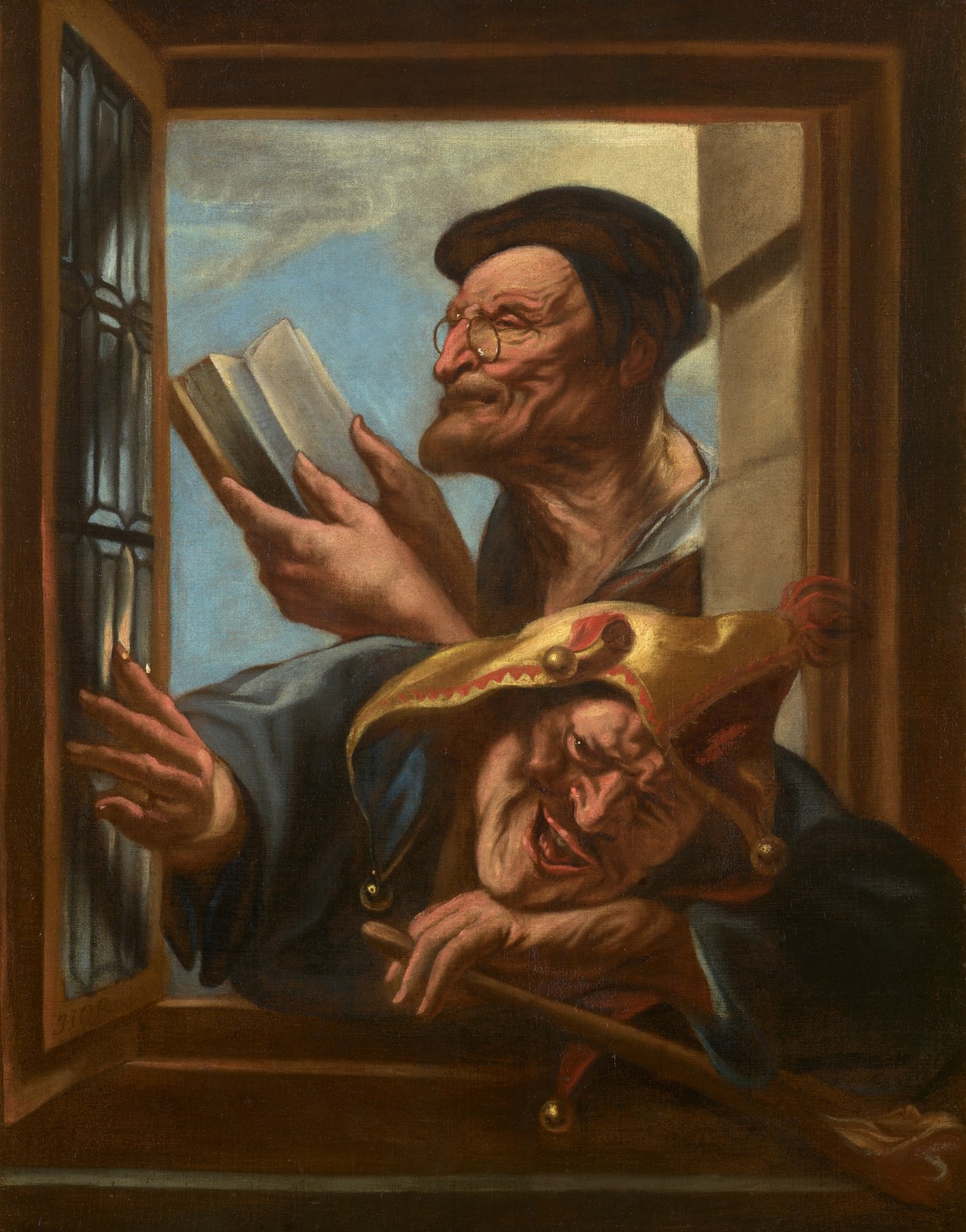
There is a genre of literature that has long performed the useful office of mocking the best that has been thought and said in the world. Wherever lofty ideas have arisen, irritable humorists have taken up arms to knock them down. Northrop Frye dubbed this genre “anatomy” (he was thinking of Robert Burton’s masterpiece The Anatomy of Melancholy, and he accordingly named his own magnum opus Anatomy of Criticism). Usually, it is called “Menippean satire.”
The brilliance of a Menippean satire seems to be in proportion to the profundity of the idea it attacks. It took the genius of Voltaire to make fun of the modal metaphysics of G.W. Leibniz. In his Discourse on Metaphysics, Leibniz argued that, however imperfect our world might seem, it is in fact the best world that God could have made, as evident in the simplicity of the natural laws by which it brings about the rich abundance of creation.11. Gottfried Wilhelm Leibniz, Discourse on Metaphysics, trans. George Montgomery (Chicago: The Open Court, 1908), 11. Not unlike Augustine in the Confessions, Leibniz also held that seeming flaws in the cosmic order would ultimately work themselves out for the good of the whole.22. See Gottfried Wilhelm Leibniz, Theodicy, trans. E.M. Huggard (Chicago: The Open Court, 1985), 129, 137. In Voltaire’s Candide, this philosophy appears in Pangloss’s defense of the syphilis that is killing him:
It was a thing unavoidable, a necessary ingredient in the best of worlds; for if Columbus had not in an island of America caught this disease, which contaminates the source of life, frequently even hinders generation, and which is evidently opposed to the great end of nature, we should have neither chocolate nor cochineal.33. Voltaire, Candide, trans. Philip Littell (New York: Boni & Liveright, 1918), 15.
Voltaire uses fiction to transform Leibniz into a pathetic buffoon, so consistent in his principles that he is willing to justify a horrific infection as a good trade for chocolate and fabric dye.
The purpose of a work like Candide is not to refute anything or to offer an alternative intellectual model. Rather, it is to burst the bubble of intellectualism altogether. Voltaire’s book famously ends with Candide’s deflationary plea: “All that is very well, but let us cultivate our garden.” The moral is that there are healthier things to do than to erect metaphysical systems.
Frye gives a useful synopsis of this species of fictional writing, in contradistinction to the novel: “The novelist sees evil and folly as social diseases, but the Menippean satirist sees them as diseases of the intellect, as a kind of maddened pedantry which the philosophus gloriosus at once symbolizes and defines.”44. Northrop Frye, Anatomy of Criticism (Princeton: Princeton University Press, 1957), 309. The satirist, in response, “shows his exuberance in intellectual ways, by piling up an enormous mass of erudition about his theme or in overwhelming his pedantic targets with an avalanche of their own jargon.” In Voltaire’s Pangloss, we get such an avalanche of Leibnizian jargon. Voltaire proves himself, not exactly wiser than Leibniz, but healthier, wittier, and more human.
Many fine satirical works have undertaken to lampoon, or “anatomize,” the heritage of liberal learning. They diagnose, through madcap storytelling, the intellectual diseases that afflict cultivated society. They take aim at curricula, canons, pedagogies, reforms, sublime beauties, and noble virtues. Yet these great books have had little place in our educational debates. It is hard to think of an issue that breeds as much pompous panegyric, or as much ingenious system-building, as education. There is plenty of venom, too, but every attack is accompanied by an alternative master plan. The glut of self-serious proposals, from both specialists and non-specialists, begins to make the whole subject tiresome—especially, one would think, to teachers and students, who know most intimately the elaborate regimen of absurdity that school-life can be.
Literary artists give voice to that sense of absurdity, which is present even when education seems to be doing its best. Bob Dylan knew how to dismiss the prestige of “the finest schools” with a petulant rhyme: “You know you only used to get / juiced in it.” But that barb is barely a taste of the rich tradition of poetry against pedagogy.
People who want to defend liberal learning should talk more about Menippean satire. It is, arguably, the genre most relevant to the theme of education. Far from being a threat to the educational enterprise, it is a natural outgrowth. It represents the last flowering of wisdom, when the mind turns its ruthless scrutiny back on itself. Without this ironic self-distancing, even sound ideas remain coarse and overearnest. We worship Lady Wisdom falsely if we cannot say with the Preacher of Ecclesiastes, “Go to now, I will prove thee with mirth.” Our defenses of learning are often mirthless and, therefore, easy targets for the skilled satirist.
Take, for instance (to pick on someone dead), this excerpt from Robert Maynard Hutchins’ The Great Conversation, the essay that prefaces the Great Books of the Western World series.
The aim of liberal education is human excellence, both private and public (for man is a political animal). Its object is the excellence of man as man and man as citizen. It regards man as an end, not as a means; and it regards the ends of life, and not the means to it. For this reason it is the education of free men.55. Robert Maynard Hutchins, The Great Conversation (Chicago: Encyclopaedia Britannica, Inc., 1952), 13.
There is nothing wrong with the substance of this. University presidents have done far worse. And read in light of Hutchins’ and Adler’s historical mission to make great literature available to all classes of Americans, it even warms the heart.
It is also a bit heavy-handed. All that talk of “human excellence” and “man” and “ends.” This is the language of formal praise, and anyone who has listened to advocates of the liberal arts, the classical method, or the restoration of the humanities has heard it before. The rhetorical situation, perhaps, demands it. It behooves the “defender of tradition” to employ an epideictic style.
But liberal learning should not be heralded with trumpets all the time. Such monotony does an injustice to a tradition that has laughed at itself so much. Too much greatness and excellence becomes trite. Ultimately, it is the content of a liberal education that makes the best case for it, and not all of that content is high panegyric. Some of it is in the Menippean vein. In what follows, I will introduce the reader to three deeply educated authors who knew how to honor their education by laughing at it.
Against the Tyranny of the Intellect: Rabelais’ Gargantua
First, let us consider that champion of humanism, François Rabelais. Rabelais’ five books of Gargantua and Pantagruel, written between 1534 and 1554, are landmarks of French prose and prototypes of the bawdy babytalk fantasies of James Joyce. The stories relate the origins and adventures of two giants, Pantagruel and his father Gargantua. Rabelais, a highly educated clergyman and doctor, followed closely the developments of Renaissance humanism and the Protestant Reformation. In his second book, The Truly Hair-raising Life of the Great Gargantua Father of Pantagruel, he takes up arms against the old conventions of medieval learning.
The book tells the life of Gargantua, from his wine-guzzling infancy to his glorious (and still bibulous) manhood. The latter half focuses on his military exploits: he saves his father’s kingdom by smashing hordes of foes with an uprooted tree or inadvertently drowning them in a sea of urine. It is in this section that we meet Gargantua’s ally Brother John Mincemeat, a warlike monk who wields a processional cross in combat and goes on to found the libertarian Abbey of Desire. But the crucial early chapters concern Gargantua’s education. In chapters fourteen and fifteen, Rabelais carefully details his course of study.
Under his first teacher, “the great philosopher, Maitre Tubalcain Holofernes,” Gargantua learns the alphabet “so well that he could say it backward, by heart.”66. François Rabelais, Gargantua and Pantagruel, trans. Burton Raffel (New York: W.W. Norton & Co., 1991), 38. So far, so good. Next, starting at age five, comes the grammar stage, where Master Holofernes “read[s] with the boy a Latin grammar by Donatus, plus a dull and well-meaning treatise on courtesy, and a long book by Bishop Theodulus, in which he proves that ancient mythology is all a heap of nonsense, and finally an exceedingly long poem in dreadfully moral quatrains.” This introduction to grammar, morals, mythology, and poetry takes “thirteen years, six months, and two weeks to accomplish.”
Now, at age eighteen, Gargantua is ready for even more grammar, plus some mathematics. For the next eighteen years, he reads De modis significandi, “ ‘The Methods of Reasoned Analysis,’ with the commentaries of Broken Biscuithead, Bouncing Rock,” and others, and learns that “de modis significandi non erat scientia, the methods of reasoned analysis [are] neither reasonable nor a science.” For another sixteen years, he reads “that great book Calculation, surely the longest almanac ever compiled.”
Sadly, Master Holofernes dies of the pox before Gargantua’s training is complete, so his father hires “another old cougher, Maitre Blowhard Birdbrain,” to carry on the cycle. With this tutor, Gargantua studies such texts as “Eberhard de Bethune’s Greekishnessisms,” “Sulpicius’ long, long poem on the psalms and death,” and Passavantus’s Sleep in Peace, “a collection of sermons chosen to make happy days still happier.” We are not told how long this stage lasts, only that under the guidance of Master Birdbrain and these auctores, Gargantua becomes “quite as wise as any blackbird ever baked into a pie.”
What stands out most in this narrative is the contrast between the grinding boredom of the activities described and the lively fun of the writing itself. Gargantua’s textbooks (some of them real and some fictional) pile up in ever more absurdly granular detail. Each one shines like a worthless, delightful costume jewel. No one would ever want to read the commentary of Broken Biscuithead on “The Methods of Reasoned Analysis,” but to read about a lazy young giant reading it is exhilarating. We are far from the classroom pathos of David Copperfield. Here, the reader gets to look down on decades of academic suffering as on a frivolous fairytale. We enjoy Gargantua’s slog because it makes us feel our own comparative health within the story’s zany verbal atmosphere. Instead of refuting the old books on their own terms, Rabelais cheerfully repurposes them as the furniture of absurd fantasy.
For Rabelais, intellectual health correlates with bodily health. During the time of his early studies, Gargantua lives a slovenly life. He rises late and combs his hair “as that great Ockhamist philosopher Jacob Almain always did—that is, with four fingers and a thumb.” And then (to give a sample of Rabelais’ earthy descriptive style),
…he shat, pissed, vomited, belched, farted, yawned, spat, coughed, sighed, sneezed, and blew his nose abundantly. Then he put away a good breakfast, the better to protect himself against the dew and the bad morning air: good fried tripe, some nice boiled steak, several cheerful hams, some good grilled beef, and several platters of bread soaked in bouillon.
Now, Rabelais has no disdain for normal bodily functions—far from it. But this catalogue of overflow and excess shows what happens when we practice intellectual gluttony. The imbalanced diet of grammatical commentaries and pious drivel also lends itself to physical dissipation.
Unlike some satirists in the Menippean line, Rabelais does have a prescription for intellectual ailment: humanism, the educational reform movement that was sweeping Europe at the time of his writing. In one sense, the miseducation of Gargantua belongs with other humanistic complaints of the period, like Martin Luther’s 1524 letter To the Councilmen of All Cities in Germany. Luther recommends that German towns establish quality libraries, which he feels the monasteries failed to provide, to the detriment of the classical tongues:
Instead of worthwhile books, the stupid, useless, and harmful books of the monks, such as Catholicon, Florista, Grecista, Labyrinthus, Dormi Secure, and the like asses’ dung were introduced by the devil. Because of such books the Latin language was ruined, and there remained nowhere a decent school, course of instruction, or method of study. This situation lasted until, as we have experienced and observed, the languages and arts were laboriously recovered—although imperfectly—from bits and fragments of old books hidden among dust and worms.77. Martin Luther, To the Councilmen of All Cities in Germany that they Establish and Maintain Christian Schools, trans. Albert Steinhaeuser, Luther’s Works Vol. 45, ed. Walther Brandt (Philadelphia: Muhlenberg Press, 1962).
The list of texts that Luther designates “asses’ dung” is a lot like Gargantua’s curriculum. (In fact, two titles are identical: Eberhard de Bethune’s Grecista is the “Greekishnessisms” of Burton Raffel’s translation of Rabelais, and Dormi Secure is the sermon collection Sleep in Peace.88. See John Warwick Montgomery, “Luther and Libraries,” The Library Quarterly vol. 32, no. 2 (April 1962), 147 note 47.) Both authors bemoan the preeminence of fusty grammatical tomes and scholastic piety. Luther’s main concern is the contamination of language study and the liberal arts, which, of course, he associates also with a spiritual malaise, since he thinks ineptitude in languages has led to widespread ignorance of the Bible. He credits the humanists with partially recovering proper methods of study by poring over “bits and fragments of old books.” It is in a humanist spirit that he urges the German councilors to renew education.
Rabelais endorses humanism, too, by giving it a salutary role in his fiction. Eventually, under the guidance of a tutor whose name can be translated “Powerbrain,” Gargantua purges his body and mind of the corruptions of the old education and becomes a kind of Renaissance philosopher-prince. He begins to rise early, exercise, say prayers, read classic authors, and study the arts of knighthood.99. Rabelais, 57-59. But importantly, the giant’s new regimen is still treated with irreverent fun. Powerbrain explains the difficult points of Scripture to him every morning while he sits in the latrine. In a state of health, too, mental and bodily digestion are related. The well-adjusted student is still not a god: he remains subject to the awkward needs of earthly life. The folly of scholasticism was to forget the body and build cloud castles of pure cognition. Rabelais’ purpose is not just to suggest an alternative syllabus. He honors humanism as a system to make the mind lean, to topple its tyranny and subject it to bodily limits.
His attack is devastating. As the above passages show, Rabelais is in full command of the intellectual tradition he aims to anatomize. There is no refuting him. He cites chapter and verse of obscure treatises for the most outrageous applications (e.g. Pliny the Elder as testimony that a woman can carry a child for eleven months). He mixes scatological gags with tropological exegesis. The whole texture of the work is that of unraveled erudition. Bookworms take a beating, no doubt. But then, you have to have read a few books to get the jokes. And while you are laughing at them, it feels as if learning is not being degraded after all, but rather set free to perform its true function—to elicit joy.
An Education in Mystery: Lewis Carroll’s Alice
A different flavor of Menippean satire appears in Lewis Carroll’s Alice’s Adventures in Wonderland. The fastidious Oxford lecturer Charles Dodgson, who wrote under the name Carroll, would never have dreamed of writing down the obscenities that so delighted Rabelais. His humor is more cerebral, involuted, and bizarre. His audience is the bored, brainy child, to whom he offers a manic daydream full of puzzles and free of lessons.
Like Rabelais, Carroll arranges intellectual matter into an imaginative atmosphere, but in his story, the intellect in question is that of his young protagonist. Alice’s Adventures in Wonderland is about a little girl’s education coming apart. After Alice goes down the rabbit hole, she finds that words have new meanings, cause and effect are confounded, and the things she knows, such as memorized poems, come out of her mouth as distorted parodies.
Worst of all, many of the creatures she meets on her trip turn out to be impatient schoolmasters, insistent that she deliver herself of her knowledge. Caterpillars, hatters, and heads of state keep ordering her to narrate, explain, and recite. But the combination of topsy-turvy physics and partial insanity (in both herself and others) seems to render Alice’s knowledge useless. In her innocent attempts to find some amusement, she faces a series of impossible puzzles. Still, she has a few conversations and a few laughs along the way. Her dream-odyssey is an exploration of both the pleasures and the frustrations of irrationality.
In the ninth chapter, Alice discovers that some of the inhabitants of Wonderland have also been to school. Shortly before the climactic trial scene that ends the story, Alice visits the Mock Turtle, a morose, half-bovine sea creature, who tells her about his education. It was, he boasts, “the best of educations.”1010. Lewis Carroll, The Annotated Alice: The Definitive Edition, ed. Martin Gardner (New York: W.W. Norton & Co., 1999), 101. The curriculum he then lays out is composed entirely of awful puns. The “regular course,” which the Mock Turtle took, consisted of “Reeling and Writhing, of course, to begin with… and then the different branches of Arithmetic—Ambition, Distraction, Uglification, and Derision.” Next came “Mystery, ancient and modern, with Seaography” (naturally, the school was in the sea); “then Drawling—the Drawling-master was an old conger-eel, that used to come once a week: he taught us Drawling, Stretching, and Fainting in Coils.” The Mock Turtle never studied under the Classical master, “an old crab,” but recalls that “[h]e taught Laughing and Grief.”
Once you are done groaning at the puns, there is a lot to ponder in this list. On one level, it is an appropriate fantasy curriculum for an aquatic academy. Just as J.K. Rowling, in her own Menippean vein, will later imagine her young wizards doing their Charms homework and trying to read from the carnivorous Monster Book of Monsters, so Carroll has his fish and reptiles studying the elements of Reeling and Writhing. Seaography is a given, but Mystery, too, seems a fitting study for inhabitants of the deep. Like so many jokes in Alice’s Adventures, these serve a purpose beyond humor. They evoke a possible world beyond mundane experience.
At the same time, they also comment sharply on mundane experience. Every subject on the list serves to ridicule stuffy teachers, including Carroll himself. “Reeling and Writhing” suggests not only fish, but the agony of the students. The four branches of Carroll’s own specialty, Arithmetic, collectively depict the fate of those who teach it. Mystery, under this interpretation, denotes obscurity and thus incompetence in the tutor. The subheadings “ancient and modern” imply a whole Western Tradition of question marks without any meaning. Meanwhile, the crab-like Classical master seems to inspire as much snickering as the mathematician—that is, when he is not inflicting grief. As for the “old conger eel,” Martin Gardner explains that this is an intentional caricature of legendary art critic John Ruskin, who really did tutor Alice Liddell and her sisters in Drawing, Sketching, and Painting in Oils.1111. The Annotated Alice, 102 note. Presumably, the Drawling Master’s three parody subjects reflect personal habits of Ruskin himself.
This aggressive side of Carroll’s satire presumes to unmask education. The puns, in this sense, are almost literal equivalences. Multiplication, for those forced to study it, is Uglification. Greek is Grief. The lived experience of school is trivial, futile, and inhumane. Like Rabelais, Carroll uses humor to diagnose an intellectual malady.
There is, however, one more layer to the Mock Turtle’s fantasy curriculum. Like the one in Gargantua, this course catalogue is fun to read. But in contrast to the drudgery of Gargantua’s research, some of the Mock Turtle’s classes could be fun for the student. I would not want to read Sulpicius’ long, long poem on the psalms and death, but I might sign up for Laughing 101, or even try my hand at Fainting in Coils. These titles represent what real students and teachers often feel like they are doing at school, but they may also represent the meaningful learning we wish we could be pursuing instead. Every scholar, no matter how earnest, has experienced the phenomenon of facts, figures, words, and even morals dissolving into nonsense. What good are they for life, which so often turns laughter to grief and beauty to ugliness? No one ever taught us to manage these bitter realities, and so we meet them haphazardly and without confidence. In such moments of warped clarity, Carroll and Rabelais are our ideal schoolmasters. Both Gargantua and Alice’s Adventures in Wonderland could well be described as master-classes in the true arts of Distraction, Uglification, and Derision. We need them as much as we need rhapsodies to Goodness, Truth, and Beauty.
Above all, we need Mystery. Both ancient and modern. No explanation of the human condition can satisfy us that succeeds by ignoring most of the data. We need philosophies that show us what we are when we are not being excellent. This may be one reason why the doctrine of the Incarnation has compelled so many people for so many centuries. In it, God comes out of the tidy little rooms to which rationality and high virtue tend to confine themselves, into the open air where anything can happen. By temptation, suffering, and truck with sinners, Christ stretches God out over a human expanse that seems to have so few transcendent moments. Good ironic literature has the same appeal. Rabelais lays open the squalor and excess of life, Carroll its abysses and non-sequiturs. In both, we glimpse life’s mysterious anatomy without a disguise. This too is a part of an education that is liberal—that liberates. Left unchecked, even the highest human ideals risk becoming a prison for the mind.
Transcendence and Snobbery: Thomas Wolfe’s Look Homeward Angel
Our final example is from twentieth-century America. Thomas Wolfe’s Look Homeward Angel, published in 1929, tells the story of his youth in Asheville, North Carolina. A sprawling, meditative family epic, it is probably reductionistic to classify the work as a pure Menippean satire. Yet parts of it clearly fit the genre. A recurring theme in the life of Eugene Gant, the protagonist and authorial stand-in, is the unselfconscious provincialism of his education.
The prose of Look Homeward Angel is highly rhetorical. Often, the narrator’s voice merges with the inner thoughts of Eugene in grand soliloquies. These can be exquisite or a little embarrassing. Take a passage from the very end, in which Eugene addresses the imagined ghost of his dead brother Ben:
O sudden and impalpable faun, lost in the thickets of myself, I will hunt you down until you cease to haunt my eyes with hunger. I heard your footfalls in the desert, I saw your shadow in old buried cities, I heard your laughter running down a million streets, but I did not find you there. And no leaf hangs for me in the forest; I shall lift no stone upon the hills; I shall haunt you, ghost, along the labyrinthine ways until—until? O Ben, my ghost, an answer?1212. Thomas Wolfe, Look Homeward, Angel (New York: Scribner, 2006), 544.
Is this the real inner voice of a teenage southerner? For all its intense emotion, it is almost unbearably stagey. The “o” of formal address, the pastoral metaphors, the tricolon—it all feels learned, not natural.
But the affected quality of Eugene’s outlook is part of the story’s point. Between the drunken Shakespearean rants of his father and the attainments of his backwater classical education, Eugene develops a sense of culture that is always veering toward barbarism. Wolfe paints an unflattering portrait of Eugene’s teachers discussing literature:
“O rare Ben Jonson!” Margaret Leonard sighed with gentle laughter. “Ah, Lord!” “My God, boy!” Sheba roared, snatching the suggested motif of conversation out of the air, and licking her buttered fingers noisily as she stormed into action. “God bless him!” Her hairy red face burned like clover, her veinous eyes were tearful bright. “God bless him, Gene! He was as English as roast beef and a tankard of musty ale!” “Ah Lord!” sighed Margaret. “He was a genius if ever there was one.” With misty eyes she gazed far off, a thread of laughter on her mouth. “Whee!” she laughed gently. “Old Ben!” “And say, ‘Gene!” Sheba continued, bending forward with a fat hand gripped upon her knee. “Do you know that the greatest tribute to Shakespeare’s genius is from his hand?”
“Ah, I tell you, boy!” said Margaret, with darkened eyes. Her voice was husky. He was afraid she was going to weep.
The ladies go on like this, bemoaning the low reputation of Ben Jonson, then the general illiteracy of the southern elite. “There are a lot of things money can’t buy, my sonny,” Sheba says to Eugene, “and one of them is the society of cult-shered men and women.”
All this pretentious cooing is uncomfortable to read. Eugene Gant’s teachers are a recognizable American type—the newcomer to high culture whose education fits awkwardly. Margaret and Sheba did not cease to be bumpkins when they read Ben Jonson. Because they are not real aristocrats, their aristocratic disdain for unlettered millionaires appears resentful. Their intellectual talk reads as compensation for low social class. Margaret Leonard is a well-meaning and talented teacher, but even as a student, Eugene notices in her talk the “tin currency of criticism she had picked up in a few courses at college.”
Eugene becomes increasingly aware of the limits of his own formation. But though he is more circumspect than his teachers, he too comes to represent the idealistic striver who gets “bogged in the gray slough of factuality.” His liberal education supplies him with eloquent language and an imaginative escape from his troubles, but it allows him neither to transcend his narrow southern world nor to find a place in it. Even his emotional outbursts, like the address to Ben’s ghost, have the ring of literary “tin currency.” Wolfe’s narration represents Eugene’s inner life with an ironic distance he himself never fully achieves. There is something beautiful about the cultured soul, but—at least in North Carolina—there is also something false about it.
How different is today’s liberal arts crusader from Margaret Leonard? Does the renewal program amount to indefinite raptures over Elizabethan poets? “Whee! Old Ben!” Look Homeward, Angel is good medicine in this regard. It is a celebration of old-fashioned literary learning, yet it points out the embarrassing affectation, insecurity, and blindness of so many who pursue it. This may be especially true in America, where ambition for learning is frequently an expression of anxiety about class. Broadly speaking, educational attainment in this country has been viewed as a gateway to social advancement, whereas in older European society it had been a marker of class identity. Thus, in an American context, there is a strong incentive to perform one’s education, as Eugene Gant’s teachers train him to do. Eugene would not have been liberally educated at all had his father not intended to make him a famous politician: “In his youngest son he saw the last hope of his name’s survival in laurels.” The son forsakes this goal and is left with a misplaced sense of superiority and importance.
Where does respect for learning end and vaulting ambition begin? The question remains relevant today for the middle-class Americans who are now seeking to revive an aristocratic form of education. It is beautiful to love poetry and disdain money. Snobbery and resentment, however, are not beautiful. We need to learn how to distinguish, and also how to notice when the virtues and the vices are mixed. Thomas Wolfe depicts this ambiguity in the education of Eugene Gant. Look Homeward, Angel is especially a good book for bright young people, who can see in Eugene both the nobility of their own hunger for transcendence and the laughable folly of their own pretense.
Conclusion
To laugh at liberal learning is not to attack it. I return, one more time, to the guiding spirit of this essay, Northrop Frye. “The influence of low-norm satire in American culture,” he wrote in 1957, “has produced a popular contempt for longhairs and ivory towers, an example of what may be called a fallacy of poetic projection, or taking literary conventions to be facts of life.”1313. Anatomy of Criticism, 230. In other words, the anti-intellectualism in American culture is a result of taking books too seriously. It is an error to learn from Rabelais to hate logic, from Carroll to despise school, or from Wolfe to scoff at poets. That would be no different from watching The Sopranos and then going to work for the mob. Fiction’s main purpose is not to provide us with literal descriptions or actionable prescriptions. It is to provide us with conventions: images, attitudes, and hypotheses to incorporate into our consciousness. The vulgar vitality of Rabelais is not a philosophy of life, but a new territory of thought that we may never have encountered without reading him. He maps out this territory for our aesthetic enjoyment, to deepen our thinking, to make us wise.
Many of the great authors bring us into the same territory again and again: the goodness of virtue, the beauty of wisdom, the glory of truth. In this they are correct. But real virtue, wisdom, and truth are more than correctness. Education cannot really be liberal if it confines itself to a rigid set of conclusions. Instead, its motto should be Terence’s line, “Homo sum, humani nihil a me alienum puto” (I am human, nothing that is human is alien to me). In fiction, we encounter human perspectives that do not demand our full assent, but expand our awareness of how human beings can think and feel. Menippean satire shows us wisdom at its most ridiculous. When we laugh along, we see that the opponents of wisdom are right in a way. We take their hypothetical attitude on board, not as an article of faith, but as an aspect of our consciousness. As a result, paradoxically, we become wiser. Certain human things become less alien to us: the boredom of students, the frustrations of teachers, the needs of the body, the limitations of rationality.
Augmenting our sympathies in this way may not lead us to act more righteously. But the alternative will certainly lead us to act foolishly. If we do not absorb the satirical perspective in a spirit of learning, we may well make the mistake Frye mentions and adopt it in earnest. Those who hope to renew a healthy respect for the intellect in our society should learn to criticize intellectualism as well as honor it. Again, we should follow the example of Solomon’s Preacher: “And I turned myself to behold wisdom, and madness, and folly.” The books we have surveyed here are good places to start.


