


(I’m posting this both here and at my Substack.)
I’ve been trying to memorize some of Robert Herrick’s poetry, which has been a delight. I want to comment briefly here on one of the poems I’ve been working on to illustrate how meter can be used to convey meaning.
The poem, one of the Noble Numbers, reads as follows:
Lord, I am like to mistletoe,
Which has no root, and cannot grow
Or prosper but by that same tree
It clings about; so I by Thee.
What need I then to fear at all,
So long as I about Thee crawl?
But if that tree should fall and die,
Tumble shall heav'n, and down will I.
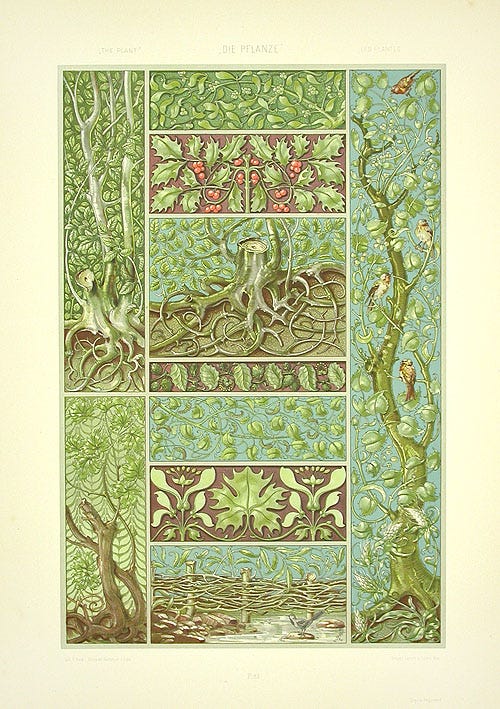
The conceit of the poem is that the speaker has no life in himself, but must, like a parasitic plant, draw his life from another source. The parasite and his host must stand and fall together. Here, the parasite is mistletoe, and the host is a tree—fitting for the poem’s Christian subject, since the tree is a dominant image in the Bible, beginning in the beginning of Genesis with the Tree of Life and the Tree of the Knowledge of Good and Evil, passing through the tree of the blessed man in the first Psalm, and culminating the the tree of the cross and “the tree of life, which is in the midst of the paradise of God” (Revelation 2:7 [KJV]; cf. Revelation 22:2).
The union of parasite and host is reflected metrically in the first seven lines of the poem, which are all regular iambic tetrameters. Consider the opening sentence, with the stressed syllables in bold:
Lord, I am like to mistletoe,
Which has no root, and cannot grow
Or prosper but by that same tree
It clings about; so I by Thee.
No conflict here between word accent and metrical ictus.
But the final two lines entertain the possibility of the tree’s collapse, which would entail the concomitant destruction of the poem’s parasite-speaker.
But if that tree should fall and die,
Tumble shall heav’n, and down will I.
Notice what happens to the meter here. Line 7 is regular:
But if that tree should fall and die…
But try to read the eighth line like that.
Tumble shall heav’n, and down will I.
Obviously, it doesn’t work. The opening iamb (u —) is inverted to a trochee (— u), giving a rhythm of stressed-unstressed-unstressed-stressed (— u u —) in the first part of the line before returning to regular iambs:
Tumble shall heav’n, and down will I.
I don’t know about you, but when I read this, the inversion has the effect, by quickening the pace of the beginning of the line, of slowing down its end to represent the finality of the speaker’s destruction on this hypothetical scenario. If it were written in an ancient quantitative meter like those of Latin and Greek, I would feel it as something like a choriamb (— u u —) followed by four spondees (— — — —). Actually, I do feel it that way. This final line is thus a masterful use of meter to reinforce sense.
A Couple of Other Things While I’m at It
Herrick uses internal rhyme effectively in this poem. Note “Thee” (6) and “tree” (7) which, in addition to rhyming with each other, echo the end-rhyme “tree” (3)/“Thee” (4), and also make a chiasmus. Note also “fall” (7), which smooths the transition from safety expressed in the end-rhyme “all” (5)/“crawl’ (6) to hypothetical danger in lines 7-8.
Finally, a grammatical point about the condition in those two lines.
Does Herrick1 seriously consider the possibility that his tree (that is, God) will fall? No, he does not; but he does seriously consider his own precarity.
This is made clear in the form of the condition. Mark the word “should” in the protasis, or if-clause. This expresses the possibility as distant: “less vivid,” to put it in the terms of the analysis of Latin conditionals.
In the “pure” form of the condition, such a protasis would usually be followed by an apodosis, or main clause, with the auxiliary “would.” But that is not what we find. Instead, when speaking of possibility raised in first clause, he says “shall” and “will,” thus making a mixed condition in which what would follow on the supposition of the if-clause is stated as an eventuality that is “more vivid.” More concisely: While we should not give credence to the tree falling, we should give credence to what that would mean: The collapse of the cosmos, and of Herrick within it.
A final remark: In the last line, note the use “shall” (in the case of heaven) and “will” in the case of Herrick. Though interpreting the precise resonance of these words with respect to time considered simply vs. suggestions of obligation and necessity (both “shall” and “will”) and volition (“will”), there is a good case to be made that the latter are in view here. That is, the sense of the ending is, “If God should fall and be no more (though he won’t), heaven of necessity must tumble down, as must I—and, in such circumstances, I wouldn’t want to stay upright anyway, because, without God, what would be the point?”
Quite a tour de force for such a small poem.
I referred to the poem’s “I” as its “speaker” above, but here I assume that persona to be interchangeable with Herrick himself. While a poem’s “I” is not always equivalent to its author, I see no reason to suspect it isn’t here.


