From 1685 to 1776
When Thomas Jefferson reflected on the Declaration of Independence fifty years after its composition, he hoped that it would make clear a “palpable truth.” That is, Jefferson wrote, “that the mass of mankind has not been born with saddles on their backs, nor a favored few booted and spurred, ready to ride them legitimately, by the grace of God.”11. Thomas Jefferson to Roger Weightman, June 1826. I use this same use of Rumbold by Jefferson in a recent piece in American Reformer wherein Rumbold as a Reformed revolutionary prompts examination of Reformed resistance theory as a particular application of Protestant constitutionalism. The articulate Jefferson loved a good turn of phrase, but this one was not his own invention. Richard Rumbold said exactly this in 1685 as he was about to be hanged, drawn, and quartered for being a conspirator in the Protestant Rye House plot to assassinate Charles II and his brother and heir James. Both had become deeply unpopular: Charles for persecuting dissenting Protestants with the Act of Uniformity (1662) and the Conventicle Act (1664), and James for converting to Catholicism.
Given what Charles had done against nonconforming Protestants, and what James, a Catholic monarch-to-be might do to all Protestants, it is easy to presume that a plot against Charles and James Stuart was motivated by religious or sectarian rivalries. According to one contemporary view of the past, Protestants and Catholics fought one another as tribes in an unenlightened and intolerant era. Or so another contemporary view might suggest, we hope that Rumbold and his co-conspirators were a vanguard of modern inclusion. By assassinating Charles and James, they hoped to end religious fighting and enable broad religious toleration and liberty. But what Rumbold and the Rye House conspirators were after was neither broad religious toleration nor sectarian score settling. Their goal was legal reform and an end to what they perceived as Stuart abuses of the law.
What Rumbold says on the scaffold is more characteristic of a constitutionalist. He says that he was to die in defense of just “rights and liberties.” “Rights and liberties” is not a phrase that should be discounted today on “postliberal” grounds. Rumbold did not have in mind the nineteenth-century ideology of liberalism, classical liberalism, progressive liberalism, Rawlsian liberalism, or any other liberalism. He would not have had in mind John Locke, Adam Smith, or John Stuart Mill. Neither Smith nor Mill were alive, and Locke had not yet published his famous Two Treatises nor his Epistola de Tolerantia. Rather, preserving rights and liberties was the whole point of British constitutionalism. Rumbold would have had in mind Magna Charta (1215), for example, that placed everyone—even the king—under the rule of law. The Stuarts did not agree with the Whigs on what that meant.
How does constitutionalism diverge from modern liberalism in which rights and liberties now seem to proliferate without end? The condemned Rumbold again serves as a brilliant tutor to help us understand this by implicitly distinguishing novelty from permanence. He says that he is dying in defense of ancient laws and liberties. The ancient character of law is explained in William Blackstone’s Commentaries on the Laws of England (1769), for example. In common law, rights derive from practices uninterrupted so long as anyone (even accounts of history) can remember. Such practices are said to exist in time “whereof the memory of man runneth not to the contrary” or as we are more likely to say now, “time immemorial.” In other words, the practices are so old that we do not know their origin, and people should therefore reasonably expect them to continue. The law being conservative and not innovative; such ancient rights are retained. Privileging long practice prevents us from continual invention of new claims about rights, whether asserted by the people or by the rulers.
But if Rumbold’s case is a constitutionalist one, and not merely a sectarian one, what should we make of what he says next? He says that his defense of the ancient laws and liberties stands against popery and slavery.22. The Last Speech of Coll. Richard Rumbold, with several Things that passed at his Tryal, 26 June, 1685. To understand why this wasn’t merely about James’s Roman Catholicism as an ecclesiastical conflict, however, we have to further understand the “Protestant” character of independence in England, and then America. Over almost two centuries, Protestants (like Rumbold), whether in Britain and America, didn’t think of being Protestant merely in terms of theological convictions or dogma. They associated Protestant identity with a conviction that the rule of law must be upheld, and that all political power must be subject to that rule. Likewise, their objection to Roman Catholicism wasn’t confined to theological or doctrinal differences but was thought of in broadly political terms as well. Catholics, also called Romanists, Papists, Jesuits, or popery generally, were treated as enemies to the rule of law. Over time, enemies of the rule of law were assigned these labels regardless of their theological convictions.
However, 250 years ago in America, something happened that put an end to this association of Protestantism with constitutionalism.
Protestant Britons
In 1775 and 1776, a certain idea and conviction prevailed in America just as it prevailed in Britain. In this semiquincentennial year, the idea and conviction is worth considering not only as an historical point, but also for its relevance to arguments about what America is and what an American is. This contemporary debate of whether America is a people or an idea contests whether America is owed to and sustained by a particular ethnic, racial, or cultural group or whether it is owed to and sustained by an idea.
We begin with a big historical fact often overlooked in reflections on the Revolution. American independence was first understood by many at that time to be something Protestant. This is not a claim about America being a people per se. Saying that American independence is owed to Protestant people would be simplistic and obvious. The great majority on both sides of the war in 1775 were Protestant. Until France and Spain allied with America, the War of Independence was a Protestant civil war. If America’s Protestant identity could not be associated with a particular group of people (since Protestants were on both sides of the independence question), was Protestantism then just a set of ideas not necessarily dependent on a particular people?
The answer to this question begins in Britain. As Linda Colley has explained in her seminal Britons: Forging the Nation 1707–1837, the disparate English, Welsh, and Scottish people needed something to join them together as “Britons.” One essential factor (though not the only factor) enabling Britons to cohere, Colley argues, was the creation of a Protestant identity. Was being “Protestant” reflective of a shared theological heritage? Only in the broadest strokes: one could parse theological and denominational differences in Britain until the cows came home, which is saying a lot in a country famous for its cows. In fact, forging a unified Protestant identity based on theological unity became more challenging as denominational and doctrinal variations grew more diverse over two centuries. Protestant identity could not, therefore, be predicated on dogma. Rather, the existence of the Protestant identity was a combination of two factors. First, it was a fiction of sorts born of political expediency. That is, as the different British peoples need to unify against a common enemy, they found ways to overlook their differences for the sake of survival. Second, differences inhibiting unity mattered less as religious establishment weakened in Britain (and America) thanks to the Toleration Act of 1689. Denominational differences remained, of course (as did cultural, geographical, or other differences). But because the various denominations enjoyed a greater degree of equal protection under the law, favored treatment by the state mattered less, and unity became more possible.33. Linda Colley, Britons: Forging the Nation 1707–1837 (Yale University Press, 1993), 11–54. For examples of Protestant unity after 1689 in America, see Puritan ecumenicism led by Cotton Mather.
As for the first point about expediency, the Protestant identity of Britons meant not so much what one was, but rather what one was not. To use the trendy academic lingo of the “Other” as Colley does, the Other for Britons was Roman Catholicism (aka, Papists, Romanists). To be Protestant was to be not Roman Catholic. One can find rejection of transubstantiation and superintending authority in the Bishop of Rome as a trope throughout British writing. However, some of that theological flag-planting was superficial—a kind of eighteenth-century virtue signaling.44. For example, David Hume’s attacks on transubstantiation were a very British thing to do, and validated Hume as a faithful Briton, but he wasn’t defending a different doctrine of communion as a faithful Christian. He was doing a very British thing. So, what did it mean for Britons to be a Protestant if it was not about doctrine or dogma?
Before answering that question, it must be stressed that the American colonists also lacked a unifying identity. The disparate regions and colonies of America possessed different geography, cultures, and experiences.55. Differences among the Americans are traced by David Hackett Fischer’s magisterial Albion’s Seed, for example. Americans’ ongoing debate about our nation as homogenous or as ultimately incompatible tribes (made more complicated by immigration) is not a new one. From George Washington’s vantage point in 1796, the future of America was anything but assured, and he felt the need to address this in his so-called Farewell Address (1796). The outgoing president implored Americans to join in a united national interest.
The name of American, which belongs to you, in your national capacity, must always exalt the just pride of patriotism more than any appellation derived from local discriminations. With slight shades of difference, you have the same religion, manners, habits, and political principles. You have in a common cause fought and triumphed together. The independence and liberty you possess are the work of joint councils and joint efforts—of common dangers, sufferings, and successes.66. The Address of Gen. Washington to the People of America on His Declining the Presidency of the United States
Many Americans would have taken exception to Washington’s claim that their differences in religion, manners, habits or politics were “slight shades of difference.” They were not slight, though their differences did not run as deep as the English, Welsh, and Scots.
Protestant Independence and the Rule of Law
The unifying Protestant identity began when King Henry VIII created the Church of England by severing it from the pope’s control. Pope Paul III responded by excommunicating him in 1538 because the pope presumed to govern not just the church in England, but its civil government as well. Pius V later excommunicated Queen Elizabeth in 1570 after she returned the Church of England to independence after the reign of Bloody Mary. Both excommunications were predicated on the belief in hierocracy wherein the pope presumed to have both supreme civil and supreme ecclesiastical authority.77. Classical Protestant Two Kingdom theology (not to be confused with David Van Drunen’s) corrected this Roman confusion. The pope’s action was therefore not a mere exercise of church discipline declaring Henry or Elizabeth unrepentant: it was overt political subversion. Excommunication freed English Catholics from any political allegiance, including any oaths of loyalty that they had made. In the case of Elizabeth’s excommunication, Pius went even further and made it a sin for Catholics to obey her. The popes launched direct assaults on the political independence, sovereignty, and stability of Britain.
When King Philip II sent the Spanish Armada in 1588, in part to restore a Catholic government there, English independence was threatened by Catholic military powers. The defeat of the Armada and the English celebration of their independence from Rome is illustrated with rich iconography in the famous Armada Portrait of Elizabeth. The painting includes a “Protestant Wind” thwarting the Spanish attack on England—a wind that was believed to return a century later when Protestant William III (William of Orange) successfully landed his fleet and rescued the Protestant throne and James II could not launch his own fleet to stop him. These events, the defeat of the Armada and the Glorious Revolution, were bookends of seventeenth-century Protestant identity in England.
To the north, Scotland had its own reformation alongside the English one. Protestants there sought independence from Rome and French Catholics. John Knox famously appealed to Scottish monarchs and nobles for Protestant reforms, desiring removal (if not regicide) of Mary of Guise. He also appealed to the laity, putting the future blessing or cursing of Scotland in covenantal terms: Scotland must reform or face judgment. England’s national interest, which was cast as a Protestant interest, led to an English invasion forcing the French army there (at the request of the Catholic Mary) to negotiate for terms as Mary lay dying. Scotland was left in the control of the Protestant Scottish Lords.
In the Wars of the Three Kingdoms (including the English Civil War) Protestants of all stripes—whether Puritan, Anglican, Royalist, Congregational, Presbyterian, Scot, or Englishman—accused their opponents of subverting the rule of law and did this by calling them agents of Rome. Each side charged the other with “innovation” that undermined history and precedent in the common law, constitutionalist style (e.g. Rumbold’s ancient liberties). For example, Dissenting and Nonconformist opponents of the Caroline church claimed to defend the common law rights and liberties of subjects. Their opponents claimed to defend the constitutional rights of the Crown and parliament.
These arguments were legal ones couched in religious terms: if you opposed the rule of law and constitutional order, you were a Papist or Jesuit. Of course, there was no reason to think that anyone on either side of the English Civil War was a true follower of Rome, but the insult was more political than ecclesiastical or theological. Religious and ecclesiastical debates in this era became so intertwined that some scholars came to view the English Civil War as the first modern European revolution. Eminent historian of the period, John Morrill, however, retorted that it was instead “the last of the Wars of Religion,” a view toward which the pendulum of scholarship is swinging back.88. John Morrill, “The Religious Context of the English Civil War” in Transactions of the Royal Historical Society, vol. 34 (1984), 155–78. For seventeenth-century Britons, it could be both political and religious. To be British was to be Protestant. To be Protestant was not just to have certain theological convictions but to also believe in constitutionalism.
By the 1670s, in the decade before the Rye House Plot, Protestant paranoia ran very hot. Protestants became so suspicious of Catholic plots against the civil order that they believed fantastical assertions, including the claim of a Catholic assassination plot in 1678 that had very little evidence but led to the death of 15 innocent men anyway. Whig fear of a Catholic monarch at this time motivated the seminal political writing of both John Locke and Algernon Sidney. Even after Protestants breathed sighs of relief when Protestant William took the throne from James, Jacobite Rebellions resurrected fears of Catholic plots against the Protestant order over and over, as did wars against Catholic foes led first by William and Anne and then by the House of Hanover.99. There were exceptions to the “Protestant vs. Catholic” delineation throughout the period, of course. Britons fought the Protestant United Provinces before 1688 and had Catholic allies from time to time: France from 1716 until 1731, and Austria during the Nine Years War and War of the Spanish Succession. But none of this discouraged the rhetoric that Protestant Britain upheld ordered liberty against either Catholic tyranny (within England or abroad) or Catholic anarchy (i.e., subverting English rulers).
American Fear of Popery
From the other side of the Atlantic, Americans cheered what became known as the “Protestant Cause.” Enjoying varying degrees of autonomy, they developed their own interests, of course. When their autonomy was challenged—by the government of Edmund Andros in New England in 1686, for example—Americans grabbed the British playbook: they compared the Dominion of New England with Louis XIV’s persecution of the Huguenots and began to wonder whether Papists were gaining ground across the ocean. Seeing the accession of William as a green light for Protestant glory, they threw off Andros’s “Papist” administration. In a 1689 sermon, Cotton Mather called for unity among Protestants and famously urged “War with none but Hell and Rome.”1010. Cotton Mather, The Wonderful Works of God Commemorated: A Thanksgiving Sermon Delivered on December 19, 1689 (Boston).
Nowhere was British fellow feeling and support for Protestant constitutionalism more evident than in American pulpits, particularly during the Seven Years War or French and Indian War (1756–1763). Arguably the first “world war,” it came with rhetoric very much in the British Protestant constitutionalist tradition. Though books have been devoted to the political pulpit of the Revolution, a book could also be devoted to the political pulpit of the decades before the Revolution. Ministers sustained a simultaneous defense of both Protestantism and the British constitution. In a sermon to soldiers in April of 1755, Congregationalist minister Isaac Morrill intertwined fears both civil and ecclesiastical:
Are we willing to be bound to the Stake and burnt? This seems to appear from the best Intelligence we have of the Conduct of the French, that their Design is as soon as possible to change the Government of these Provinces; and if they change the Government of this Land, they will the Religion of it too. And are we willing to give up our civil Rights and Privileges, and become subjected to Tyranny and arbitrary Government?1111. Isaac Morrill, The soldier exhorted to courage in the service of his king and country, from a sense of God and religion: A sermon preached at Wilmington, April 3, 1755 (Boston).
In that same year, Congregationalist Rev. John Lowell in Newbury told soldiers that “the Estates, Laws, Liberties, Lives, and Religion of People are to be defended at the utmost Hazard.” Presbyterian and revivalist minister Gilbert Tennent, in a February, 1756 sermon warned soldiers of the “dismal Consequences of a French, a Popish Government, that in such a Situation you must be deprived of your Estates and civil Liberty.” Tennent concluded his attack on Roman Catholicism and defense of Protestantism by placing Islamic governments above Catholic ones: “It is a Thousand Times better to be under the Government of Turks than Papists, for there we might enjoy some Liberty, but here none at all; there are not such bloody, tyrannical Taskmasters under the whole heaven as the Papists, we have therefore Reason to dread their Government more than Death itself.”1111. Gilbert Tennent. The Happiness of Rewarding the Enemies of our Religion and Liberty, 1756 (Philadelphia).
Such rhetoric was not confined to New England. Anglican minister William Smith (later the provost of what became the University of Pennsylvania) charged a gathering of soldiers in Philadelphia in 1757 to “cultivate in yourselves and those under you, a noble, manly, and rational Enthusiasm in the glorious cause wherein you are engaged.” That cause, Smith argued, was the cause of “Justice, the Protestant-cause, the cause of Virtue and Freedom on earth” and “an unconquerable passion for Liberty, and the purity of the Protestant faith.”1212. William Smith. The Christian Soldier’s Duty; the Lawfulness and Dignity of his Office; and the Importance of the Protestant Cause in the British Colonies. Preached in Christ-Church, Philadelphia; April 5, 1757 (London).
Such privileging of the British constitution above all others was stark. In a 1759 sermon of Rev. James Lockwood, he told his audience, “There is no Nation in Europe, nor on the Earth whose Civil Government is like that of Great Britain—none that exceeds, perhaps none, that, in all Respects, equals it in Excellency.” Lockwood contrasted rule under the British constitution with what he called “arbitrary rule” in Europe and Asia, which he said is “One of the greatest engines of Misery & Desolation to Mankind—the most dreadful Curse that ever blasted and devour’d the Earth.”
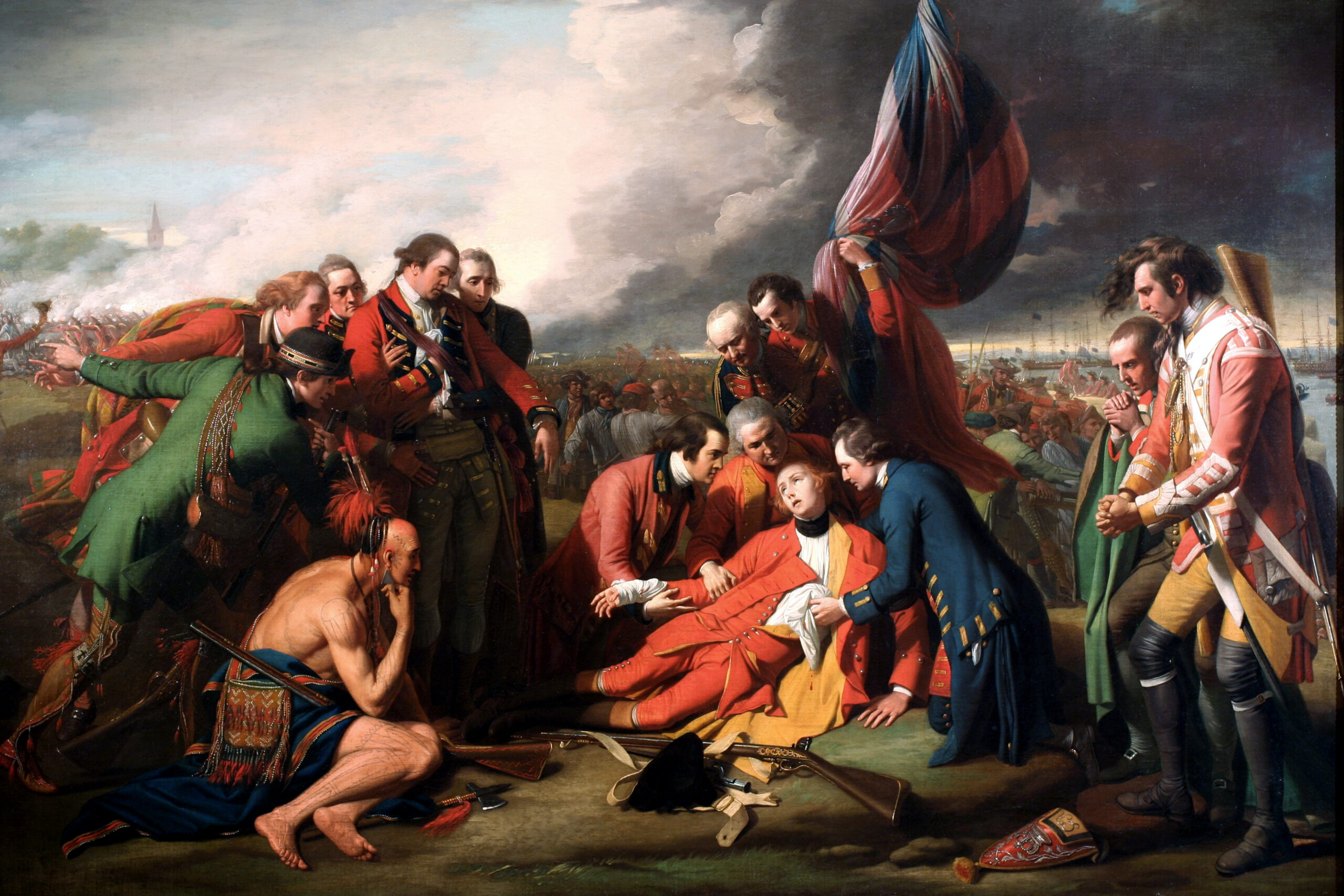
Those who died in service to Britain did not have to die in ways one typically thinks of to become martyrs. General James Wolfe died in battle at the Plains of Abraham in 1759 when the British tried to seize French Quebec. He was not captured and forced to acknowledge the pope or transubstantiation, but he was considered to have died for the true faith in a different way: he was killed leading a British (Protestant) army against French (Catholic) foes. Sermons on the battle treated his death as one would a martyr’s because he died for the cause of Protestant Britain. His death was immortalized by Benjamin West’s The Death of General Wolfe (1770) with a deliberate pose of martyrdom, arguably even an imitation of the pose of the crucified Christ in previous paintings.
After the war, anti-Papist rhetoric continued unabated. In the 1765 Dudleian Lecture at Harvard, a prestigious annual academic event, Rev. Jonathan Mayhew asserted, “We ought in reason and prudence to detest the church of Rome, in the same degree that we prize freedom. Her laws, more arbitrary than those of Draco, are, in effect, like his, all written in blood. Popery and liberty are incompatible; at irreconcilable enmity with each other.” He went on to emphasize that his concern was not ecclesiastical. “Our controversy … is not merely a religious one … but a defense of our laws, liberties and civil rights as men, in opposition to the proud claims and encroachments of ecclesiastical persons, who under the pretext of religion, and saving men’s souls, would engross all power and property to themselves and reduce us to the most abject slavery.” Ten years earlier, in an Election Day sermon, Mayhew cleverly said of Papism that it “transubstantiated liberty, property, religion, and happiness” into “slavery, poverty, superstition, and wretchedness.”1313. Jonathan Mayhew, Popish idolatry: a discourse delivered in the chapel of Harvard-College in Cambridge, New-England, May 8, 1765 (Boston). Mayhew, A sermon preached in the audience of His Excellency William Shirley, Esq . . . May 29, 1754 (Boston).
Some scholars have argued that rhetoric about “Papists” and “Romanists” was a rhetorical device for elites—especially ministers—to pander to unenlightened masses, but there is plenty of evidence to the contrary in both Britain and America. Such language was often used even by less-than-orthodox elites who happily conflated Protestantism with ordered liberty under law and Roman Catholicism with tyranny. The very popular Cato’s Letters, for example, argued against Catholic influence albeit with some Enlightenment-influenced motivations. The letters, authored by John Trenchard and Thomas Gordon, were first published in England and then republished in America and read widely by the general public. In America, they were read and cited by influential American leaders like John Adams and Thomas Jefferson. Trenchard and Gordon argued that “tricks and juggles of heathen and popish priests” made it impossible for people to exercise independent judgment. Furthermore, in a passage less inclusive than Tennent’s, they yoked Popery and Islam together, “When people are taught to reverence butchers, robbers, and tyrants, under the reverend name of rulers, to adore the names and persons of men, though their actions be the actions of devils: Then here is a confirmed and accomplished servitude … secured by the servitude of the mind, oppression fortified by delusion. This is the height of human slavery. By this, the Turk and the Pope reign.”1414. For the thesis of elites vs the masses, see Francis Cogliano, No King, No Popery: Anti-Catholicism in Revolutionary New England (Greenwood Press, 1995). For statements from Cato’s Letters, see John Trenchard and Thomas Gordon, Cato’s Letters or Essays on Liberty Civil and Religious, and Other Important Subjects (Liberty Fund, 1995), 2:573, 907. Anti-Catholic rhetoric was not a device confined to the pulpit.
America Abandons the Protestant Cause?
As the split between colonists and England widened, Americans maintained their Catholic conspiracies. One primary concern of Americans leading into the War of Independence was the 1774 Quebec Act passed by Parliament. The Act had many different provisions, including denying land previously promised to American settlers, but it also removed the Protestant faith from the oath of allegiance in Quebec and enabled the imposition of Catholic tithes and free practice of the Roman Catholic faith. Alexander Hamilton criticized it in 1775 in his Remarks on the Quebec Bill and before that in 1774 in The Farmer Refuted. He said that the Act established “arbitrary power” and “the Popish Religion.” The Continental Congress considered the Quebec Act an establishment of the “Roman Catholick Religion,” abolition of the “equitable system of English laws,” and the erecting of tyranny. In their appeal to the people of Great Britain against the Quebec Act, Congress argued that European immigrants to Canada would be “fit instruments . . . to reduce the ancient free Protestant Colonies to the same state of slavery with themselves.” Thomas Jefferson responded to Lord North’s peace proposal in 1777 with a complaint that it did not repeal the 1774 Quebec Act’s changes to the “government & [Catholic] religion of Canada.” In a series of newspaper essays critiquing Britain’s handling of her own constitution in 1775, John Adams contrasted “the Reformation and Protestant religion” with “the worst tyranny that the genius of toryism has ever yet invented; I mean the Roman superstition.” After the war was underway, Thomas Paine’s Common Sense (1776) capitalized on the rhetoric, calling monarchy “the popery of governments” and complained of “a low papistical design” against America.1515. Alexander Hamilton, Remarks on the Quebec Bill: Part One, [15 June 1775]; David D. Hall, A Reforming People: Puritanism and the Transformation of Public Life in New England (Alfred A. Knopf, 2011), 55–56; F. J. Zweirlin, “The End of No-Popery in the Continental Congress.” Thought 11:357–77, 364–365; John Adams and Jonathan Sewall, Novanglus, (1819), 13; Thomas Paine, Common Sense.
Loyalists and Patriots used the terms of Protestant and Papist as shorthand legal or political terms, just as opponents in Britain had used it in controversies over the two centuries prior. For example, Boston Loyalist Harrison Gray described Massachusetts delegates to the First Continental Congress as “Jesuitical gentlemen.” Customs Commissioner Henry Hulton called Rev. Samuel Cooper (one of Boston’s most important Patriot leaders) a “smooth, artful, civil, Jesuitical Priest.” Tory Peter Oliver, in his history of the Revolution, said of Cooper that he was “Proficient in Jesuitism.” No one really thought that Cooper was an actual Jesuit. But just as Jesuits had once been the agents of Rome to subvert the Reformation and governments in Protestant lands, and therefore in England, so Cooper was likewise a rebel. Similarly, when Patriots complained of a “creeping Romanism at court” they did not suspect a conspiracy from Rome in London.1616. Harrison Gray, A Few Remarks Upon Some of the Votes and Resolutions of the Continental Congress. Boston. (1775), 10; Charles W. Akers, The Divine Politician: Samuel Cooper and the American Revolution in Boston (Northeastern University Press, 1982), 82; Douglas Adair and John A. Schultz (eds.), Peter Oliver’s “Origin & Progress of the American Revolution”: A Tory View (Stanford University Press, 1961) 43–45, 61–62. They were asserting tyranny there.
By the time America won her independence, however, the anti-Catholic rhetoric had largely disappeared from the American pulpit and the American newspaper. The reasons for that disappearance began with one of the Americans’ most effective weapons: diplomacy. Americans wanted to force Britain to ration limited blood and treasure and solicited Spain and Holland to settle scores while Britain was trying to suppress the American Revolution. Neither country made a formal alliance or committed troops or ships to the Patriot government, but they did engage with British forces abroad and sent war matériel to help George Washington. France would enter into a formal alliance. The British would have to open yet another front against the French abroad and fight elements of the French army and navy at the decisive battle of Yorktown.
For the Americans, who had feared Spanish and French settlements for over a century as beachheads for Papists and Jesuits, this should have presented a dilemma to join with Catholic nations. Shrewd diplomacy won out instead, which required rethinking the conflation of constitutionalism with Protestantism. For example, a letter from the Continental Congress to Quebec’s inhabitants in 1774 invited them to join the American cause. In this letter, one can see the old rhetoric about Popery disintegrating—a point that America’s enemies in Britain gleefully exploited as hypocritical and insincere. In the letter, the Americans reminded those in Quebec that they may not be able to trust the British government with their religious liberty (granted in the Quebec Act). And besides, they argued, liberty of conscience was already God-given. Such a statement implied that Quebec would have religious liberty should the Americans have any say in it. Furthermore, the letter approvingly mentions how Swiss cantons, both Roman Catholic and Protestant, came to live “in the utmost concord and peace with one another” in the cause of defeating tyranny. Such a peace seemed increasingly possible to Americans when they encountered sympathetic Catholics in their military campaigns north to Quebec and saw Roman Catholic Patriot leaders at home signing the Declaration (and later the Constitution).1717. Continental Congress to the Inhabitants of the Province of Quebec, 26 Oct. 1774. Letters were also sent in 1775 and 1776. A strong bias against and fear of Catholics persisted in America for almost two centuries after the Revolution, especially in the nativist movement, but did not result in a two-tiered approach to rights as existed for British Catholics.
Other vestiges of the campaign against Popery collapsed under the expediency of the war effort. George Washington banned Guy Fawkes Day celebrations as Commander in Chief in 1775 and enjoined Benedict Arnold to protect free exercise of religion in his army’s expedition to Canada. Virginia, Pennsylvania, and Maryland passed acts of religious toleration in 1776. In a subtle reference to the Quebec Act, the Declaration of Independence ignored the religious association of Romanism and tyranny and instead merely indicts “abolishing the free System of English Laws in a neighboring Province.” Even Protestant Bostonians eventually converted their version of Guy Fawkes Day (“Pope’s Day”) into a celebration of the alliance with France. No one abandoned the Protestant cause as a constitutional cause, however, even if they stopped calling it Protestant.
Lessons for Today: Is America a People or an Idea?
What should we make of all this today? Can we speak coherently of America as a people? If so, who are those people? The conception of a “Briton” was always centered more on conviction than on shared experience or culture. Neither Britons nor Americans had a shared experience or culture to share. Welsh or Scots, for example, were not English. None of the three initially thought of themselves as Britons, except in their outrage against attempts to rob them of independence. The same can be said for Americans: New Englanders did not really understand Virginians, but as Britons they were united in common cause against the enemies of Britain. Later, on the eve of independence, Patriots in both regions shared common cause against British abuses of their rights and liberties. What enabled the creation of the Briton in the seventeenth century, or the American in the eighteenth, was the preservation of a constitutionalism that flattened differences under the rule of law.
At first, Protestantism was an idea holding together disparate people in Britain and in America. It was a political conviction or sensibility. Did that conviction reflect a certain experience unique to a particular people? At first, yes. Britons increasingly marshalled around their independence from Catholic powers and proclaimed a Protestant character. Patriots in America likewise marshalled around their independence. And they called their enemies Papists and Jesuits as the British had done for generations. However, beneath what sounded like religious talk was (as it had been all along) also enduring legal and political talk. The Patriots believed that the colonies could preserve the ideals of the British constitution, including liberty under law and the protection of rights. Constitutionalism had failed in Britain but could be preserved and sharpened in America, they argued. This was the promise of the Declaration of Independence, especially in its list of grievances. The “Protestant” conviction remained, but it revealed itself to be a commitment to constitutionalism.
That commitment to take up what was thought to have failed was not shared by a “people,” however much Americans then might look like a homogenous people to us in hindsight. If the failure of the British constitution was so obvious, as it was to the Patriots, there wouldn’t have been so many Americans with the same experiences opposed to the Patriot cause. There wouldn’t have been many others ambivalent about the fight for independence. The disagreement among Americans in 1776 makes it obvious to us that presuming to be the same “people” provided no guarantee at all of holding the same political conviction.
The same is true today. To presume that a “people” will preserve a particular political conviction or practice is folly—even if they share the same experience, let alone the same race, ethnicity, or culture. Then, as now, Americans are divided. Too many are prepared to discard constitutionalist convictions, the old “Protestantism,” at the first sign of a crisis. The expediency of the moment is used to defend populist autonomy (anarchy) or unaccountable magistrates (tyranny). Outside of America, in the broader Anglosphere of the UK, Canada, Australia, or New Zealand, the ancient rights and liberties of the British constitution fare even worse. The Anglosphere inherited a brilliant constitutional patrimony but did not preserve it. This did not happen because Anglo countries ceased to be a homogeneous people. Britons, Canadians, and the rest began abandoning their rights and liberties under law generations ago. In America, even those who would like to think of themselves as real Americans—those who can trace their origins to the pilgrims, founders, or pioneers, or whatever the current bona fides may be (presumed to make a homogeneous “people”)—find excuses to abandon constitutionalism and the rule of law whether from the political Right or the political Left.
It is, therefore, not enough to be a so-called people to be a nation. The ideas that define the nation must survive as a conviction. If the old people cannot hold that conviction, then it will be up to others to take it up. If we are going to preserve the most important part of civic or civil life, our belief in the rule of law and the preservation of ancient rights and liberties, we cannot presume upon the necessity or even sufficiency of a people any more than Patriots or Loyalists could presume that their neighbor had the same political convictions. But neither should we think of constitutionalism as an idea easily transferred—as one might catch a cold or recite a poem without understanding it. Common experience and conviction reinforce one another. As we consider the political promises of the Declaration, particularly its implicit promise that America would preserve rights and liberties thought to be abandoned by the Crown, let us resolve to make the Protestantism—the constitutionalism of 1776—great again.