

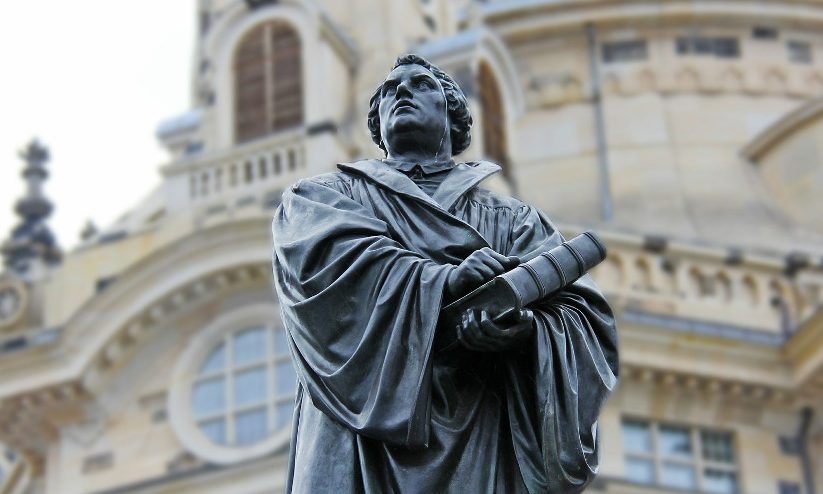
Inhabiting the Places of Promise: Martin Luther’s Teaching on the Three Institutions
A focus on Luther's "two kingdoms" theology often neglects his views on the "three estates" of church, household, and state.


A focus on Luther's "two kingdoms" theology often neglects his views on the "three estates" of church, household, and state.
Last week, John MacArthur used his immense stature in the evangelical church to call Christians to civil disobedience. WE
Christian justice, as Hemmingsen defines it, is "the obedience of Christ imputed to the one who believes." The one who is just "evangelically," or "according to the gospel," is the one whose sins are forgiven and to whom the justice of the Son has been imputed.

Aristotle described politics as involving art or craft (techne). It, too, required skill. It, too, could produce excellent, even wondrous edifices: regimes. Once upon a time, the Reformed tradition saw politics in the same manner. Althusius, for example, spoke of “the art of governing.”[1] Joseph Caryl, a Westminster Divine, described rulers as engaging in an “art” or a “craft.” These thinkers, moreover, developed this artistry, doing so consciously within a Reformed framework.

Not many passages in the New Testament speak directly to political order. The first part of the thirteenth chapter of Romans is perhaps the most famous. I would like to focus in this essay on vv. 3-4, which may appear prima facie to be something of an interpretive crux. Are these verses descriptive or prescriptive? That is, are they simply declarative, or are they imperatival, telling us what magistrates ought to do?

Christian morality is not ultimately instruction in how to make oneself a member of the Christian club. It is not a self-help program whose rules are adopted by a small set of people who wish to better themselves. Christian morals, rather, are simply moral teachings that agree with the natural design of the universe.

When Thomas Paine published Common Sense in 1776, his was not the only commonly held sense of the term “common sense.” Ironically, the term was already complicated at the American founding.
Liberalism has failed. Or so confidently declares Patrick Deneen in his obviously named Why Liberalism Failed. Deneen offers one of the more useful and concise attacks on the often vaporously defined liberalism that has, according to Deneen, plagued modern societies for the last several hundred years. Deneen’s proof of liberalism’s failure is not that it failed to change society, but that liberal societies became exactly what they were supposed to be. The liberal state increasingly worked towards removing cultural and social institutions responsible for governing society’s consumer and sexual appetites. Few orthodox Christians dispute that these are woeful problems. And Deneen deserves praise for identifying the ills that plague modern society. The book’s weaknesses are anachronism, and imprecise and lethargic taxonomy.
By Brian J. Auten I’ll begin by asserting that intelligence ethics is in the midst of its awkward teenage years. The speciality spent its schoolyard days in the post…
By Jake Meador This article appeared in the 10th issue of Ad Fontes magazine. I don’t think I’ll ever forget the day that I actually began to understand some of what…
